

In Memoriam: Vic Michaels (1954-2025)
By
Geoff Kimmerly
MHSAA.com senior editor
December 30, 2025
The hearts of the MHSAA and countless others in the school sports community are heavy after the unexpected death Monday of Catholic High School League director Vic Michaels, also a longtime and devoted member of the MHSAA’s Representative Council. He was 71.
Michaels was inducted into the CHSL Hall of Fame in 2024 as a “Legend” – a title carrying prestige that certainly described his contributions to school sports on a statewide level as well.
After a decorated 17-year career as a coach, teacher and administrator at Center Line St. Clement, Michaels joined the CHSL office as associate director in 1995, and then assumed the role as leader of the league in 2003 when then-director Tom Rashid left to become associate director at the MHSAA.
 Michaels also joined the Representative Council in 2003, representing non-public schools and serving as the Council’s secretary-treasurer. But his impact was much more far-reaching than titles could explain. As MHSAA executive director Mark Uyl told the Detroit Free Press in coverage of Michaels’ 2024 CHSL recognition, “I’m not sure there’s been anyone who’s been more important to the MHSAA over the last 40 years than Vic Michaels,” and called him one of the key builders of the MHSAA over its first 100 years as that milestone was celebrated in 2024-25.
Especially over the last decade, as numerous Council and MHSAA staff members have retired or move on from school sports, Michaels has supplied vital context and institutional knowledge especially as a long-serving member of the Executive Committee, which considers eligibility decision appeals and other issues that must be addressed on a frequent basis. He provided a calm voice of reason and advocacy, not only for students he represented from nonpublic schools but for athletes, coaches and administrators from all 1,500+ high schools and junior high/middle schools that make up the MHSAA membership. And serving as treasurer, he filled another crucial role in making sure the MHSAA stood on solid ground financially even amid the challenge of COVID-19 and while expanding its numbers of sponsored tournament sports and students served.
Michaels attended Detroit St. Phillip High School, and after St. Phillip closed, was part of the final graduating class at Detroit St. Ambrose in 1972. He attended and played college basketball at Detroit Institute of Technology and earned his teaching certificate from University of Detroit Mercy.
He coached junior varsity at Dearborn St. Alphonsus and Redford St. Mary before beginning a tenure in 1978 at St. Clement where he taught, served as athletic director and assistant principal and won more than 300 games as the school’s boys and girls varsity basketball coach, earning statewide “Coach of the Year” awards leading both programs during the 1980s.
Michaels and his wife Linda were married 46 years, and he also is survived by his sons Marc and Brad, their wives and grandchildren.
As the CHSL noted in its memorial to Michaels, “Vic dedicated his life to Catholic education, interscholastic athletics, and the young people entrusted to his care. His leadership of the CHSL was marked by integrity, vision, humility, and an unwavering belief that athletics are an extension of the classroom — meant to form the whole person in faith, character, discipline, and service. … His decisions were thoughtful, his counsel wise, and his love for the educational athletics unmistakable.”
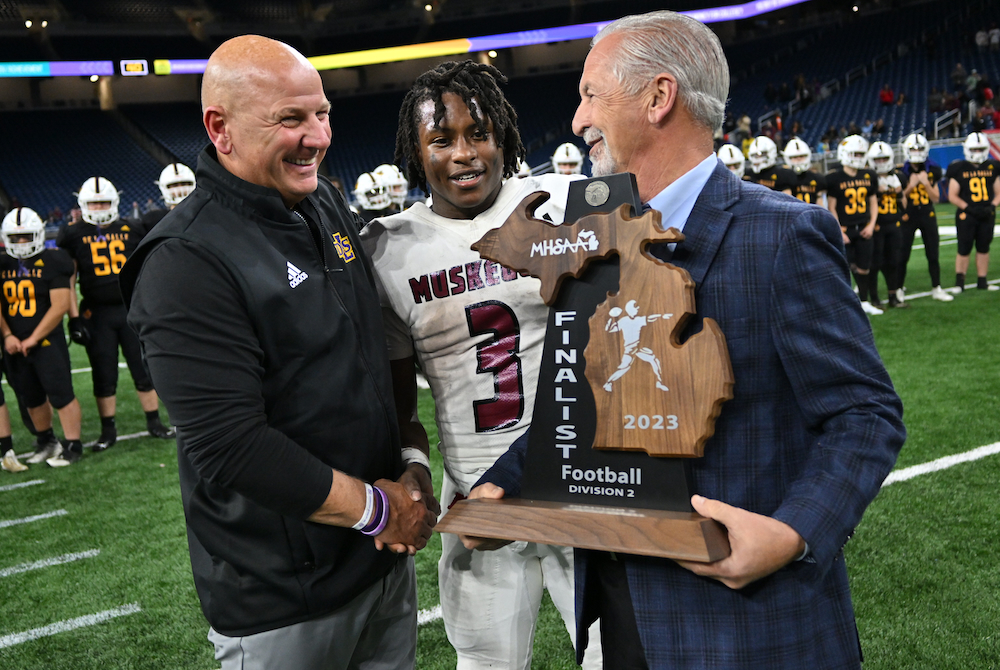
PHOTO MHSAA Representative Council member Vic Michaels, far right, with the assistance of MHSAA Student Advisory Council member M'Khi Guy from Muskegon, presents Warren De La Salle Collegiate coach Dan Rohn the finalist trophy after the 2023 11-Player Football Final at Ford Field. (Photo by Hockey Weekly Action Photos.)
'Anyone Can Save a Life' Aims to Prepare
July 28, 2015
By Rob Kaminski
MHSAA benchmarks editor
It was 2008 when Jody Redman and staff at the Minnesota State High School League developed an emergency action plan to provide guidance and procedure in the event of sudden cardiac arrest during scholastic athletic competition.
The desired response from schools upon receipt of the plan was, well, less than enthusiastic.
“Only about 40 percent of our schools used the information and implemented the program,” said Redman, associate director for the MSHSL. “Our focus was completely on sudden cardiac arrest, that being the worst-case scenario regarding athletic-related health issues.”
The MSHSL asked the University of Minnesota to survey its member schools, and results showed that the majority of schools not on board simply felt a sudden cardiac arrest “would never happen at their school.” Naive or not on the schools’ parts, that was the reality – so Redman went back to revise the playbook.
“We expanded the plan to deal with all emergencies, rather than specific incidents,” Redman said. “Now it’s evolved so that we are prepared to deal with a variety of situations which put participants at risk. We shifted gears and got more schools to participate.”
Did they ever. And not just in Minnesota.
This summer, the “Anyone Can Save a Life” program, authored by the MSHSL and the Medtronic Foundation, is being disseminated to high schools nationwide with the financial support of the NFHS Foundation. The program will reach schools in time for the 2015-16 school year.
Once received, schools will find that there are two options for implementation, via in-person training or online.
“The in-person method is facilitated by the athletic administrator with the assistance of a training DVD” Redman said. “The important element is the follow through, ensuring coaches return their completed Emergency Action Plan (EAP). With the e-learning module on anyonecansavealife.org, individuals will complete an e-learning module that will walk them through the details of their specific plan, and as they answer questions, the information will automatically generate a PDF of the Emergency Action Plan (EAP) which they can edit at a later date as information changes.”
Schools will find five major components of the program to be received this summer: the first is an implementation checklist for the AD, explaining their role. Next are sections for in-person training, online training and event staff training. The last item contains a variety of resources that will ensure the successful implementation of a comprehensive emergency response to all emergencies.
Generally speaking, the program prompts schools to assemble preparedness teams, broken into four categories: a 911 team, a CPR team, an AED team and a HEAT STROKE team. The groups are made up of coaches and their students who will be in close proximity to all after-school activities.
“The reality about school sports is, at 3:30 every day the office closes and any type of medical support ceases to exist,” Redman said. “We then send thousands of students out to gyms, courts, fields and rinks to participate without systemic support for emergencies. This program puts into place that systemic support.”
Another stark reality is that the majority of schools in any state do not have full-time athletic trainers. Even for those fortunate enough to employ such personnel, it’s most likely the training “staff” consists of one person. That one body can only be in one place at one time, and on widespread school campuses the time it takes to get from one venue to another could be the difference between life and death.
“Athletic trainers can champion the program, but someone needs to oversee that every coach has a completed EAP in place,” Redman said. “For every minute that goes by when a cardiac arrest occurs, chance for survival decreases by 10 percent.”
Thus, it’s imperative to train and grant responsibility to as many people as possible, including student-athletes. In fact, students are a vital component to having a successful EAP. Students will be put in position to call 911, to meet the ambulance at a pre-determined access point, to locate the nearest AED, to make sure emersion tubs are filled for hot-weather practices, and for those who are trained, to assist with CPR. Coaches will identify students at the beginning of the season and prior to an emergency taking place. They will provide them with the details of the job they are assigned so they will be ready to assist in the event of an emergency.
“We have game plans for every sport, and for every opponent on our schedule,” Redman said. “But we don’t have a plan to save the life of a member of our team or someone attending a game at our school.
“This is about developing a quick and coordinated response to every emergency so we give someone in trouble a chance at survival, and then practicing it once or twice a season. We have ‘drop the dummy’ drills where we drop a dummy and evaluate how it went, and how everyone performed. In one scenario, it’s the coach that goes down, and then you have a group of 15- or 16-year-olds standing there. That’s why students have to take ownership of this, too.”
The key to an effective emergency action plan is to utilize and empower students in every sport and at every level to be a part of the response team. Following are brief descriptions of the teams.
The 911 Team
- Two students will call 911 from a pre-determined phone and provide the dispatcher with the location and details of the emergency.
- Two students will meet the ambulance at a pre-determined access point and take them to the victim.
- Two students will call the athletic trainer, if one is available, and the athletic administrator and alert them to the emergency.
The CPR Team
- The coach is the lead responder on this team and is responsible for attending to the victim and administering CPR, if necessary, until trained medical personnel arrive.
- One person is capable of providing effective CPR for approximately two minutes before the quality begins to diminish. Having several students trained and ready to administer CPR will save lives.
The AED Team
- Two students will retrieve the AED and take it to the victim.
- Two students will physically locate the athletic trainer, if one is available, and take him or her to the victim.
The Heat Stroke Team
- Two students identify locations of emersion tub, water source, ice source and ice towels.
- Two students prepare tub daily for practices and events.
For more information, visit anyonecansavealife.org or contact the MSHSL.