


Risks & Rewards
May 7, 2012
When my terrific son was a college student, I suggested he get into sports officiating. You know, to earn some money, stay involved in sports, keep in shape. His response was “No. It’s not worth the hassle.” He didn’t want to subject himself to being criticized, heckled and second-guessed; and I couldn’t blame him.
Which told me then (and I’m reminded often) that sports officials are risk-takers. Men and women willing to step out and step up.
The best officials make the toughest calls at the tightest times in the competition. They’re risk-takers in ways mere spectators are not.
And in this so-called “modern world,” where people can sit comfortably at home and comment irritably on everything, and fans can text, tweet and transmit videos instantly, it has never taken more courage to be a sports official than it does today.
Tomorrow evening, for the 33rd consecutive year, the MHSAA hosts a banquet that honors our most veteran MHSAA registered officials. Officials who have reached the 20-, 30-, 40-, 45- and 50-year service milestones will be recognized; and Rockford’s Lyle Berry will receive the Vern L. Norris Award for a lifetime of grassroots contributions to high school sports officiating in Michigan.
It is one of the rare occasions when we ask officials, referees and judges to step out of the background and into the spotlight. Without any risk.
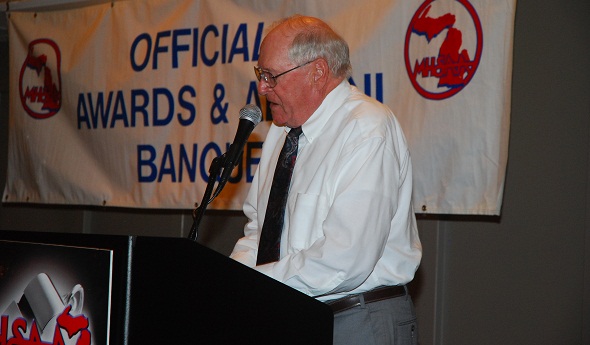
Making the Right Calls for 50 years
May 7, 2012
By Geoff Kimmerly
Second Half editor
Lyle Berry began this track season with about 10-12 events on his officiating schedule.
But when administrators he’s known for decades called for help, that slate quickly doubled in size for this year’s MHSAA Vern L. Norris Award winner.
The Rockford resident has been an official for more than a half century, and was honored for his service at Saturday’s annual Officials’ Awards & Alumni Banquet at the Kellogg Center in East Lansing.
Second Half caught up with Berry a few minutes before he left for another track meet Monday. Click for our Q&A session, including conversation about what keeps him coming back every season and how he continues to mentor and recruit of new officials.
Berry has been a long-time member of both the West Michigan Officials Association and the Association of Track Officials of Michigan. He received ATOM’s Presidential Leadership Award in 2009 and its Bob Bloomer Award in 2010. Berry was the WMOA Basketball Official of the Year in 1988. Next month he'll return to the Division 3 Track and Field Finals, and later this month will officiate Division 1 and 2 Regionals.
Previous recipients of the Norris Award are:
1992 – Ted Wilson, East Detroit
1993 – Fred Briggs, Burton
1994 – Joe Brodie, Flat Rock
1995 – Jim Massar, Flint
1996 – Jim Lamoreaux, St. Ignace
1997 – Ken Myllyla, Escanaba
1998 – Blake Hagman, Kalamazoo
1999 – Richard Kalahar, Jackson
2000 – Barb Beckett, Traverse City; Karl Newingham, Bay City
2001 – Herb Lipschultz, Kalamazoo
2002 – Robert Scholie, Hancock
2003 – Ron Nagy, Hazel Park
2004 – Carl Van Heck, Grand Rapids
2005 – Bruce Moss, Alma
2006 – Jeanne Skinner, Grand Rapids
2007 – Terry Wakeley, Grayling
2008 – Will Lynch, Honor
2009 – James Danhoff, Richland
2010 – John Juday Sr., Petoskey
2011 – Robert Williams, Redford
PHOTO: Lyle Berry speaks to the audience during Saturday's Officials’ Awards & Alumni Banquet at the Kellogg Center in East Lansing.