


Risks & Rewards
May 7, 2012
When my terrific son was a college student, I suggested he get into sports officiating. You know, to earn some money, stay involved in sports, keep in shape. His response was “No. It’s not worth the hassle.” He didn’t want to subject himself to being criticized, heckled and second-guessed; and I couldn’t blame him.
Which told me then (and I’m reminded often) that sports officials are risk-takers. Men and women willing to step out and step up.
The best officials make the toughest calls at the tightest times in the competition. They’re risk-takers in ways mere spectators are not.
And in this so-called “modern world,” where people can sit comfortably at home and comment irritably on everything, and fans can text, tweet and transmit videos instantly, it has never taken more courage to be a sports official than it does today.
Tomorrow evening, for the 33rd consecutive year, the MHSAA hosts a banquet that honors our most veteran MHSAA registered officials. Officials who have reached the 20-, 30-, 40-, 45- and 50-year service milestones will be recognized; and Rockford’s Lyle Berry will receive the Vern L. Norris Award for a lifetime of grassroots contributions to high school sports officiating in Michigan.
It is one of the rare occasions when we ask officials, referees and judges to step out of the background and into the spotlight. Without any risk.
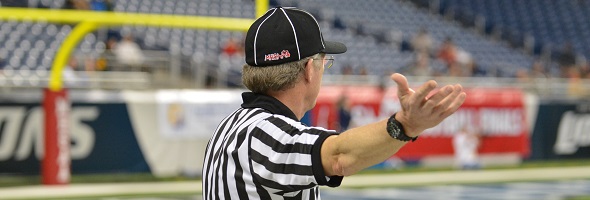
Be the Referee: Registration - Part 2
December 18, 2014
This week, MHSAA assistant director Mark Uyl continues last week's explanation of the steps to becoming an MHSAA registered official.
"Be the Referee" is designed to help educate people on the rules of different sports, to help them better understand the art of officiating and to recruit officials. The segment can be heard on Mondays, Wednesdays and Fridays during the school year on The Drive With Jack Ebling on WVFN-AM, East Lansing.
Below is this week's segment - Registration Part 2 - Listen
Today we are going to build on last week’s segment which dealt with how a person becomes an MHSAA Registered Official.
Once a person completes the first step in the process – passing the basic Officiating Exam through the MHSAA Office, the next step is to get that person connected with a local officials association that specializes in that sport across our state.
These local associations are the ones that do the training – whether it’s on the court, on the field or video training – to get, for example, that person interested in basketball completely immersed in the rules, mechanics and coverages of what it takes to become a good basketball official.
Past editions
Dec. 10 - Registration Part 1 - Listen
Dec. 3 - Legacy Program - Listen
Nov. 26 - Sideline Management - Listen
Nov. 19 - 7-Person Mechanics - Listen
Nov. 12 - Blocking Below the Waist - Listen
Nov. 5 - Tournament Selection - Listen
Oct. 29 - Uncatchable Pass - Listen
Oct. 22 - Preparation for Officials - Listen
Oct. 15 - Automatic First Downs - Listen
Oct. 8 - Officials & Injuries - Listen
Oct. 1 - Overtime - Listen
Sept. 25 - Field Goals - Listen
Sept. 18 - Tackle Box - Listen
Sept. 11 - Pass Interference - Listen
Aug. 25 - Targeting - Listen