


Sportsmanship and Success in Soccer
August 16, 2012
Ralph Polson, president of the National Soccer Coaches Association of America (NSCAA), reports in the July/August 2012 Soccer Journal that there is a strong statistical link between sportsmanship and success in intercollegiate soccer. He cites the work of Tim Lenahan, head men’s coach at Northwestern University, who compiled total fouls, yellow cards and red cards for the 2011 season to create a “Fair Play Rating” (FPR).
Polson reports that 12 of the 20 teams with the top FPR made the NCAA tournament, while only one of the teams in the bottom 20 did. Of course, this is a statistical link, not necessarily cause and effect. But here’s how Mr. Polson concludes his column:
“How should we interpret this data? One direction is toward more disciplined teams. It seems to me the more a culture of sportsmanship and fair play is established, the more likely any team is to demonstrate the consistency needed for success. The data suggests those teams without entrenched standards, with respect to on-field behavior, should anticipate a higher likelihood of failure in today’s highly competitive environment.
“Play within the spirit of the game and more than just a win may be gained; play against the spirit of the game and much more than just a game may be lost.”
Dr. Brian Crossman, chair of the NSCAA Ethics Committee, contributes this to the discussion in the same issue of Soccer Journal:
“A five year study from 2007 to 2011 of almost 4,700 intercollegiate soccer matches in which only one player was red-carded during the match showed a strong likelihood that the player’s team would lose. Teams that had one player red-carded lost 67 percent of the matches, tied 10 percent of the matches and won 23 percent of the matches. In other words, a team that had a player red-carded at any time during the match was three times more likely to lose the match than win it. Taking steps to encourage clean and fair play, and thus to reduce the likelihood of having players ejected, will pay dividends in sportsmanship and should improve your team’s won-loss record.”
For more, go to www.nscaa.com.
Let 'Battle of the Fans VI' Begin
December 14, 2016
By Geoff Kimmerly
Second Half editor
It's become a winter tradition; as the Michigan weather gets frosty, high school gyms all over our state heat up in anticipation of competition both on the floor and in the stands as well.
And so the scene is set for the "Battle of the Fans VI," the MHSAA Student Advisory Council's annual contest to award the top high school student cheering section in Michigan.
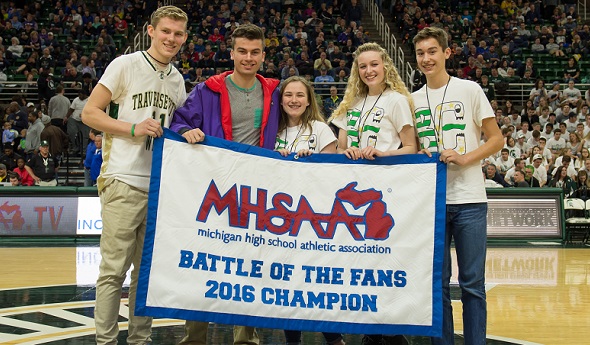
Traverse City West was named last year’s champion and presented with a banner during the MHSAA Boys Basketball Finals at Michigan State University’s Breslin Center. Sections from Charlotte, Munising, Muskegon Western Michigan Christian and Yale also were finalists and recognized during the Breslin ceremony.
Schools are invited to submit a short video, via YouTube, of their cheering sections in action. Video submissions should be between 90 seconds and three minutes long and explain how that section meets the following contest criteria: positive sportsmanship, student body participation, school spirit, originality of cheers, organization of the group, student section leadership and fun.
The deadline for student-submitted video applications is noon Jan. 7. Five finalists including at least one Class C or D school then will be chosen and visited on a home game night by MHSAA staff and Advisory Council representatives. The MHSAA will produce a video of that finalist after each visit, with the champion being selected by the Student Advisory Council based in part on activity on the MHSAA’s social media sites.
This year’s winner will be announced Feb. 17 and recognized March 24 at the Breslin Center.
“Five years of Battle of the Fans have created standards and expectations not only for this contest, but for student section sportsmanship overall,” said Andy Frushour, MHSAA director of brand management and advisor to the Student Advisory Council. “We’ve written about the best and the lessons they’ve taught us. We’ve shown videos of their work to students all over the state. Battle of the Fans has proven that school student sections can create a positive atmosphere and still have fun. We see it over and over again, and this year gives us another chance to see more fun student sections in action.”
Rules, directions for submitting videos, plus links to coverage of finalists from the first five years of the contest can be found on the MHSAA Website. This year’s finalist videos, plus the announcement of the 2016-17 winner, will be published on the MHSAA Second Half.
The Student Advisory Council is made up of eight seniors and eight juniors, who each serve two-year terms. The Council acts as the voice of Michigan's student-athletes; it serves as a student sounding board for the MHSAA's Representative Council, assists in planning Sportsmanship Summits, Captains Clinics and other student leadership events; participates in a yearly focus group about the state of high school sports for Michigan State University's Institute for the Study of Youth Sports and assists with medal ceremonies at MHSAA championship events.
PHOTO: Representatives from Traverse City West's "Bleacher Creatures" accept the Battle of the Fans championship banner in March at the Breslin Center.