

Calumet Invite Produces Northern Stars
September 18, 2013
By Geoff Kimmerly
Second Half editor
The Calumet Invitational dates back roughly 30 years as an annual staple of the cross country schedule for schools at the northernmost tip of Michigan's Upper Peninsula.
A creative move by the Copper Kings last year added some statewide prestige to the event.
 Last week, for the second season, Calumet ran the series of races at Keweenaw Mountain Lodge, a resort near Copper Harbor and the northern bank of the Keweenaw Peninsula.
Calumet is the northernmost high school in Michigan. And moving this race another 35 miles northeast more or less guaranteed it's the northernmost event run in the state.
"We figured it was pretty safe. We're the northernmost school in the state, and you can only go four more miles and you're in Lake Superior," Calumet athletic director Sean Jacques said. "Nobody else is going to do anything more north than that."
A total of 10 schools were represented this fall in the races for boys and girls varsity, junior varsity and middle schoolers.
Jacques said the event formerly was run at a golf course in Calumet. But a few years ago, Calumet graduate and former Copper Kings cross country runner Dan Harri moved home from Florida to become general manager at the Mountain Lodge (he's also a renowned chef and has owned restaurants in Miami with Hall of Fame Dolphins coach Don Shula).
Harri had asked a few times about bringing a cross country or golf event to the lodge. Jacques told him last year they'd give it a try, so Harri set up a course that includes golf course, a couple of bridges, trails and finishes with a climb on the No. 1 fairway. It also provides various points for fans to watch runners go by, not always available on other courses.
"We were looking for a little bit of a change, and it's a beautiful course," Jacques said. "We thought if people were willing to make the extra drive, it would be really nice."
Calumet won the boys race this season, just ahead of runner-up Houghton. Houghton's girls were victorious, followed by the host Copper Kings.
Click to read more about this year's event from the Houghton Mining Gazette.
Michigan's claim to an NFL evolution
As part of its NFL preview this month, Sports Illustrated reported on one of the most significant developments for offenses over the last few decades – the silent snap count, which is used regularly by visiting teams because offensive linemen can’t hear the quarterback calling for the ball over the clamor of the home crowd.
And the article explained that the silent snap count might’ve gotten its start at one of Michigan’s smallest high schools – Flint’s Michigan School for the Deaf.
Offensive linemen during the 1980s were feasted on by pass rushers like Lawrence Taylor and Bruce Smith, who built record sack totals by blasting past blockers who seemed a step slow. Turns out, that was true. Defensive players were getting an edge by attacking as soon as they saw the ball move. But blockers (especially offensive tackles), focused instead on the defensive ends and linebackers lined up across from them, and didn’t have the luxury of watching the ball – and since they also couldn’t hear the snap count, started each play a step behind.
Enter the silent count. The quarterback signals to the center that he is ready to receive the ball (with a pat on the back, by raising a foot, etc.). The center then raises his head, and after a predetermined count of at least one second snaps the ball without a sound. This means an offensive tackle doesn’t have to listen for a snap count – he just counts after seeing the center get set.
The SI report recognized longtime offensive line coach Howard Mudd as the guru of the silent snap count. But Mudd recalled a conversation he’d had while working for the Seattle Seahawks with another coach, the late Andy MacDonald, who also had coached early in his career at a school for the deaf in Michigan.
The article doesn’t mention Michigan School for the Deaf by name. But it seems to make sense that the Tartars were the first to use the now-revolutionary count. MacDonald – who played at Central Michigan University and went on to coach at Michigan State and four other colleges and also for the Buffalo Bills – grew up in Flint and attended Flint Northern before playing for the Chippewas from 1950-53. The historical web site Michigan-football.com has results for Flint’s Michigan School for the Deaf dating to 1950, making it a decent assumption that MacDonald might’ve gotten in a little early coaching experience at the school down the road from his home.
Click for the SI story and go to page 4 for the mention of Michigan’s school.
Michigan mourns trooper, running standout
The law enforcement community is mourning the death of Michigan State Police trooper Paul Butterfield, who was shot Sept. 9 during a traffic stop in Mason County. He also was a well-known distance runner during the 1980s and the MHSAA Class A cross country champion running for Bridgeport in 1987.
According to a Ludington Daily News report, Butterfield continued running after high school at the University of Tennessee, and also competed at the 1989 Pan American Junior Games in Argentina.
Butterfield was stationed in Hart after previously serving in Manistee, and lived in Mason County. He also had served in the U.S. Army. Click to read more from the Ludington Daily News.
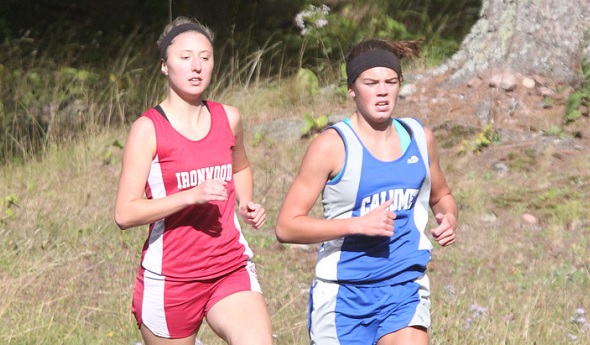
PHOTO: Calumet's Chelsea Jacques (right) won this season's Calumet Invitational with a time of 21:08.06, just ahead of Ironwood's Jessica Gering at 21:46.16. (Photo courtesy of Calumet athletic department.)
Preview: Pair of Returning Champions, Familiar Team Favorites Top Finals Lineup
By
Geoff Kimmerly
MHSAA.com senior editor
October 16, 2025
A pair of returning individual champions are expected to be in the hunt one more time during this weekend’s Lower Peninsula Girls Golf Finals.
Dexter senior Avery Manning in Division 2 and Grand Rapids Christian senior Lillian O’Grady in Division 3 are back seeking repeats, while on the team side Grand Rapids Catholic Central is top-ranked seeking a third-straight Division 3 title and Farmington Hills Mercy can run its Division 2 championship streak to four.
But those are just some of the more familiar contenders. Northville in Division 1 also is top-ranked and seeking a repeat, but on the whole this weekend’s Finals also should provide several opportunities for new stars to emerge.
Play begins both Friday and Saturday at 10 a.m., and live scoring is available through iWanamaker. See the Girls Golf page for qualifiers, results and more from all four divisions. Below is a glance at several team and individual contenders:
LP Division 1 at The Meadows at Grand Valley State University
Top-ranked: 1. Northville, 2. Rochester Adams, 3. Macomb Dakota.
Northville emerged last season for its first championship since 2021 but fifth over the last seven seasons. The Mustangs dominated that Final with two freshmen and only one senior, winning by 46 strokes. Adams, the back-to-back champion in 2022 and 2023, finished fourth a year ago.
Northville: The Mustangs cruised to a 35-stroke Regional win last week at Salem Hills, carding a 302 that was the lowest team score at any LPD1 Regional by 20 strokes. Sophomores McKenzie Stevens and Cam Baker finished first and second, respectively – they were the two freshmen in last year’s lineup and tied for eighth at the 2024 Final. Junior Naaz Gil also tied for eighth last year and was fourth at the Regional last week. Seniors Grace Bae and Serena Ku tied for seventh and finished ninth, respectively, at Salem Hills, and Ku also was part of last year’s Finals lineup.
Rochester Adams: Senior Hannah Wang and sophomore Saisha Dhawan were part of last season’s lineup, and Wang finished 12th individually and also was part of the championship five in 2023. She tied for fifth at the Regional last week at Fieldstone in Auburn Hills as Adams won as a team by nine strokes ahead of Dakota. Four sophomores fill out the rest of the lineup, with Alayna Scanlon and Leah Blackmore tying for seventh at the Regional.
Macomb Dakota: The Cougars moved up from No. 6 to No. 3 heading into Regionals, and they followed junior runner-up Marissa Monteith to last week’s team runner-up finish at Fieldstone. Sophomore Dakota Cooper tied for fifth as well, and they were the team’s low scorers last season when Dakota finished third at the Final. Junior Angelina Accuso and senior Sophia Martin also are back from the 2024 lineup.
Individuals: Along with the three Northville golfers who were part of a tie for eighth, only two of the last season’s top seven are back this weekend – Romeo sophomore Tula Puzzuoli, who finished runner-up, and Rochester senior Ananya Kumar, who placed fifth. Puzzuoli edged Monteith in a tie-breaker for a Regional title last week, and joining her and Stevens as Regional champs were Portage Central junior Seneli Amaratunga, Dearborn junior Calyssa Post, Clarkston senior Lily Haviland and Okemos freshman Saisha Patil.
LP Division 2 at Battle Creek’s Bedford Valley
Top-ranked: 1. Bloomfield Hills Cranbrook Kingswood, 2. Dexter, 3. Grand Rapids Forest Hills Central.
Farmington Hills Mercy has won the last three Division 2 championships and enters this weekend ranked No. 6 with two golfers back from last year’s Finals five. Cranbrook is seeking its first championship since claiming Division 3 in 2021, Dexter its first since spring 2007 and Forest Hills Central its first ever.
Bloomfield Hills Cranbrook Kingswood: The Cranes moved to Division 2 in 2023 and placed second that season and fourth a year ago with only one senior in the lineup. They won their Regional at Farmington Hills Golf Club last weekend ahead of No. 9 Bloomfield Hills Marian and No. 10 Birmingham Seaholm with four golfers back from last season’s contender – sophomore Sixtine Charnelet, seniors Sydney Behnke and Alina Yuan and junior Brianna Giudici. All four finished among the top nine at the Regional, as did junior Josie Vanderhaute, with Charnelet tying for runner-up.
Dexter: Reigning individual champion Avery Manning leads a lineup the finished only five strokes back of Mercy in second at last year’s Final. The Dreadnaughts also return senior Millie Truesdell and sophomore Maddy Manning – and Avery Manning, Truesdell and Maddy Manning finished 1-2-3, respectively, at last week’s Regional at Forest Akers East. Manning has won four Regional titles and also was the Division 2 Final runner-up in 2023.
Grand Rapids Forest Hills Central: The Rangers didn’t make the field last season, but tied for fourth in 2023. They’re storming back coming off earning an eight-stroke Regional win at Island Hills in Centreville against a field that also included No. 4 Lowell and No. 8 St. Joseph. All five golfers finished among the top 22 at the Regional, and only one is a senior. Sophomore Alivia Offer tied for second and junior Caroline Vandervelde in fourth led the way.
Individuals: As noted above, Avery Manning is the reigning Finals champion. Grand Rapids Forest Hills Northern senior Chaille Payne (third) and Plainwell junior Ayla Jaeger (tied for ninth) also are back from last year’s top 10. Jaeger joined Manning as a Regional champion last week, and Payne was a runner-up after a tiebreaker with Muskegon Reeths-Puffer junior Sophia McCollum at Lincoln Golf Club in Muskegon. Also winning Regionals were Petoskey senior Riley Barr, Mercy junior Megan Guerrera and Marian senior Pippa Dawson.
LP Division 3 at Michigan State University’s Forest Akers West
Top-ranked: 1. Grand Rapids Catholic Central, 2. Grand Rapids Christian, 3. Goodrich.
Grand Rapids Catholic Central has won the last two Division 3 championships and been ranked No. 1 all but one week this season. The lone week, the Cougars were passed by Grand Rapids Christian, which has climbed after sending only an individual qualifier to the Finals last season and is seeking its first top-two finish at the season-ending event. Goodrich has one, as runner-up in 2015, and will seek is first championship coming off a fourth-place finish a year ago.
Grand Rapids Catholic Central: The Cougars won last season’s Final by 65 strokes and return four golfers from six who played a round or both at that tournament – including three who also were part of the winning five in 2023. Senior Kelsey Preston tied for eighth individually two years ago and placed third last season, while senior Sofia Piccione (tied for seventh), senior Margaret Deimel (tied for 12th) and senior Mary Irwin also are back. They all scored among the top 11 as GRCC finished 22 strokes ahead of Grand Rapids Christian at last week’s Regional at Pigeon Creek in West Olive. Deimel was second, Preston third and Piccione fourth to key that performance.
Grand Rapids Christian: This will be the Eagles’ first team appearance at the Finals since 2021, although senior Lillian O’Grady has represented well as an individual qualifier the last three seasons with three top-five finishes include the championship a year ago. She won the Regional at Pigeon Creek last week, with freshman Eleanor O’Grady tying for seventh and senior Jane Snyder tying for 17th.
Goodrich: The Martians graduated only one golfer from last year’s fourth-place team. Senior Madilyn Sheerin won last week’s Regional at Flint Elks in Grand Blanc Township after tying for 12th at last year’s Final, and all five Martians finished among the top 25 at the Regional with junior Brookelyn Webb fifth and sophomore Lahna Palshan tied for 10th. Webb also was part of last year’s lineup, as were two others in this weekend’s top five.
Individuals: Four golfers total are back from last season’s top 10 – the three mentioned above, plus Williamston junior Paige Radebach, who tied for fourth. O’Grady won last year’s title by nine strokes and will be tough to catch, but joining her and Sheerin among Regional champions last week were Detroit Country Day junior Halle Heineman, Freeland junior Alexis Heinz, Charlotte junior Peyton Howarth and Big Rapids senior Kate Posey.
LP Division 4 at Katke at Ferris State University
Top-ranked: 1. Lansing Catholic, 2. Montague, 3. Monroe St. Mary Catholic Central.
Lansing Catholic is seeking its second Finals championship in three seasons after finishing fourth a year ago. Kalamazoo Christian is the reigning champion and currently ranked No. 5. Montague is hoping to jump up from sixth last season to add a championship to its back-to-back titles in 2020 and 2021, and Monroe St. Mary is seeking its first and tied for 11th a year ago.
Lansing Catholic: Senior Addi Rule was part of the championship lineup in 2023 and with senior Elisabeth Ruddell returns from last year’s fourth-place finisher. The Cougars posted the third-lowest score at a Division 4 Regional last week, carding a 381 at Calderone Golf Club in Grass Lake with all five golfers among the top 10 – sophomore Anna Robinson third, freshman Erin O’Connell fifth, Rule and Ruddell tied for sixth and junior Olivia Riley placing 10th.
Montague: The Wildcats graduated only one golfer from last year’s sixth-place finisher and have only one senior among this season’s top five. That senior, Cadence Fox, tied for eighth as Montague edged No. 6 Grand Rapids NorthPointe Christian by a stroke at last week’s Regional at The Falls at Barber Creek in Kent City. Juniors Addi Smith (third at the Regional) and Brynlee Kessler (tied for fourth) also are returnees from last year’s run, along with sophomore Marguerite O’Connell.
Monroe St. Mary Catholic Central: Senior Nora Kinsey and junior Lauren Tolliver are the only returning golfers from last season’s starting Finals five, but they finished third and fourth, respectively, as SMCC won its Regional last week at Rustic Glen in Saline. They were the low scorers for the Kestrels at last year’s Final as well.
Individuals: Napoleon senior Anna McCubbins – placing seventh – was the only non-senior among last year’s top 12 (top 10 placers with ties). She’s back after finishing second at Calderone last week to Bath freshman Addilyn Duflo. Joining Duflo among Regional champions were Elk Rapids’ freshman Piper Smith, Saginaw Nouvel Catholic Central junior Gabi Thiel, Fowler junior Noelle Krepps, Olivet senior Jocelyn Rolston and Clawson junior Joslynn Ramirez.
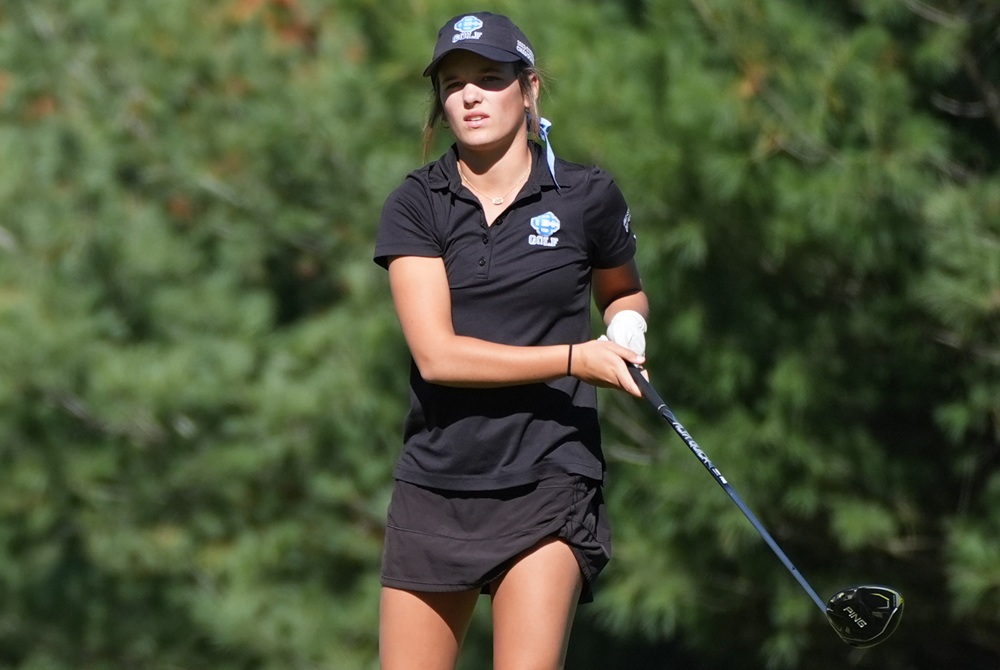
PHOTO Grand Rapids Catholic Central’s Kelsey Preston follows one of her drives during last season’s Lower Peninsula Division 3 Final. (Click for more from High School Sports Scene.)