

Casting Lines for Future Tournaments
August 12, 2016
By Jack Roberts
MHSAA Executive Director
The MHSAA is best known to the public for the tournaments it conducts to conclude the fall, winter and spring seasons each school year.
These tournaments, the first and largest program of the MHSAA, have survived the Vietnam War, the Korean conflict and two World Wars. They have survived the technology bubble, the housing collapse, the energy crisis and the Great Depression.
MHSAA tournaments existed at the dawn of aviation and at the time of our nation’s lunar landing. Popes, presidents and governors have changed and changed again and again, and MHSAA tournaments roll on year after year.
But the sense of tradition and permanence and inevitability of MHSAA tournaments doesn’t dissuade us from asking questions about our tournaments, even some of the most basic questions. Here are two.
Question #1
I have long been and will always be an advocate for a Ryder Cup format for the MHSAA Golf Finals, and a team tennis approach to the MHSAA Tennis Finals; but 90 years of tradition is hard to overcome. Might this be a more exciting format? Could it be co-ed? Could it reverse the decline in boys tennis participation, and increase girls golf participation? Wouldn’t it be fun to try?
Periodically, the International Olympic Committee requires each of the designated Olympic sports to defend its status, to state its case why the sport should remain a part of the Olympic program. Then, after a series or votes that retain one sport at a time, the IOC drops the sport that makes the weakest case. It does so to make room for one of the previously unlisted sports that makes the best case for inclusion.
This would appear to keep the existing Olympic sports on their toes, and to keep the Olympic movement fresh and reflective of modern trends in sports.
While I would not enjoy the controversy, I can see the potential for some positive results if the MHSAA were to invoke the same policy for determining the 14 tournaments it will provide for girls and the 14 for boys.
This might cause us to consider more deeply what a high school sport should look like, or at least what an MHSAA tournament sport should stand for.
On the one hand, we might be inclined to drop tournaments for those sports that involve mostly non-faculty coaches and non-school venues, or require cooperative programs to generate enough participants to support a team, or resort almost entirely to non-school funding, or cater to individuals more than teams.
Or perhaps this process would cause policymakers to forget traditional thinking and ask: “In this day and age, should we shake off traditional notions of sport and consider more where modern kids are coming from?” That might mean fewer team sports and more individual sports, more “extreme” sports like snowboarding and skateboarding, and more lifetime sports, meaning not just golf and tennis and running sports, but also fishing and even shooting sports.
Currently, MHSAA policy states that the MHSAA will consider sponsorship of a tournament series for any sport which 64 member schools conduct on an interscholastic basis as a result of action by the governing boards of those schools.
Should the only question be how many schools sponsor a sport, or must an activity also have certain qualities and/or avoid certain “defects?” What should an MHSAA tournament sport look like and stand for?
Question #2
Bristling from criticism that his association is a money-grabbing exploiter of children, my counterpart in another state said, “If we were running our programs just to make money, we would do very many things very differently.” I knew exactly what he meant.
Because we care about the health and welfare of students, because we mean what we say that the athletic program needs to maximize the ways it enhances the school experience while minimizing academic conflicts, and because we try to model our claim that no sport is a minor sport when it comes to its potential to teach young people life lessons, we operate our programs in ways that make promoters, marketers and business entrepreneurs laugh, cry or cringe.
If money were the only object, we would seed and select sites to assure the teams that attracted the most spectators had the best chance to advance in our tournaments, regardless of the travel for any team or its fan base. If money were the only object, we would never schedule two tournaments to overlap and compete for public attention, much less tolerate three or four overlapping events. If money were the only object, we would allow signage like NASCAR events and promotions like minor league baseball games.
Those approaches to event sponsorship may not be all wrong; they’re just not all right for us. And we will live with the consequences of our belief system.
During a typical school year, more than 20 percent of the MHSAA’s 2,097 District, Regional and Final tournaments lose money. Not a single site in golf, skiing or tennis makes a single penny. In no sport did every District, Regional and Final site have revenue in excess of direct expenses.
In fact, in only three sports – boys and girls basketball and football – is revenue so much greater than direct expenses overall that it helps to pay for all the other tournaments in which the MHSAA invests.
That’s right: invests. When we present our budget to our board, we talk about the MHSAA’s investment in providing tournament opportunities in all those sports and all those places that cannot sustain the cost of those events on their own. How much is this investment worth to students, schools and society?
These two are core questions that require our focus far in advance of talk about scheduling, site selection, seeding and the myriad matters that too often hijack our time and attention.
Preview: Familiar Favorites, New Challengers Sure to Energize Competitive Cheer Finals
By
Geoff Kimmerly
MHSAA.com senior editor
March 5, 2026
The return of the top four placers in all four divisions – and 23 of 32 teams total – from last year’s MHSAA Competitive Cheer Finals guarantees renewed rivalries, fierce competition and plenty of storylines this weekend at Central Michigan University’s McGuirk Arena.
It’s also easy to anticipate that an expected 7,000+ fans pouring in over the next two days will follow tradition in creating one of the most electric atmospheres of any MHSAA championship event this school year.
Division 4 leads off the weekend at 2 p.m. Friday, followed by Division 1 at 6:30 p.m. Division 3 starts Saturday’s competitions at 11 a.m., with Division 2 finishing the weekend at 3:30 p.m. The full schedule, plus information on purchasing tickets and how to watch online are all available on the Competitive Cheer page of MHSAA.com.
Division 1
BRIGHTON
Ranking: No. 3
League finish: First in Kensington Lakes Activities Association West & overall
Coach: Christina Wilson-Peacock, 14th season
Championship history: Class A runner-up 1999.
Top score: 792.10.
Team composition: 27 total (seven seniors, 11 juniors, five sophomores, four freshmen).
Outlook: Brighton improved from sixth in 2024 to fifth at last season’s Final and enters this weekend coming off District and Regional championships. The Bulldogs have scored 779 or more points in every competition and broken 790 three times. Seniors Sofia Tepper and Aubrie Sutton-Gates earned all-state honorable mention last season.
GRANDVILLE
Ranking: No. 4
League finish: First in Ottawa-Kent Conference Red
Coach: Julie Smith-Boyd, 45th season
Championship history: Six MHSAA titles (most recent 2015), 10 runner-up finishes.
Top score: 791.22.
Team composition: 32 total (seven seniors, eight juniors, 14 sophomores, three freshmen).
Outlook: Grandville could be on the verge of another jump after winning its District, finishing second at its Regional and improving from eighth in 2024 to sixth at last season’s Final. A 790.48 at the District was the team’s second-highest score of the season, and the Bulldogs also have broken 790 three times total. Senior Avery Johnson made the all-state second team last season, and senior Maddy Denman earned honorable mention.
HARTLAND
Ranking: No. 7
League finish: Second in KLAA West
Coach: Candace Fahr, ninth season
Championship history: Division 1 runner-up 2013.
Top score: 788.14 at District.
Team composition: 30 total (four seniors, seven juniors, 10 sophomores, nine freshmen).
Outlook: The Eagles are coming off back-to-back fourth-place Finals finishes and will make another push after finishing a close runner-up to Brighton in the KLAA West and also placing second at the overall league championship meet. Junior Mia Marra made the all-state second team last season, and senior Chloe Setlock earned honorable mention.
MACOMB L’ANSE CREUSE NORTH
Ranking: No. 8
League finish: First in Macomb Area Conference Red
Coach: Lauren Turner, sixth season
Championship history: Seeking first top-two Finals finish.
Top score: 786.50 at Regional.
Team composition: 30 total (10 seniors, eight juniors, eight sophomores, four freshmen).
Outlook: L’Anse Creuse North is back at the Finals for the third time in four seasons and after not qualifying a year ago, and advanced by posting its season-best score to finish fourth at a Regional that included six ranked teams. The Crusaders have broken 780 four times this season, all over their most recent five meets. Senior Addison Waters earned all-region honorable mention last season.
ROCHESTER
Ranking: No. 2
League finish: Second in Oakland Activities Association Red
Coach: Samantha Dean, fourth season
Championship history: 15 MHSAA titles (most recent 2023), one runner-up finish.
Top score: 793.78 twice, including at Regional.
Team composition: 30 total (10 seniors, 12 juniors, four sophomores, four freshmen).
Outlook: After finishing second at last season’s Final by just 32 hundredths of a point, Rochester is rallying in a big way as it upped its score 4.3 points between the District and Regional to go from third to first place, respectively, at those events. The Falcons have broken 790 points seven times this winter and reached 793.70 three times. Seniors Natalie Cote and Claire O’Neill and junior Kara Sawicki made the all-state second team last season.
ROCHESTER ADAMS
Ranking: No. 1
League finish: First in OAA Red
Coach: Brooke Miller, 12th season
Championship history: Three MHSAA titles (most recent 2022), five runner-up finishes.
Top score: 793.30.
Team composition: 28 total (12 seniors, 10 juniors, four sophomores, two freshmen).
Outlook: Adams placed third at last year’s Final after two straight runner-up finishes, but entered this postseason ranked No. 1 and won its District before finishing third at its Regional. All six of the team’s scores of 790 or higher have come over the Highlanders’ last seven meets. Senior Nikala Hall earned all-state honorable mention a year ago, and senior Libby Schultz and junior Gabriella Montgomery earned all-state recognition in 2024.
ROCHESTER HILLS STONEY CREEK
Ranking: No. 5
League finish: Third in OAA Red
Coach: Tricia Williams, 23rd season
Championship history: Four MHSAA titles (most recent 2025), Division 1 runner-up 2022.
Top score: 791.98 at Regional.
Team composition: 26 total (13 seniors, six juniors, six sophomores, one freshman).
Outlook: Stoney Creek is seeking to become the 13th competitive cheer program in MHSAA history to win at least three Finals championships in a row. The Cougars will attempt to do so coming off runner-up finishes at both their District and Regional, where they posted their two highest overall scores this season. Seniors Mia Badalucco, Audrey Harvath and Natalie Marco made the all-state first team last season, seniors Taylor Brandimarte and Kendall Keller and sophomore Kate Kacy made the second team, and senior Cassidy Niester and junior Isabel Willams earned honorable mentions.
ROMEO
Ranking: Unranked
League finish: Fourth in MAC Red
Coach: Jaclyn Delamielleure, 12th season
Championship history: Seeking first top-two Finals finish.
Top score: 780.74 at Regional.
Team composition: 24 total (eight seniors, five juniors, eight sophomores, three freshmen).
Outlook: Romeo qualified for the Finals for the first time by posting its top score this season and snagging fourth place at its Regional by less than a point. The Bulldogs also placed third at their District but are the only team from that group still competing. Romeo bumped up its overall score 3.08 points from the District to the Regional. Senior Claudia Berry made the all-district first team last season.
Division 2
ALLEN PARK
Ranking: No. 1
League finish: First in Downriver League
Coach: Julie Goodwin, 24th season
Championship history: Seven MHSAA titles (most recent 2025), five runner-up finishes.
Top score: 796.10.
Team composition: 23 total (four seniors, seven juniors, seven sophomores, five freshmen).
Outlook: Allen Park is seeking a third-straight Division 2 championship and sixth over the last seven seasons, and has finished first in all of its competitions this winter. The Jaguars have surpassed 790 points in seven straight meets, and the 796 score in nearly four points higher than their best heading into the Final a year ago. Senior Sophia Ramey and juniors Ella Brown, Peyton Keys and Isabella Robinet made the all-state first team last season, junior Daryn Bailey made the second team, and junior Ava Rice and sophomore Claire Barry earned honorable mentions.
CARLETON AIRPORT
Ranking: No. 6
League finish: First in Huron League
Coach: Emily Dusik, fourth season
Championship history: Six MHSAA titles (most recent 2024), five runner-up finishes.
Top score: 788.34.
Team composition: 21 total (five seniors, nine juniors, four sophomores, three freshmen).
Outlook: Airport finished second in 2024 and third at last season’s Final, and has shown the potential to pile up points again this winter with three scores of at least 782 including at their Regional where they finished fourth among a field that included seven ranked teams. Seniors Kaddie McDonald and Jocelyn Kleman made the all-state first team last season, seniors Reese Kopsi and Lilyann Books made the second, and juniors Isabella Mulvin and Grace Post earned honorable mentions.
GIBRALTAR CARLSON
Ranking: No. 2
League finish: Second in Downriver League
Coach: Alyssa Tocco, fifth season
Championship history: 12 MHSAA titles (most recent 2023), eight runner-up finishes.
Top score: 795.20.
Team composition: 26 total (two seniors, eight juniors, 10 sophomores, six freshmen).
Outlook: After finishing first or second at 16 of the last 18 Division 2 Finals, Carlson is sure to be in the championship mix again and has scored at least 780 points in all but one meet this season – and 790 or higher five times. All of this is more impressive as the team has only two seniors, but still a solid group with big-meet experience. Junior Kaitlyn Skinner and sophomore Jillian Gates made the all-state second team last season, and juniors Josi Farago and Payton Archer earned honorable mentions.
MASON
Ranking: No. 8
League finish: First in Capital Area Activities Conference Red
Coach: Angela Boerkoel, 14th season
Championship history: Seeking first top-two Finals finish.
Top score: 783.94.
Team composition: 24 total (four seniors, four juniors, five sophomores, 11 freshmen).
Outlook: Mason is back at the Finals after two seasons away and has put together an impressive run finishing first or second at all of its competitions and winning its District and Regional. The Bulldogs jumped from seventh at last year’s Regional to win by nearly 12 points this time. Seniors Chloe Showers, Ella Bahl and Hayden Surbrook and junior Mikayla Rice made the all-district first team in 2025.
MIDDLEVILLE THORNAPPLE KELLOGG
Ranking: Unranked
League finish: First in O-K Gold
Coach: Madelynn Lula, third season
Championship history: Seeking first top-two Finals finish.
Top score: 773.94 at District.
Team composition: 22 total (eight seniors, one junior, eight sophomores, five freshmen).
Outlook: MTK also is back after a year away and will compete at its third Final in four seasons. The Trojans have placed among the top three at all of their competitions and followed up the league championship with runner-up finishes at both their District and Regional. Senior Mia Hilton made the all-region first team last season, and senior Claira Kovich earned honorable mention.
PLAINWELL
Ranking: No. 10
League finish: First in Wolverine Conference
Coach: Kylie Cook, seventh season
Championship history: Class B champion 2000, Class B runner-up 2001.
Top score: 777.28 at District.
Team composition: 22 total (10 seniors, seven sophomores, five freshmen).
Outlook: Plainwell has finished first or second at 10 of its 12 meets this winter and posted its top score by nearly 12 points in winning its District. The Trojans improved from seventh at the 2024 Final to fifth last season and could climb again – the 777.28 is nearly 10 points higher than their top score heading into last year’s Final. Senior Mackenzie Meert earned an all-state honorable mention last season.
WALLED LAKE WESTERN
Ranking: No. 5
League finish: Second in Lakes Valley Conference
Co-coaches: Amber Stocks, 16th season; Michelle Frey, 14th season
Championship history: Seeking first top-two Finals finish.
Top score: 785.50.
Team composition: 20 total (eight seniors, four juniors, six sophomores, two freshmen).
Outlook: Western placed fourth at last season’s Final and is building toward another big finish with its top two overall scores this winter coming while taking second at its District and third at its Regional, the latter as part of a field that included seven ranked teams. The Warriors also finished first or second at 10 of their 12 meets. Senior Hannah Fore and junior Audrey Breitmeyer made the all-state second team last season, and juniors Ella Spiess and Mariana Gonzalez earned honorable mentions.
ZEELAND WEST
Ranking: Unranked
League finish: First in O-K Black/White
Coach: Emillie Gort, 14th season
Championship history: Seeking first top-two Finals finish.
Top score: 766.18 at District.
Team composition: 23 total (three seniors, seven juniors, six sophomores, seven freshmen).
Outlook: After the making the Finals last season for the first time, West is headed back for the second year in a row and coming off a third-place finish at its Regional after taking fourth at its District. The Dux won seven of their nine regular-season competitions, and their top score is nearly five points higher than heading into last year’s Final. Senior Addysen Miller earned an all-state honorable mention last season.
Division 3
ARMADA
Ranking: No. 3
League finish: Second in Blue Water Area Conference
Coach: Deanna Misiak, 10 season
Championship history: Seeking first top-two Finals finish.
Top score: 783.04.
Team composition: 25 total (five seniors, two juniors, 11 sophomores, seven freshmen).
Outlook: Armada has finished an impressive fourth the last two seasons and will once again look to contend after placing third at both their District and Regional while competing against BWAC champ Richmond and reigning Division 3 winner Notre Dame Prep. The Tigers finished first or second at all of their regular-season competitions. Senior Madison Porter and sophomore Madelyn LaMontagne made the all-state second team last season, and sophomores Hannah Koss and Chloe Langbeen earned honorable mentions.
CHARLOTTE
Ranking: Unranked
League finish: Third in CAAC White
Coach: Jade Bowhall, third season
Championship history: Seeking first top-two Finals finish.
Top score: 752.76.
Team composition: 19 total (eight seniors, five juniors, two sophomores, four freshmen).
Outlook: Charlotte returned to the Finals last season and finished sixth, and will seek to climb after finishing among the top three at all of its competitions this winter. Seniors make up nearly half the roster, and Ava Waterman made the all-state second team last season.
GRAND RAPIDS WEST CATHOLIC
Ranking: Unranked
League finish: Third in O-K Gold
Coach: Anna Ramirez, 12th season
Championship history: Seeking first top-two Finals finish.
Top score: 743.80.
Team composition: 18 total (three seniors, five juniors, six sophomores, four freshmen).
Outlook: Grand Rapids West Catholic advanced from its District – finishing second – and scored its second-highest total of the season to finish fourth at the Regional and qualify for the Finals for the first time since 1996. Senior Kate Steffens earned an all-region honorable mention last season.
GROSSE ILE
Ranking: No. 4
League finish: Fourth in Huron League
Coach: Angela Raithel, ninth season
Championship history: Two MHSAA titles (most recent 2010), two runner-up finishes.
Top score: 782.02 at District.
Team composition: 21 total (two seniors, six juniors, seven sophomores, six freshmen).
Outlook: Grosse Ile finished runner-up last season, its best Finals performance since winning the Division 3 title in 2010. The Red Devils graduated seven from that team but have ascended again and won their District by 24 points before taking fourth at a Regional that had seven top-10 teams in the field. Juniors Laynie Gratz and Kamryn Waddell made the all-state first team last season, and juniors Rylie Gratz and Delaney Davis made the second team.
HOWARD CITY TRI COUNTY
Ranking: No. 5
League finish: First in Central State Activities Association
Coach: Jennifer Laskey, 22nd season
Championship history: Seeking first top-two Finals finish.
Top score: N/A.
Team composition: 21 total (three seniors, one junior, eight sophomores, nine freshmen).
Outlook: Tri County has reached the Finals for the fifth-straight season and after moving up to fifth place a year ago, their best of this recent run. The Vikings also graduated seven last spring, but have returned with several underclassmen and by winning their District and Regional competitions both by at least 10 points. Senior Briana Cheatham made the all-state first team last season, and senior Violet Bellamy earned honorable mention.
LAKE ODESSA LAKEWOOD
Ranking: No. 6
League finish: First in CAAC White
Coach: Kim Martin, 32nd season
Championship history: Seeking first top-two Finals finish.
Top score: 763.86.
Team composition: 16 total (two seniors, seven juniors, four sophomores, three freshmen).
Outlook: The Vikings have returned to the Finals after a year away, and after placing third at their first competition won the rest during the regular season and finished second at their District and Regional. Senior Taylor Carpenter made the all-region second team last season, and junior Skylarr Anderson earned honorable mention.
PONTIAC NOTRE DAME PREP
Ranking: No. 2
League finish: Does not compete in a conference.
Coach: Jocelyn Welsh, third season
Championship history: Six MHSAA titles (most recent 2025), five runner-up finishes.
Top score: 787.50
Team composition: 22 total (seven seniors, six juniors, six sophomores, three freshmen).
Outlook: After two straight runner-up finishes, Notre Dame Prep won its first championship last winter since 2018 and will seek to repeat this weekend after finishing second to top-ranked Richmond at their District but winning their Regional by more than six points. The Fighting Irish have scored at least 782 points their last four competitions. Senior Jenna Robin and junior Eva Thomas made the all-state first team last season, and senior Madeline Rennwald, junior Sadie Shook and sophomore Holly Haras earned honorable mentions.
RICHMOND
Ranking: No. 1
League finish: First in Blue Water Area Conference
Coach: Kelli Matthes, 18th season
Championship history: Six MHSAA titles (most recent 2022), five runner-up finishes.
Top score: 788.62.
Team composition: 28 total (six seniors, seven juniors, nine sophomores, six freshmen).
Outlook: Richmond is looking to move up from third last season, and their scores certainly make that possible; the Blue Devils reached 788 in three straight meets before the Regional, winning their District ahead of No. 2 Notre Dame Prep by more than three points. Richmond also won all of its competitions this season before the Regional second place, impressive again as the BWAC has three teams competing this weekend and had four ranked among the top seven heading into the postseason. Sophomores Paisley Kolakowski and Ana Lovett made the all-state first team last season, senior Ava Widmaier made the second team, and senior Elizabeth Schafter and junior Anna Jagoda earned honorable mentions.
Division 4
HANOVER-HORTON
Ranking: No. 2
League finish: First in Cascades Conference
Coach: Sarah DuBois, fifth season
Championship history: Division 4 champion 2025.
Top score: 754.86 at District.
Team composition: 18 total (four seniors, four juniors, five sophomores, five freshmen).
Outlook: Hanover-Horton completed its ascent with its first Finals championship last season, and is pursuing a repeat after winning its District and finishing second at its Regional to top-ranked Pewamo-Westphalia. Prior to the Regional, the Comets had scored at least 748 opponents in three straight meets and have topped 751 twice this winter. Senior Aley Ketcham and juniors Maya Mason and Brynlee Swihart made the all-state first team last season, and senior Sydney Waffle and sophomore Renee Rodriguez earned honorable mentions.
HUDSON
Ranking: No. 5
League finish: First in Lenawee County Athletic Association
Coach: Kelly Bailey, 29th season
Championship history: Six MHSAA titles (most recent 2024), six runner-up finishes.
Top score: 747.68 at District.
Team composition: 14 total (three seniors, five juniors, six freshmen).
Outlook: Hudson saw its five-year championship streak end last season, but still finished a notable fourth and has returned this weekend after winning its District by 17 points and finishing third at a Regional that included P-W and Hanover-Horton among five ranked teams total. Junior Emmalin Rodifer made the all-state first team last season, and juniors Brooke Worrell and Paige Butts made the second.
MERRILL
Ranking: Unranked
League finish: First in Mid-State Activities Conference
Coach: Jena Glazier, sixth season
Championship history: Division 4 runner-up 2014.
Top score: 702.36 at Regional.
Team composition: 15 total (four seniors, three juniors, four sophomores, four freshmen).
Outlook: Merrill is returning to the Finals for the first time since 2018 and put up a big performance to get here, bumping up its previous high score this season by nearly 27 points to advance. The Vandals also made the jump after finishing sixth at their District a year ago, this time placing third and then fourth at their Regional. Sophomore Alexis Monk earned all-district recognition last season.
NORTH MUSKEGON
Ranking: Unranked
League finish: First in West Michigan Conference
Coach: Melody Zziwambazza, fifth season
Championship history: Class D champion 1997, two runner-up finishes.
Top score: 710.34 at Regional.
Team composition: 15 total (three seniors, five juniors, two sophomores, five freshmen).
Outlook: North Muskegon is back at the Finals after a season away and made an impressive jump to earn the trip, besting its previous high score this season by 15 points to earn a third-place Regional finish. The Norsemen also moved up from fifth at last year’s District to second this time. Seniors Naomi Zziwambazza and Gabrielle Benedict and juniors Anna Koman and Maura McRae earned all-district honors last winter.
NORWAY
Ranking: No. 4
League finish: Does not compete in a conference.
Coach: Hailey Micoley, fourth season
Championship history: Seeking first top-two Finals finish.
Top score: 761.68 at District.
Team composition: 17 total (three seniors, nine juniors, four sophomores, one freshman).
Outlook: After returning to the Finals last season for the first time since 2009, Norway is a repeat qualifier and should make a run at climbing the standings after winning all of its competitions except the Regional, where the Knights finished runner-up. They’ve scored at least 726 points in five straight meets. Junior Jenna Ramlow made the all-state second team last season, and junior Amara Humphreys earned an honorable mention.
ONSTED
Ranking: No. 6
League finish: Second in LCAA
Coach: Michelle Goetz, 10th season
Championship history: Class C runner-up 1994.
Top score: 735.96.
Team composition: 12 total (four seniors, two juniors, three sophomores, three freshmen).
Outlook: Onsted is returning to the Finals for the first time since 2020 after finishing second at their District and fourth at their Regional among a field that included five ranked teams. The Wildcats have topped 722 points at five meets and 734 twice. They competed in Division 3 previously, and senior Sofia Priest earned a Division 3 all-region honorable mention in 2025.
PEWAMO-WESTPHALIA
Ranking: No. 1
League finish: Does not compete in a conference
Coach: Staci Myers, 19th season
Championship history: Nine MHSAA titles (most recent 2019), 14 runner-up finishes.
Top score: 780.08 at District.
Team composition: 22 total (six seniors, two juniors, nine sophomores, five freshmen).
Outlook: The Pirates have finished second at the Finals the last two seasons and could be on the verge of breaking through for a first championship since 2019 after reaching 750 points six times this season and 765 twice – and averaging 748.48. They won their District by 56 points and their Regional by more than 15. Junior Brynn Feldpausch made the all-state first team last season, senior Karsyn Simmon and sophomore Lainey Thelen made the second, and senior Brianna Feldpausch and sophomore Kendalyn Grays earned honorable mentions.
SANFORD MERIDIAN
Ranking: No. 3
League finish: First in Jack Pine Conference
Coach: Val MacKenzie, 36th season
Championship history: Division 4 runner-up 2018.
Top score: 751.74.
Team composition: 16 total (one senior, seven juniors, three sophomores, five freshmen).
Outlook: Meridian has finished first or second at all but one competition this season, winning both its District and Regional, and topped 740 points eight times and 750 twice. The Mustangs also are seeking to climb after improving from fifth at the 2024 Final to third a year ago. Junior Marlee Kelly made the all-state first team last season, juniors Ellie Beach and Payton Mathe made the second team and junior Alyza Molski earned an honorable mention.
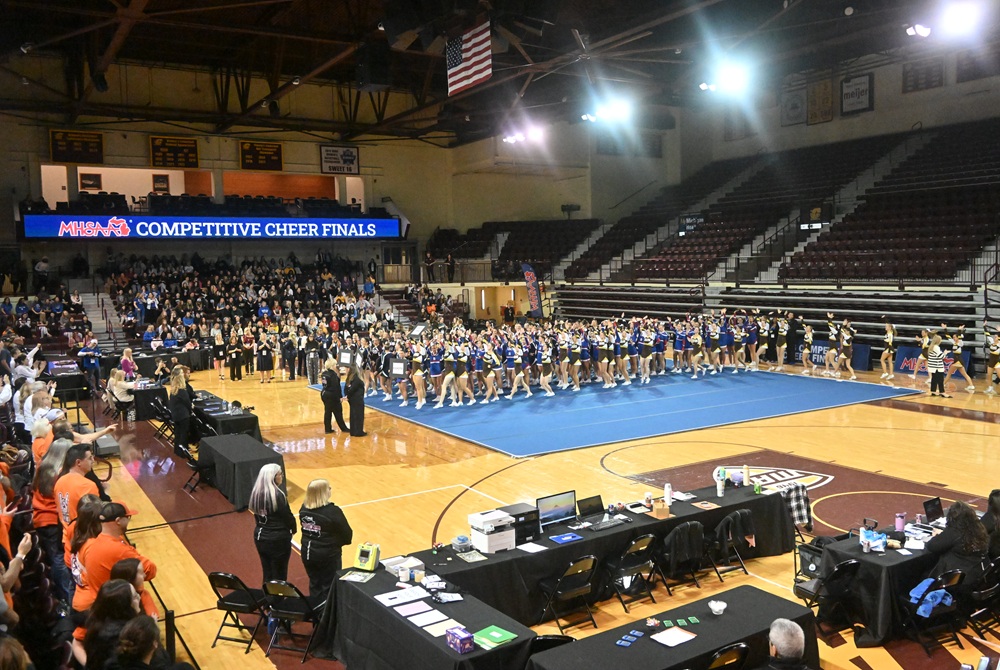
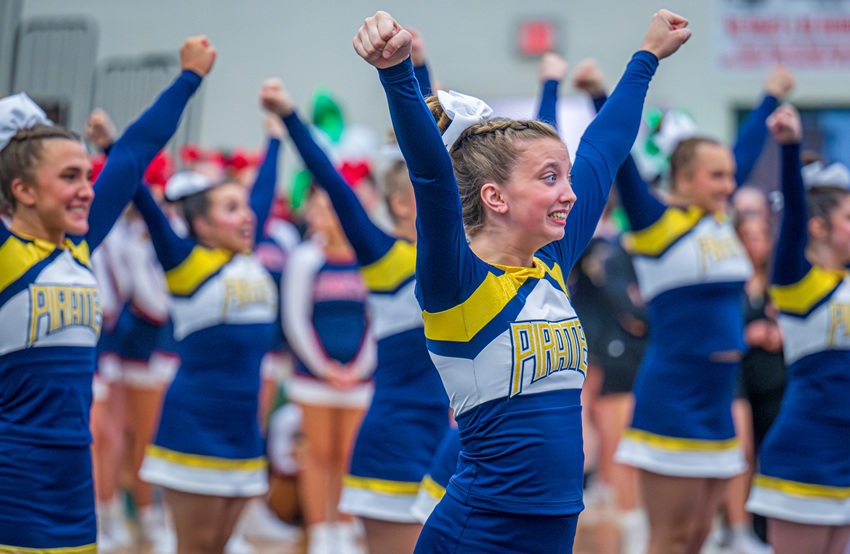
PHOTOS (Top) Division 1 contenders take the mat prior to the start of their 2025 Final at McGuirk Arena. (Middle) Pewamo-Westphalia competes at its Division 4 Regional last weekend. (P-W photo by Jim Pivarnik.)