

Casting Lines for Future Tournaments
August 12, 2016
By Jack Roberts
MHSAA Executive Director
The MHSAA is best known to the public for the tournaments it conducts to conclude the fall, winter and spring seasons each school year.
These tournaments, the first and largest program of the MHSAA, have survived the Vietnam War, the Korean conflict and two World Wars. They have survived the technology bubble, the housing collapse, the energy crisis and the Great Depression.
MHSAA tournaments existed at the dawn of aviation and at the time of our nation’s lunar landing. Popes, presidents and governors have changed and changed again and again, and MHSAA tournaments roll on year after year.
But the sense of tradition and permanence and inevitability of MHSAA tournaments doesn’t dissuade us from asking questions about our tournaments, even some of the most basic questions. Here are two.
Question #1
I have long been and will always be an advocate for a Ryder Cup format for the MHSAA Golf Finals, and a team tennis approach to the MHSAA Tennis Finals; but 90 years of tradition is hard to overcome. Might this be a more exciting format? Could it be co-ed? Could it reverse the decline in boys tennis participation, and increase girls golf participation? Wouldn’t it be fun to try?
Periodically, the International Olympic Committee requires each of the designated Olympic sports to defend its status, to state its case why the sport should remain a part of the Olympic program. Then, after a series or votes that retain one sport at a time, the IOC drops the sport that makes the weakest case. It does so to make room for one of the previously unlisted sports that makes the best case for inclusion.
This would appear to keep the existing Olympic sports on their toes, and to keep the Olympic movement fresh and reflective of modern trends in sports.
While I would not enjoy the controversy, I can see the potential for some positive results if the MHSAA were to invoke the same policy for determining the 14 tournaments it will provide for girls and the 14 for boys.
This might cause us to consider more deeply what a high school sport should look like, or at least what an MHSAA tournament sport should stand for.
On the one hand, we might be inclined to drop tournaments for those sports that involve mostly non-faculty coaches and non-school venues, or require cooperative programs to generate enough participants to support a team, or resort almost entirely to non-school funding, or cater to individuals more than teams.
Or perhaps this process would cause policymakers to forget traditional thinking and ask: “In this day and age, should we shake off traditional notions of sport and consider more where modern kids are coming from?” That might mean fewer team sports and more individual sports, more “extreme” sports like snowboarding and skateboarding, and more lifetime sports, meaning not just golf and tennis and running sports, but also fishing and even shooting sports.
Currently, MHSAA policy states that the MHSAA will consider sponsorship of a tournament series for any sport which 64 member schools conduct on an interscholastic basis as a result of action by the governing boards of those schools.
Should the only question be how many schools sponsor a sport, or must an activity also have certain qualities and/or avoid certain “defects?” What should an MHSAA tournament sport look like and stand for?
Question #2
Bristling from criticism that his association is a money-grabbing exploiter of children, my counterpart in another state said, “If we were running our programs just to make money, we would do very many things very differently.” I knew exactly what he meant.
Because we care about the health and welfare of students, because we mean what we say that the athletic program needs to maximize the ways it enhances the school experience while minimizing academic conflicts, and because we try to model our claim that no sport is a minor sport when it comes to its potential to teach young people life lessons, we operate our programs in ways that make promoters, marketers and business entrepreneurs laugh, cry or cringe.
If money were the only object, we would seed and select sites to assure the teams that attracted the most spectators had the best chance to advance in our tournaments, regardless of the travel for any team or its fan base. If money were the only object, we would never schedule two tournaments to overlap and compete for public attention, much less tolerate three or four overlapping events. If money were the only object, we would allow signage like NASCAR events and promotions like minor league baseball games.
Those approaches to event sponsorship may not be all wrong; they’re just not all right for us. And we will live with the consequences of our belief system.
During a typical school year, more than 20 percent of the MHSAA’s 2,097 District, Regional and Final tournaments lose money. Not a single site in golf, skiing or tennis makes a single penny. In no sport did every District, Regional and Final site have revenue in excess of direct expenses.
In fact, in only three sports – boys and girls basketball and football – is revenue so much greater than direct expenses overall that it helps to pay for all the other tournaments in which the MHSAA invests.
That’s right: invests. When we present our budget to our board, we talk about the MHSAA’s investment in providing tournament opportunities in all those sports and all those places that cannot sustain the cost of those events on their own. How much is this investment worth to students, schools and society?
These two are core questions that require our focus far in advance of talk about scheduling, site selection, seeding and the myriad matters that too often hijack our time and attention.
Preview: Historic Skate Guaranteed as 5 Seek 1st Trip to Saturday Center Ice
By
Geoff Kimmerly
MHSAA.com senior editor
March 4, 2026
All three 2025 MHSAA Finals winners will return to USA Hockey Arena this weekend intending to repeat – and, in fact, Detroit Catholic Central will be playing for a sixth-straight title.
But we also will welcome five teams that have never reached a championship game in this sport – and we’re guaranteed to see at least one take the ice Saturday in Plymouth with a championship on the line.
Utica Eisenhower, Northville, Detroit U-D Jesuit, Caledonia and Traverse Bay Reps are those five teams seeking to make the season’s final day for the first time. Eisenhower and Northville will face off in a Friday Semifinal, guaranteeing the winner also celebrates that historic achievement.
Division 1 – Friday Semifinals
#1 Detroit Catholic Central (27-1-1) vs. #4 Rockford (21-8-1), 5 p.m.
#2 Utica Eisenhower (24-6) vs. #3 Northville (22-8), 7:30 p.m.
Division 2 – Thursday Semifinals
#1 Flint Powers Catholic (25-5) vs. #4 Detroit U-D Jesuit (13-15), 5 p.m.
#2 Caledonia (21-5-1) vs. #3 Livonia Stevenson (19-9-1), 7:30 p.m.
Division 3 – Friday Semifinals
#1 Houghton (23-6-1) vs. #4 Traverse Bay Reps (16-12-1), 11 a.m.
#2 Orchard Lake St. Mary's (24-4) vs. #3 Grosse Pointe Woods University Liggett (25-5), 1:30 p.m.
Saturday – Finals
Division 1 – 7 p.m.
Division 2 – 11 a.m.
Division 3 – 3 p.m.
All Semifinals and Finals will be streamed live on MHSAA.tv and viewable with subscription. For information on tickets and more, go to the Ice Hockey page – and see below for a glance at all 12 contenders, listed by seed.
Division 1
#1 DETROIT CATHOLIC CENTRAL
Record/rank: 27-1-1, No. 2
Coach: Brandon Kaleniecki, 11th season (270-33-3)
League finish: First in Michigan Interscholastic Hockey League, first in Catholic High School League
Championship history: Nineteen MHSAA titles (most recent 2024), five runner-up finishes.
Best wins: 1-0 (Quarterfinal) and 4-3 over No. 1 Howell, 5-0 over No. 6 Brighton, 6-3 over Division 2 No. 1 Flint Powers Catholic, 8-4 over Division 2 No. 8 Trenton, 3-2 (OT) and 5-2 over Division 3 No. 1 Orchard Lake St. Mary’s.
Players to watch: Sean Goff, jr. F (11 goals, 13 assists); Lucas Szmagaj, jr. F (11 goals, 16 assists); Ryan Dye, sr. D (9 goals, 25 assists), Costa Karadimas, sr. F (9 goals, 18 assists).
Outlook: Detroit Catholic Central opened this season with a win over Howell and then added another in the Quarterfinal to return to this weekend. The lone loss came Nov. 19 to No. 3 Hartland, and the Shamrocks also have defeated strong opponents from Ohio, Illinois and Wisconsin. Goff centers Szmagaj and Karadimas on the top line, but a second of seniors Jack Dorgan (13 goals/14 assists)-Matthew Naida (8/14)-Gabe Thompson (18/3) is similarly potent, and junior defenseman Sam Masek (10/17) has reached double-digit goals as well. Junior Nicholas Kogut (1.47 goals-against average) and senior Maxxon Sulla (0.60) have combined for 12 shutouts.
#2 UTICA EISENHOWER
Record/rank: 24-6, No. 4
Coach: David Erwin, second season (47-11)
League finish: First in Macomb Area Conference Red
Championship history: Has never played in an MHSAA Final.
Best wins: 7-1 and 10-6 over No. 10 Macomb Dakota, 4-1 over Division 2 No. 4 Byron Center, 4-2 over Division 2 No. 6 Rochester United, 4-2 over Division 2 No. 9 Mattawan, 5-2 over Division 2 No. 10 St. Clair Shores United.
Players to watch: Sawyer Hotchkiss, sr. F (20 goals, 25 assists); Bode Farr, sr. F (43 goals, 46 assists); Joseph Zelenak, sr. F (41 goals, 58 assists); Nathan Schilkey, sr. F (49 goals, 48 assists).
Outlook: Eisenhower has advanced to the Semifinals for the first time since 2006 anchored by serious scoring power especially on the top line where Farr centers Zelenak and Schilkey. Junior forward Ryan Dex (16 goals, 18 assists) is another top scorer, and junior defenseman Zach Morrison (8/21) is among blueliners adding most to the attack. Hotchkiss, Farr and senior goalie Connor Holmes (1.86 GAA) all earned all-state honorable mentions last season. The Eagles’ only loss since the start of December came to No. 7 Grand Rapids Forest Hills Central.
#3 NORTHVILLE
Record/rank: 22-8, No. 5
Coach: Ryan Ossenmacher, fourth season (61-45-3)
League finish: Fourth in Kensington Lakes Activities Association West
Championship history: Has never played in an MHSAA Final.
Best wins: 3-1 over No. 6 Brighton in Regional Final, 4-3 over Division 2 No. 4 Byron Center, 3-2 over Division 3 No. 3 Bloomfield Hills Cranbrook Kingswood, 5-1 over Division 3 No. 9 South Lyon Unified.
Players to watch: Tommy Marinoff, sr. F (32 goals, 19 assists); Jordan Sziraki, sr. F (11 goals, 15 assists); Lucas Goerke, sr. F (12 goals, 16 assists); Ethan Egelski, sr. F (30 goals, 19 assists).
Outlook: Northville is returning to the Semifinals for the first time since 2017, and Ossenmacher has brought the Mustangs back after they finished just 10-15-2 in his first season four years ago. The fourth place in the KLAA West requires context; Northville finished behind No. 1 Howell, No. 3 Hartland and No. 6 Brighton and then avenged their regular-season loss to the Bulldogs in the Regional Final. Marinoff made the all-state first team last season. Senior defenseman Graham Ryba also is among team leaders in assists with 14, and junior Andrea Castiglioni (1.94 GAA) and sophomore Carter Nissen (1.72) are solid in net.
#4 ROCKFORD
Record/rank: 21-8-1, No. 8
Coach: Carl Mokosak, fourth season (51-53-1)
League finish: Second in Ottawa-Kent Conference Rue
Championship history: Division 1 runner-up 2021.
Best wins: 4-0 (Regional Final) and 4-1 over No. 7 Grand Rapids Forest Hills Central, 5-4 (SO) over No. 5 Northville, 3-2 over Division 2 No. 3 Grandville, 5-3 over Division 2 No. 4 Byron Center.
Players to watch: Jonah Packard, sr. F (39 goals, 22 assists); Jackson Vollmer, sr. F (17 goals, 20 assists); Brody Raguckas, sr. F (16 goals, 12 assists); Chase Laverell, jr. F (8 goals, 26 assists).
Outlook: Rockford is back at the Semifinals for the first time since its runner-up finish five years ago and after ending only 10-15 a season ago. The Rams have won 12 of their last 13 games and made the impressive jump keyed by a senior-heavy offensive effort that also includes Michael Mead (11 goals, 13 assists) and Warner Korytkowski (5/20) among team statistical leaders. Rockford has scored at least five goals in nine of those 12 most recent victories and also held both Regional opponents Sparta and Forest Hills Central scoreless. Packard earned all-state honorable mention last season.
Division 2
#1 FLINT POWERS CATHOLIC
Record/rank: 25-5, No. 1
Coach: Travis Perry, 20th season (411-123-20)
League finish: First in Saginaw Valley League
Championship history: Division 3 champion 2023 and 2025, seven runner-up finishes.
Best wins: 9-1 over No. 2 Livonia Stevenson, 6-0 over No. 7 Alpena, 3-1 over Division 1 No. 5 Northville, 8-0 over Division 3 No. 6 Escanaba.
Players to watch: Ayden Cook, sr. F (53 goals, 48 assists); Owen Perry, soph. F (34 goals, 53 assists); Parker Bendall, sr. F (22 goals, 43 assists); Hunter Clark, sr. G (1.85 GAA, 7 shutouts).
Outlook: The Chargers are seeking their second-straight title and third in four seasons backstopped by an all-state honorable mention goalie in Clark and scoring nearly seven goals per game. Seniors Gavin Vorwerk (20 goals, 19 assists) and Jack Johnson (11/13) and sophomores Sam Beebe (15/14) and Chase Stevens (10/15) also have reached double-digit goals, and junior defenseman Julian Meyer has 39 assists to go with seven goals from the blue line. Powers hasn’t given up a score during the postseason, defeating Fenton, Saginaw Heritage and Midland Dow by a combined 29-0. All five losses were to teams ranked among the top three in Division 1 or 3.
#2 CALEDONIA
Record/rank: 21-5-1, No. 5
Coach: Tyler Jaenicke, first season (21-5-1)
League finish: Second in O-K Rue
Championship history: Has never played in an MHSAA Final.
Best wins: 3-2 OT (Regional Final) and 4-2 over No. 4 Byron Center, 3-1 over No. 9 Mattawan in Regional Semifinal, 2-1 (OT) over No. 3 Grandville, 4-2 over Division 1 No. 6 Brighton, 5-0 over Division 1 No. 7 Grand Rapids Forest Hills Central, 4-2 over Division 1 No. 8 Rockford.
Players to watch: Ty Lewandowski, sr. F (17 goals, 16 assists); Sam Hoag, sr. G (1.65 GAA); Harmon Esch, sr. F (20 goals, 17 assists); Gabe Supuk, jr. D (10 goals, 13 assists).
Outlook: Caledonia has increased its win total four straight seasons and advanced to the Semifinals to the first time with a tournament run that also included a 4-3 double-overtime victory over Muskegon Mona Shores in the Quarterfinal. The Fighting Scots started a current eight-game winning streak by edging Division 3 semifinalist Traverse Bay Reps, and along the way have avenged losses to Byron Center and Mattawan. Junior Ethan Sova (17 goals, 18 assists) centers the top line, and sophomore Bryce Mitchell (10/8) is also a top scorer. Hoag made the all-state first team last season, and Lewandowski made the second team.
#3 LIVONIA STEVENSON
Record/rank: 19-9-1, No. 2
Coach: Jay Thompson, first season (19-9-1)
League finish: First in KLAA East
Championship history: Division 2 champion 2013, three runner-up finishes.
Best wins: 4-3 (Quarterfinal) and 2-1 (SO) over No. 6 Rochester United, 4-2 over No. 9 Mattawan, 5-2 over No. 8 Trenton, 4-3 over Division 1 No. 5 Northville, 6-3 over Division 1 No. 3 Hartland, 4-3 over Division 1 No. 6 Brighton, 5-3 over Division 3 No. 3 Bloomfield Hills Cranbrook Kingswood, 3-1 over Division 3 No. 7 Riverview Gabriel Richard.
Players to watch: Colin Stroble, sr. D (14 goals, 33 assists); Dawson Wallis, sr. D (12 goals, 28 assists); Blake Calhoun, sr. F (20 goals, 17 assists); Brendan Sise, sr. F (18 goals, 30 assists).
Outlook: Stevenson won its first Regional title since 2023 and is making its first Semifinal trip since its most recent runner-up season in 2016, with Thompson leading the way after formerly serving as an assistant coach for a decade and then the last three seasons as an assistant at Northville. Stroble made the all-state first team last season and Wallis earned honorable mention, and they give the Spartans a high-powered top defense pair to go with an attack that also includes seniors Garrett Teahan (11 goals/19 assists) and Tyler Breitbach (10/8). The win over Hartland on Jan. 14 started a current 10-3-1 run.
#4 DETROIT U-D JESUIT
Record/rank: 13-15, unranked
Coach: Domenic Recchia, second season (19-36)
League finish: Fourth in MIHL South
Championship history: Has never played in an MHSAA Final.
Best wins: 4-3 (OT) over No. 8 Trenton in Quarterfinal, 3-1 over Dexter in Semifinal, 2-1 (SO) over Huron Valley United, 3-1 over Marysville.
Players to watch: Zack Barringer, sr. F (10 goals, 10 assists); Teo Mosera, jr. F (12 goals, 9 assists); Carter Gogate, sr. F (10 goals, 14 assists); Brody Contat, sr. F (8 goals, 12 assists).
Outlook: Jesuit is making its second trip to the Semifinals in four seasons, improving from 6-21 just a year ago and after starting this playoff run with a 6-3 victory over Bloomfield Hills Brother Rice. Of the team’s 14 losses, 10 came to opponents ranked in their divisions’ respective top 10s at the end of the regular season. The Cubs have only five seniors, and junior forward Will Balasia (10 goals, 5 assists) is another top scorer and centers the second line. Recchia played at Jesuit and returned as a varsity assistant in 2013 and then became junior varsity head coach before taking over the program.
Division 3
#1 HOUGHTON
Record/rank: 23-6-1, No. 2
Coach: Micah Stipech, third season (65-17-3)
League finish: Does not play in a conference.
Championship history: Class B-C-D champion 1982, five runner-up finishes.
Best wins: 4-0 (Quarterfinal) and 6-0 over No. 4 Marquette, 9-1 (Regional Final), 3-1 and 5-1 over No. 5 Calumet, 5-0 (Regional Semifinal) over Hancock, 10-5 over No. 3 Grosse Pointe Woods University Liggett, 4-1 and 4-1 over No. 10 Painesdale Jeffers, 6-5 (OT) over No. 7 Riverview Gabriel Richard, 5-4 over Division 2 No. 8 Trenton, 2-0 over Division 2 No. 9 Mattawan, 4-1 over Division 2 No. 3 Grandville, 5-1 over Division 1 No. 7 Grand Rapids Forest Hills Central, 6-1 over Division 1 No. 6 Brighton, 2-1 (OT) over Division 1 No. 3 Hartland.
Players to watch: Connor Arko, sr. F (24 goals, 34 assists); Noah Maillette, sr. F (28 goals, 21 assists); Jack Sayen, sr. F (15 goals, 19 assists); Gunner Gullstrand, soph. F (13 goals, 15 assists).
Outlook: Houghton is about as tested as they come heading into this weekend, with five of the six losses also to ranked opponents and the sixth coming to rival Hancock two weeks before the Gremlins avenged to the start the postseason. Houghton last finished Division 3 runner-up in 2019 and reached the Semifinals most recently in 2023. Arko made the all-state second team last season. Gullstrand centers a second line of two more top scorers, sophomore Braden Kari (11 goals/15 assists) and junior Brody Donnelly (18/17).
#2 ORCHARD LAKE ST. MARY’S
Record/rank: 24-4, No. 1
Coach: Brian Klanow, 27th season (426-220-39)
League finish: Third in MIHL North
Championship history: Four MHSAA titles (most recent 2025), two runner-up finishes.
Best wins: 3-1 over No. 9 South Lyon Unified in Regional Final, 9-1 and 5-1 over No. 7 Riverview Gabriel Richard, 5-3 over Division 1 No. 3 Hartland, 8-3 over Division 1 No. 6 Brighton, 7-4 over Division 2 No. 2 Livonia Stevenson, 7-2 over Division 2 No. 1 Flint Powers Catholic, 10-2 over Division 2 No. 8 Trenton.
Players to watch: Thaddeus Raynish, jr. F (20 goals, 13 assists); Dominic Pizzo, sr. F (20 goals, 19 assists); Diezel Cariera, sr. D (7 goals, 24 assists); Charlie Roberts, sr. F (28 goals, 23 assists).
Outlook: The reigning champion has been building toward a potential repeat, riding a 13-game winning streak with its only losses to Detroit Catholic Central (twice), Howell and Cranbrook. Roberts and Raynish have been among the team’s leading scorers multiple seasons, and Raynish made the all-state first team a year ago. Eight players this winter have scored at least 11 goals, and 13 have at least 10 assists. Senior Matthew Mourad (11 goals/16 assists)-junior Emmett Pilch (12/13)-sophomore Matthew Boyda (11/16) are a potent second line, and junior Daniel Ramos (12/16) and senior John Brown (11/16) also are double-digit scorers with sophomore Brandon Kondrat (9/17) needing one more goal to join the group.
#3 GROSSE POINTE WOODS UNIVERSITY LIGGETT
Record/rank: 25-5, No. 8
Coach: Colin Smith, fifth season (91-40-2)
League finish: Second in Metro League East, first in CHSL Cardinal Tournament
Championship history: Three MHSAA titles (most recent 2012).
Best wins: 2-0 over No. 3 Bloomfield Hills Cranbrook Kingswood in Regional Final, 3-2 (Quarterfinal), 6-3 and 4-2 over Dearborn Divine Child, 5-2 and 5-4 over Division 1 No. 10 Macomb Dakota, 5-3 over Division 2 No. 1 Flint Powers Catholic.
Players to watch: Landen Maltby, sr. C (15 goals, 11 assists); Griffin Marchal, sr. RW (29 goals, 39 assists); Luke Slanec, jr. C (18 goals, 39 assists); Nick Gould, sr. LW (43 goals, 34 assists).
Outlook: Liggett won its first Regional title since 2020 and will play at the Semifinals for the first time since its most recent championship season of 2012. The Knights advanced by winning their fourth matchup this season with Metro League East champ Divine Child, which had defeated Liggett 18 days earlier. Liggett opened this postseason with a 3-2 double-overtime win over Warren De La Salle Collegiate. Junior left wing Johnny Secco (10 goals/14 assists) and senior defenseman Ryan Cordaro (5/20) also are among top contributors to the attack.
#4 TRAVERSE BAY REPS
Record/rank: 16-12-1, unranked
Coach: Mike Matteucci, eighth season (136-72-7)
League finish: Does not play in a conference.
Championship history: Has never played in an MHSAA Final.
Best wins: 3-1 over Petoskey in Regional Final, 3-0 over Warren De La Salle Collegiate, 5-2 and 2-1 over Traverse City Central.
Players to watch: Tyler Boynton-Fisher, sr. G (1.53 GAA, 6 shutouts); Carter Denoyer, sr. F (5 goals, 20 assists); Thatcher Beaudoin, jr. F (20 goals, 7 assists); Eddie Walter, sr. F (17 goals, 16 assists).
Outlook: The Reps won their first Regional title since 2023 and will be returning to the Semifinals for the first time since 2019, and after finishing 12-15 a year ago. The impressive rise really took hold in early December, as the Reps began rebounding from a 2-6 start that included three overtime or shootout defeats. They are 10-2-1 since mid-January, that tie coming against Division 2 No. 4 Byron Center, and the Regional Final win over the Northmen avenged a regular-season loss. Boynton-Fisher earned all-state honorable mention last season, and junior Joel Ziecina (7 goals/17 assists) and sophomore Chase Kent (5/11) are the top defensive pair in front of him.
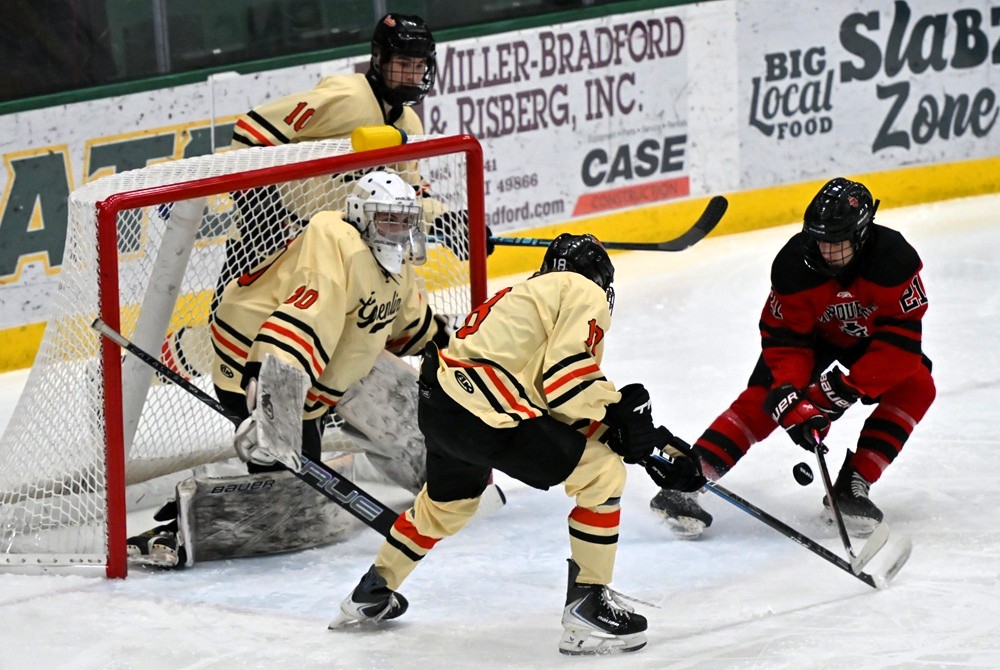
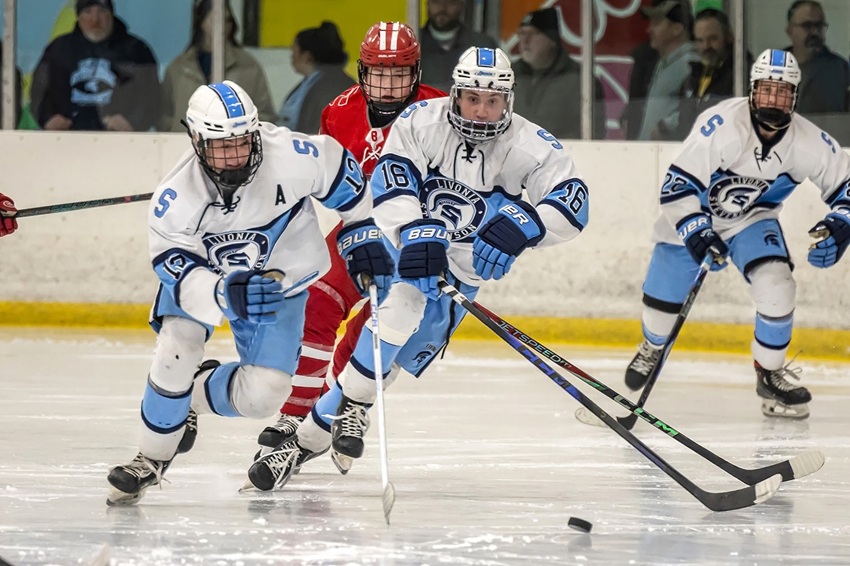
PHOTOS (Top) Houghton's Ian Hembroff (18) deflects the puck away from goalie Cooper Flachs and Marquette's Evan Mattila during the Gremlins’ Quarterfinal win Saturday. (Middle) Garrett Teahan (12) and Brendan Sise (16) lead a rush during Stevenson’s win over Livonia Red on Jan. 3. (Houghton/Marquette photo by Cara Kamps. Stevenson/Livonia Red photo by Douglas Bargerstock.)