

And the MHSAA Survey Says ...
April 2, 2015
By Rob Kaminski
MHSAA benchmarks editor
A survey of MHSAA member schools was conducted in the fall of 2014 aimed to determine opinions for and against a myriad of out-of-season coaching/contact period topics within the school year.
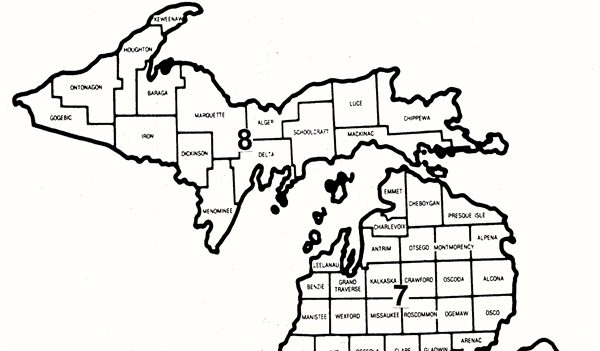
Below are some of the summaries drawn from that survey, plus a map of zones referred to in a number of points.
Survey Summary and Highlights
The larger the school, the higher the percentage of students who are involved in organized non-school sports.
The Detroit metro area (Zone 3) has the highest percentage of respondents in each of two groups in which the highest percentage of students are involved in organized non-school sports ... the 60 to 80% and 40 to 60% groups. The Grand Rapids area (Zone 6) ranks second.
The northern Lower Peninsula (Zone 7) and the Upper Peninsula (Zone 8) have the highest percentage of respondents in the group in which the lowest percentage of students are involved in organized non-school sports . . . the 0 to 20% group. This is also true of Zones 1, 2 and 5, although less dramatically.
In the majority of schools, coaches work with students out of season under the three- or four-player rule for a few weeks just before the season. This is generally true regardless of school classification or geographic zone.
In nearly 80% of schools, the frequency of coaches working with students out of season under the three- or four-player rule is one or two days a week.
100% of schools that sponsor basketball hold open gyms for basketball. Two-thirds of volleyball schools hold volleyball open gyms. Half of lacrosse schools hold lacrosse open gyms. Open gyms in baseball, softball and soccer occur in 40 to 45% of responding schools. Open gyms are less common for other sports.
More than half of all schools conduct open gyms for only a few weeks, just before the season begins.
In 85% of schools, the frequency of open gyms is one or two days a week.
The multi-sport athlete is common in schools of every classification, but more common in Class C and D schools than in Class A and B.
The multi-sport athlete is common in schools of every geographical zone, but more common in Zones 1, 2, 4, 7 and 8 than in Zones 3, 5 and 6.
Two-thirds of schools do not ban athletes from out-of-season workouts while in-season in a different school sport. Permitting weightlifting is most common (84%), then three- or four-player workouts (70%), then conditioning (66%) and open gyms (65%), and finally non-school competitions (57%).
Single-sport coaches are more common in smaller schools than larger (perhaps because fewer sports are sponsored in smaller schools).
For one question, schools were asked to rate ideas from 1 (I like the concept) to 6 (I do not like the concept). Average would be 3.5.
More than 60% of schools favor a no-contact period for all out-of-season sports at the start of every other sport’s season. (Support ranges from 55% for Class A schools to 65% for Class D schools and from 56% for Zones 1 and 3 to 71% for Zone 7.)
More than 72% of schools favor (in conjunction with a no-contact period) a defined contact period out of season. Support ranges from 69% for Class B schools to 76% for Class D schools and from 64% in Zone 6 to 88% in Zone 1.
Two-thirds of schools favor setting a limit on the number of contact days for out-of-season coaching. Support ranges from 63% for Class A schools to 72% for Class C schools and from 50% for Zone 2 to 73% for Zone 1.
More than 68% of schools favor setting a limit on the number of contact days in a week. There’s almost no difference based on school class. Support ranges from 58% in Zone 6 to 76% in Zone 5.
Counting days more than players – that is, allowing practice with any number of students for a defined number of days over a period of time – is favored by more than 72% of schools. Support ranges from 69% for Class D to 76% for Class A and from 59% for Zone 5 to 76.5% for Zone 3.
The least support of any idea surveyed was for allowing scrimmage competition (allowing the coach to coach any number of students from that coach’s school in competition against individuals not enrolled in that school).
More than 62% of schools favor a rule that would allow a school coach to coach a non-school team within a defined contact period; that is, a team with students from the coach’s school (and possibly other schools too), but not supported with school funds, administration, insurance, uniforms, etc. Support ranged from 58% for Class C schools to 68% for Class B schools. Support ranged from 54% for Zone 2 to 69% for Zone 6.
This is the most popular proposal (doesn’t preclude others being approved too): 84% of schools favor removing the phrase “under one roof” from Regulation II, Section 11(H) 2 a (see Tuesday's report). Support ranged from 80% for Class D schools to 86% for Class C schools and from 78% in Zone 2 to 89% for Zone 5.
Removing the portion of Interpretation 237 which prohibits setting up rotations that would allow a coach to work with dozens of players who rotate to his/her direct attention in groups of three or four is favored by 69% of schools, but with a distinct large school vs. small school difference of opinion: Class A (80.5% favorable), Class B (72.9%), Class C (61.3%) and Class D (61.7%).
Vander Klay's Dedication to Wyoming Schools Netted 400+ Wins, Trip to Breslin
By
Dean Holzwarth
Special for MHSAA.com
April 6, 2026
WYOMING – Over the past 31 years, it was relatively easy to notice a boys basketball team coached by Thom Vander Klay.
 Athletic and tough-nosed players who competed hard while playing an up-tempo offense and in-your-face defense were trademarks of his teams at Wyoming Park and Wyoming High School.
“In some ways, at Wyoming Park, and then Wyoming, our athletes have been very similar through those 31 years of varsity,” Vander Klay said.
“Some teams were more skilled and more athletic than others, but they were the same. We never had big kids. We’ve always had kind of gritty kids that would compete hard and play fast, and we had quite a few of them on every team. That bled into what we did.”
Vander Klay will retire from teaching after 40 years at the end of May, and his time as the longtime basketball coach will end as well.
“It’s been a struggle, and it’s hard because it’s my home,” Vander Klay said. “I live in Wyoming, my kids went to Wyoming and I went to Wyoming (Park). I’m the youngest of three and my older brother and sister were Vikings and that’s who I was. I was Wyoming, and I still am, so it was really difficult to say I was going to step away from things I really enjoyed doing.”
Vander Klay has been coaching for 41 years. He was the junior varsity coach at Wyoming Park before replacing Kelly McEwen in 1995.
When Wyoming Park and Wyoming Rogers merged in 2012, he became the head coach at the new Wyoming High School.
During his tenure, he went 424-274 as a varsity coach and won nine conference championships, six District titles and one Regional title. He also helped coach football and track & field.
“So many memories and so many kids, and you love those kids,” said Vander Klay, who coached his two sons, Brock and Chase. “When I think back to when I started, guys like Jack VerDuin, Ron Engels, Dick Locke, Frank Grimm and Kelly McEwen were great mentors that I had. I go back to those days and blink, and here we are 40 years later and I'm the old guy.”
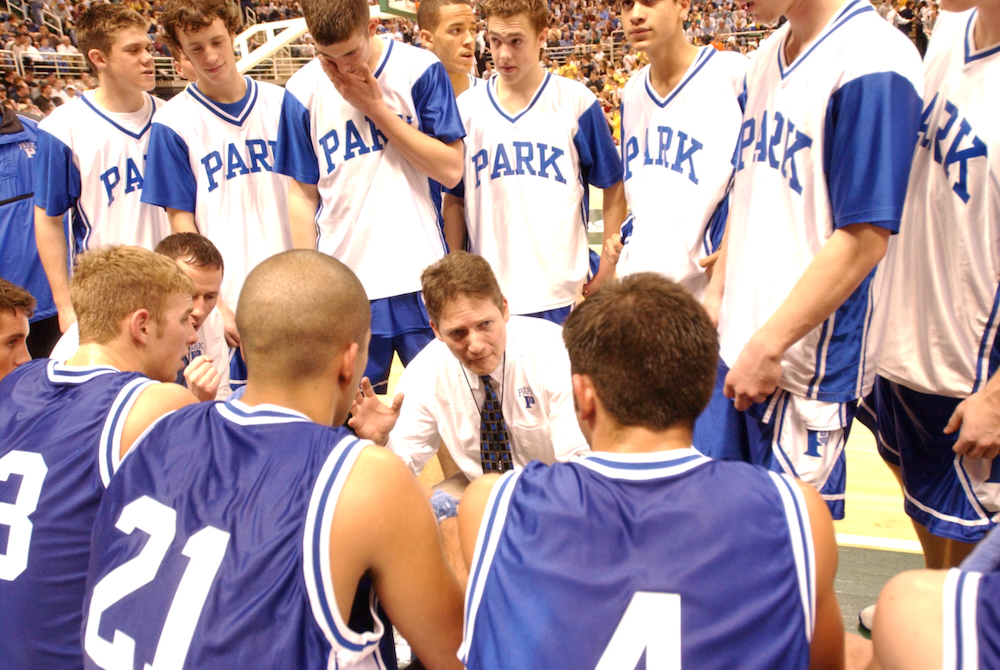
Vander Klay’s best season came in 2004 at Wyoming Park, led by eventual Michigan State standout Drew Neitzel. The Vikings advanced to the Class B Semifinals, losing to Detroit Renaissance.
 Vander Klay was named Class B Coach of the Year and enjoyed his time coaching Neitzel, the Mr. Basketball Award winner who is widely considered one of the best players in program history.
“Drew was so well-rounded,” Vander Klay said. “A great leader, great student, great attitude and just mentally tough and so skilled.
“Coaching him was more about trying to get all five guys on the same page, but those teams that Drew played on, we had good players other than him, too. It wasn't just him because we had other guys who stepped up – but he was the best player in the state.”
Jacob Underhill, Vander Klay’s longtime assistant and junior varsity coach, said Vander Klay has been more than just a mentor.
“He has been the blueprint for the teacher and coach I strive to be,” Underhill said. “He has always been incredibly gracious in sharing his knowledge of the game and his wisdom on how to lead young men. Every decision he makes is filtered through a single focus: doing what is best for the students and athletes of Wyoming.
“While his retirement marks the end of an era, his legacy is undeniable. Since the merger of Wyoming Park and Wyoming Rogers, he has been the heartbeat of the basketball program. He has had a profound impact on my professional career, and I cherish the time we’ve spent serving the community together.”
Underhill has witnessed firsthand the influence Vander Klay has had on former players with whom he has reconnected.
“It’s a true testament to his character,” Underhill said. “He is an exceptional human being who makes everyone around him better and ensures they recognize their own value.”
The 62-year-old Vander Klay is keeping his options open in terms of a return to coaching elsewhere.
“I’ll take some time off and maybe there is something else out there,” he said. “I'm wide open to anything, and maybe I’ll coach again and maybe not. We will see what the future holds.”
Two other longtime Grand Rapids-area coaches also stepped down after longstanding careers on the hardwood.
Unity Christian coach Scott Soodsma retired after 43 years on the sidelines. He won more than 800 games and three MHSAA Finals championships as a boys and girls coach. Soodsma coached his last game in the Division 2 Boys Basketball Final at Breslin Center. The Crusaders lost to Freeland, 42-32.
Sparta boys basketball coach Scott Berry also retired after 34 seasons. He won 245 games at Comstock Park and Sparta.
 Dean Holzwarth has covered primarily high school sports for Grand Rapids-based WOOD-TV for five years after serving at the Grand Rapids Press and MLive for 16 years along with shorter stints at the Ionia Sentinel and WZZM. Contact him at [email protected] with story ideas for Allegan, Kent and Ottawa counties.
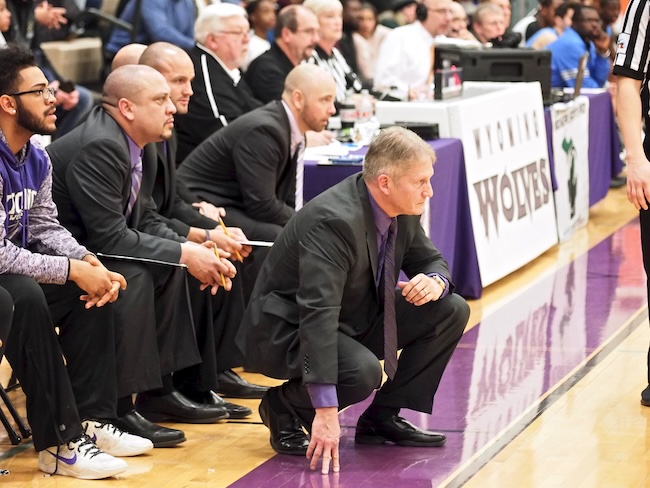
PHOTOS (Top) Coach Thom Vander Klay (kneeling) talks to his Wyoming Park team during a break in its 2004 Class B Semifinal at Breslin Center. (Middle) Vander Klay (kneeling) coaches his Wyoming High team. (Top photo from MHSAA archives; middle photo submitted by Thom Vander Klay.)