


Century of School Sports: Connection at Heart of Coaches Advancement Program
By
Geoff Kimmerly
MHSAA.com senior editor
November 19, 2024
As we believe that educational athletics are an extension of the academic classroom, it’s important to recognize as well that coaches – similar to teachers during the school day – are another first point of contact for more than 170,000 high school athletes and thousands more who play middle school sports in Michigan.
For two decades, the MHSAA’s Coaches Advancement Program has served as an avenue to provide our coaches with a variety of tools to assist in working through issues they encounter daily while building up their teams and building these relationships.
Past Executive Director John E. “Jack” Roberts, when writing about the CAP program in 2017, noted “the thousands of dollars and hours that the MHSAA devotes to CAP demonstrates this organization’s belief that nothing – absolutely nothing – is more important in the process of educational athletics than the quality of the coach-athlete connection.”
That commitment and dedication to the coach-athlete connection continues as the MHSAA moves through its 100th anniversary year.
Through the end of the 2023-24 school year, coaches had completed 41,167 sessions within the eight-level program since its creation for the 2004-05 school year. Counting this past weekend’s CAP 1 and 2 courses taught at Detroit Henry Ford, another 1,167 sessions have been completed since the start of the 2024-25 educational year.
The CAP program is broken into nine levels, each addressing a set of topics:
- CAP 1: Coaches Make the Difference, The Coach as Teacher, Sports Medicine and First Aid.
- CAP 2: Effective Communication, Legal Responsibilities, Psychology of Coaching.
- CAP 3: Additional Coaching Responsibilities, Effectively Working with Parents, Managing Time and Energy.
- CAP 4: Understanding Athletic Development, Strength and Conditioning, Preparing for Success.
- CAP 5: Healthy Living, Teaching Emotional Toughness, Resolving Conflicts in Athletics.
- CAP 6, 7, 8 & 9: Current Issues and Topics in Educational Athletics.
Those who complete the program receive a level of certification after their first 12 hours (completing CAP 1 and 2). Through this past school year, 2,295 individuals have advanced through CAP 5 – earning them themselves CAP Masters Certification. From that group, 476 have advanced through CAP 6, 100 through CAP 7 and 87 through CAP 8, with the first class to complete that module in 2015-16. CAP 9 was created this fall.
Perhaps just as notably, 20,960 individuals have completed CAP 1 over the last two decades. Completion of either CAP 1 or CAP 2 became a requirement for first-year varsity head coaches beginning with the 2016-17 school year, and predictably numbers have climbed since that time with 12,515 completing CAP 1 over the last eight school years.
The program is constructed and coordinated by MHSAA Assistant Director Kathy Vruggink Westdorp, who joined the MHSAA staff in 2004 after several years as a principal, athletic director, teacher and coach in Grand Rapids and Forest Hills public schools. She lives the program’s philosophy of providing CAP training “anytime, anywhere” across the state, and over just the last five months CAP 1 alone has been delivered at 19 schools plus during 14 dates at the MHSAA office in East Lansing. Flint Kearsley isn’t on the list of CAP 1 hosts this year, but instead welcomed in 45 students for a CAP 5 session in early August.
Additionally, colleges and universities in Michigan are licensed to present up to five levels through their undergraduate or graduate studies, and eight are scheduled to do so again this school year.
The faculty for 2024-25 includes well-known leaders in Michigan educational athletics, officiating and sports medicine. Instructors include past and present athletic directors, principals, officials, coaches, college professors, athletic trainers, leaders from the Michigan Interscholastic Athletic Administrators Association (MIAAA) and MHSAA staff.
For more information, see the Coaches Advancement Program page.
Previous "Century of School Sports" Spotlights
Nov. 12: Good Sports are Winners Then, Now & Always - Read
Nov. 5: MHSAA's Home Sweet Home - Read
Oct. 29: MHSAA Summits Draw Thousands to Promote Sportsmanship - Read
Oct. 23: Cross Country Finals Among MHSAA's Longest Running - Read
Oct. 15: State's Storytellers Share Fall Memories - Read
Oct. 8: Guided by 4 S's of Educational Athletics - Read
Oct. 1: Michigan Sends 10 to National Hall of Fame - Read
Sept. 25: MHSAA Record Books Filled with 1000s of Achievements - Read
Sept. 18: Why Does the MHSAA Have These Rules? - Read
Sept. 10: Special Medals, Patches to Commemorate Special Year - Read
Sept. 4: Fall to Finish with 50th Football Championships - Read
Aug. 28: Let the Celebration Begin - Read
PHOTOS Clockwise from top left: (1) Former Ypsilanti Community and current Wayne Memorial boys basketball coach Steve Brooks (far right) celebrates with a trophy-winning team. (2) Brighton girls lacrosse coach Ashton Peters raises the Division 1 championship trophy in the spring. (3) Pontiac Notre Dame Prep volleyball coach Betty Wroubel applauds during pre-match introductions. (4) Trenton baseball coach Todd Szalka (middle) huddles on the mound during last season's Division 2 Semifinals. (5) Past Calumet athletic director Sean Jacques (left) passes the Class C championship trophy to his girls basketball coach in 2015. All five have received levels of CAP certification.
MHSAA Vault: Shooks a Legend as Freshman Coach
By
Geoff Kimmerly
MHSAA.com senior editor
September 4, 2026
The following originally appeared in the Lansing State Journal on Oct. 28, 2004, and was reprinted by the MHSAA that winter.
Wayne Shooks retired from coaching entirely in 2008 and died Tuesday at the age of 84.
Wayne Shooks tried the varsity football thing once. Some time during the late 1980s, longtime DeWitt coach Gail Thornton asked Shooks to be his offensive coordinator.
“I didn't sleep a night. My wife, after three weeks, said, ‘You're going back to freshmen,’” Shooks remembered.
And those three weeks were in the month of June.
But Shooks' wife must have been on to something. Because few, if any, freshman football coaches have accomplished what Shooks finished with one last win last fall.
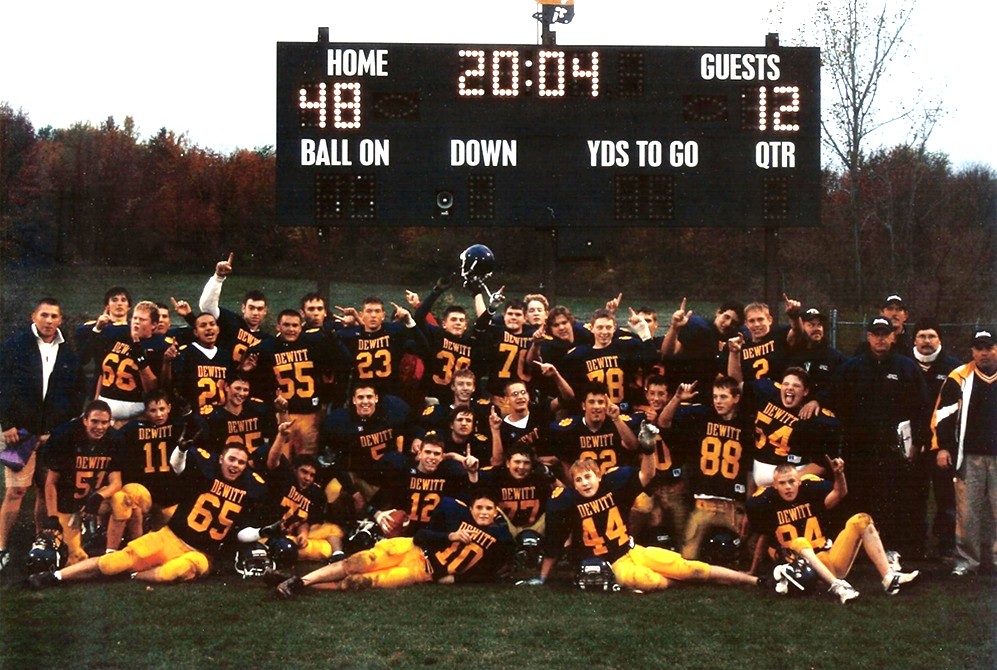
He ended his 16th and final season as freshman coach with a 135-2-1 record.
Amazing.
“You can't lose a game for him, or you'll feel bad,” DeWitt senior Mat Brynick recalled from his days as a freshman. “Coach never says it, but it's what everyone expects.
“He taught us how to win.”
 Guys like Shooks, 62, usually go unappreciated.
They get the kids fresh to high school, fresh to high school sports, and still learning things like not spiking the ball after a touchdown.
But few freshman football coaches are as legendary as Shooks is in DeWitt. They are so unappreciated that it's impossible to find out if anyone has accomplished what he's done.
Shook is not big on numbers. Never has been during his 41 years teaching in the district, or more than 20 coaching everything from football to basketball to wrestling to tennis. Oh, and track since 1980.
He also coached 8th-grade football for a few years, junior varsity for one season and was a varsity assistant. But he'll be remembered for what he did with the freshmen.
The losses came in 1993 to Mason during a terrible wind storm, and in 2002 to Greenville. That same year, the Panthers tied Haslett, meaning it was the only year during his tenure that DeWitt wasn't sure if it finished first in its league, since league titles aren't handed out at the freshmen level.
“The kids felt bad. They did their best,” Shooks remembered.
But the losses, however few, were more of a relief for Shooks than a letdown.
Don't take that to mean Shooks doesn't like to win.
Sure, he embraced the role of teacher as much as any freshman coach. But as DeWitt varsity coach Rob Zimmerman said, “If he was a 5th-grade coach, he'd be the most competitive 5th-grade coach you've ever seen.”
“I never pointed (our record) out, it was not our goal,” Shooks said. “Our goal was to win the next week. Although the kids knew it. They just assumed we were going to go 9-0, I guess.”
Guess so.
Shooks had more easily-attainable goals:
- Have fun
- Learn fundamentals
- Emphasize the logical stuff, like the importance of bringing equipment to school every day
“He does a really good job teaching expectations about being young men and being great students,” Zimmerman said. “It's gigantic.”
And it kept kids coming back to junior varsity and varsity. You could hear the fun coming out in Brynick's voice.
He was remembering his freshman football experience, remembering his time with perhaps Michigan's most successful coach at that level.
“I remember a few games, we'd find one play that works, and we ran it to death, pounding it and pounding it,” Brynick recalled. “He loves running the same play over and over. If you can do that, march 80 yards down the field, you're doing something right. No one could stop us.”
That was not all Brynick remembered, or didn't.
Shooks almost never yelled. If he did, it meant a kid messed something up over and over and over again.
He has a doctorate in zoology. Education is obviously a big deal. He loves to win, but he loves to teach. And he's hesitant to go looking for any attention for what he's done.
All made him a perfect freshmen football coach.
“Sometimes I don't think people understand about coaches. You think college level, they are coaches first, that's their job, but not at the high school level,” Shooks said.
“It's not what I've done, it's what they've done. I've always believed the focus should be on the kids. My job is a teacher. I coach because I love to coach.”
PHOTO DeWitt freshman coach Wayne Shooks, fourth from right, stands for a photo with this final football team in 2004. (Photos courtesy of the DeWitt football program.)