


Coaches Get U-M Concussion Training
July 24, 2012
Already administering a strong set of protocols addressing the removal and return to play of young athletes suspected of sustaining concussions in competition, the Michigan High School Athletic Association is further ramping up its concussion education efforts of coaches, student-athletes and parents as the 2012-13 school year approaches.
In partnership with the University of Michigan’s NeuroSport and the Pediatric Trauma Program at C.S. Mott Children’s Hospital, required online rules meetings for coaches and officials will include an education component illustrating the serious nature of concussions; recognition of the signs and symptoms; a review of return to play protocols; applicable MHSAA regulations; and downloadable co-branded resources from NeuroSport, as well as materials produced by a joint effort of the Brian Injury Association of Michigan, the Detroit Lions, the Center for Disease Control and the MHSAA.
This is the second year the MHSAA has included concussion education in its online rules meetings, which are annually viewed by nearly 20,000 coaches and game officials. This year, the Michigan NeuroSport Concussion Education - High School Coach edition, endorsed by the American Academy of Neurology last fall, has been modified for the MHSAA audience. The MHSAA will also promote the availability of the NeuroSport concussion education modules offered specifically for parents and coaches.
“These educational efforts, coupled with protocols addressing concussions when they take place on the field of play, put our schools in the best possible position to minimize the risk to young people,” said John E. “Jack” Roberts, executive director of the MHSAA. “We’re pleased to have our new partnership with University of Michigan NeuroSport and our ongoing partnership with the Brian Injury Association of Michigan which put our state at the forefront of addressing the critical health issue for interscholastic athletes.”
Roberts added that the same educational materials the Association has co-branded with its partners will also be used to help raise concussion awareness in other youth sports by other sponsors in the state.
“We are proud to partner with MHSAA and bring the most up-to-date concussion education to those on the frontline of athletics. Education is a vital component to improving player safety,” says Amy Teddy, injury prevention program manager at C.S. Mott Children’s Hospital. “We believe that ‘It takes a team to keep concussions on the sidelines.’ Parents, coaches, teammates, officials and athletic trainers all have a role in protecting athletes from serious injury.
“In addition to our coach modules, we recently launched our parent edition to help another member of the ‘team’ better recognize and understand concussion.” added Teddy, who also is director of education for Michigan Neurosport.
The NeuroSport online programs for parents, high school coaches and youth sports coaches is now available at http://www.MichiganNeuroSport.com. An online program for athletes will be available soon.
NeuroSport has also produced a 60-second public service announcement in which one of the state’s all-time winningest football coaches – John Herrington of Farmington Hills Harrison – talks about concussions. This video, along with a 30-second PSA recently updated by the MHSAA, “No Such Thing As Just Getting Your Bell Rung,” will be made available to media outlets in time for the coming sports season, and will be shown during MHSAA programming online and on cable television.
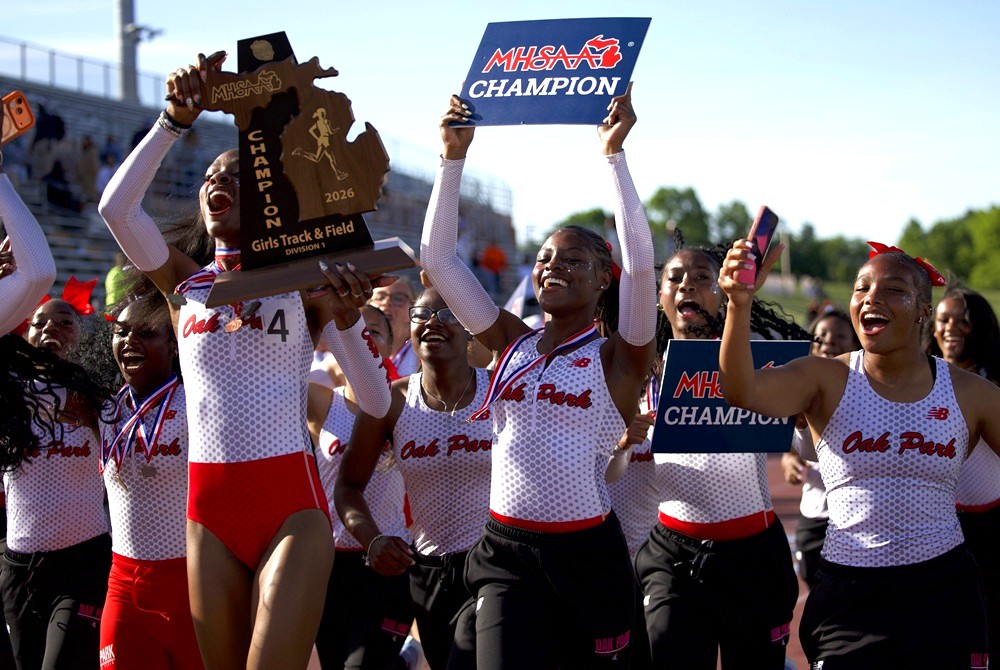
Several 1st-Time Winners Highlight 2025-26 MHSAA Parade of Champions
By
Geoff Kimmerly
MHSAA.com senior editor
June 18, 2026
Three schools celebrated their first Michigan High School Athletic Association Finals championships in any sport during the 2025-26 school year as 39 teams total won first Finals titles in their respective sports.
Holland Calvary, in boys cross country, Durand in boys bowling and Walled Lake Northern in softball won their schools’ first Finals championships in any sport, as 88 schools total won at least one of the 132 MHSAA team titles awarded over the three seasons.
A total of 23 schools won two or more championships this school year, paced again by Marquette with eight earned in girls and boys cross country, boys golf, girls skiing, girls and boys swimming & diving, boys tennis and boys track & field. Detroit Country Day was next with seven Finals championships, followed by Detroit Catholic Central with six and Ann Arbor Pioneer with four.
Bloomfield Hills Cranbrook Kingswood, Negaunee, Northville and Rockford all won three titles in 2025-26. Winning two were Birmingham Seaholm, Charlevoix, Farmington Hills Mercy, Flint Kearsley, Flint Powers Catholic, Grand Rapids West Catholic, Jackson Lumen Christi, Lake Linden-Hubbell, Lowell, Newberry, Orchard Lake St. Mary’s, Pewamo-Westphalia, Ravenna, Rudyard and West Iron County.
A total of 48 champions were repeat winners from 2025-26. A total of 31 teams won championships for at least the third-straight season, while 22 teams extended title streaks to at least four consecutive seasons. The Lowell wrestling program owns the longest title streak at 13 seasons, followed by Dundee wrestling’s nine consecutive titles and runs of seven straight Finals victories by the Detroit Catholic Central ice hockey team and Marquette’s boys cross country and boys swimming & diving programs.
This school year saw the addition of field hockey and boys volleyball to the MHSAA’s postseason tournament offerings. Eighteen of the MHSAA's 30 team championship tournaments are unified, involving teams from the Upper and Lower Peninsulas, while separate competition to determine title winners in both peninsulas is conducted in remaining sports.
For a sport-by-sport listing of MHSAA champions for 2025-26, click here (PDF).
The MHSAA is a private, not-for-profit corporation of voluntary membership by more than 1,500 public and private senior high schools and junior high/middle schools which exists to develop common rules for athletic eligibility and competition. No government funds or tax dollars support the MHSAA, which was the first such association nationally to not accept membership dues or tournament entry fees from schools. Member schools which enforce these rules are permitted to participate in MHSAA tournaments, which attract more than 1.4 million spectators each year.
PHOTO The Oak Park girls track & field team hoist their championship trophy and sign May 30 at Rockford High School. (Click for more from RunMichigan.com.)