


Coaches Get U-M Concussion Training
July 24, 2012
Already administering a strong set of protocols addressing the removal and return to play of young athletes suspected of sustaining concussions in competition, the Michigan High School Athletic Association is further ramping up its concussion education efforts of coaches, student-athletes and parents as the 2012-13 school year approaches.
In partnership with the University of Michigan’s NeuroSport and the Pediatric Trauma Program at C.S. Mott Children’s Hospital, required online rules meetings for coaches and officials will include an education component illustrating the serious nature of concussions; recognition of the signs and symptoms; a review of return to play protocols; applicable MHSAA regulations; and downloadable co-branded resources from NeuroSport, as well as materials produced by a joint effort of the Brian Injury Association of Michigan, the Detroit Lions, the Center for Disease Control and the MHSAA.
This is the second year the MHSAA has included concussion education in its online rules meetings, which are annually viewed by nearly 20,000 coaches and game officials. This year, the Michigan NeuroSport Concussion Education - High School Coach edition, endorsed by the American Academy of Neurology last fall, has been modified for the MHSAA audience. The MHSAA will also promote the availability of the NeuroSport concussion education modules offered specifically for parents and coaches.
“These educational efforts, coupled with protocols addressing concussions when they take place on the field of play, put our schools in the best possible position to minimize the risk to young people,” said John E. “Jack” Roberts, executive director of the MHSAA. “We’re pleased to have our new partnership with University of Michigan NeuroSport and our ongoing partnership with the Brian Injury Association of Michigan which put our state at the forefront of addressing the critical health issue for interscholastic athletes.”
Roberts added that the same educational materials the Association has co-branded with its partners will also be used to help raise concussion awareness in other youth sports by other sponsors in the state.
“We are proud to partner with MHSAA and bring the most up-to-date concussion education to those on the frontline of athletics. Education is a vital component to improving player safety,” says Amy Teddy, injury prevention program manager at C.S. Mott Children’s Hospital. “We believe that ‘It takes a team to keep concussions on the sidelines.’ Parents, coaches, teammates, officials and athletic trainers all have a role in protecting athletes from serious injury.
“In addition to our coach modules, we recently launched our parent edition to help another member of the ‘team’ better recognize and understand concussion.” added Teddy, who also is director of education for Michigan Neurosport.
The NeuroSport online programs for parents, high school coaches and youth sports coaches is now available at http://www.MichiganNeuroSport.com. An online program for athletes will be available soon.
NeuroSport has also produced a 60-second public service announcement in which one of the state’s all-time winningest football coaches – John Herrington of Farmington Hills Harrison – talks about concussions. This video, along with a 30-second PSA recently updated by the MHSAA, “No Such Thing As Just Getting Your Bell Rung,” will be made available to media outlets in time for the coming sports season, and will be shown during MHSAA programming online and on cable television.
Advisory Council Seeking Class Of '23
By
Geoff Kimmerly
MHSAA.com senior editor
April 6, 2021
The Michigan High School Athletic Association is seeking student-athletes to become members of its Student Advisory Council beginning with the 2021-22 school year.
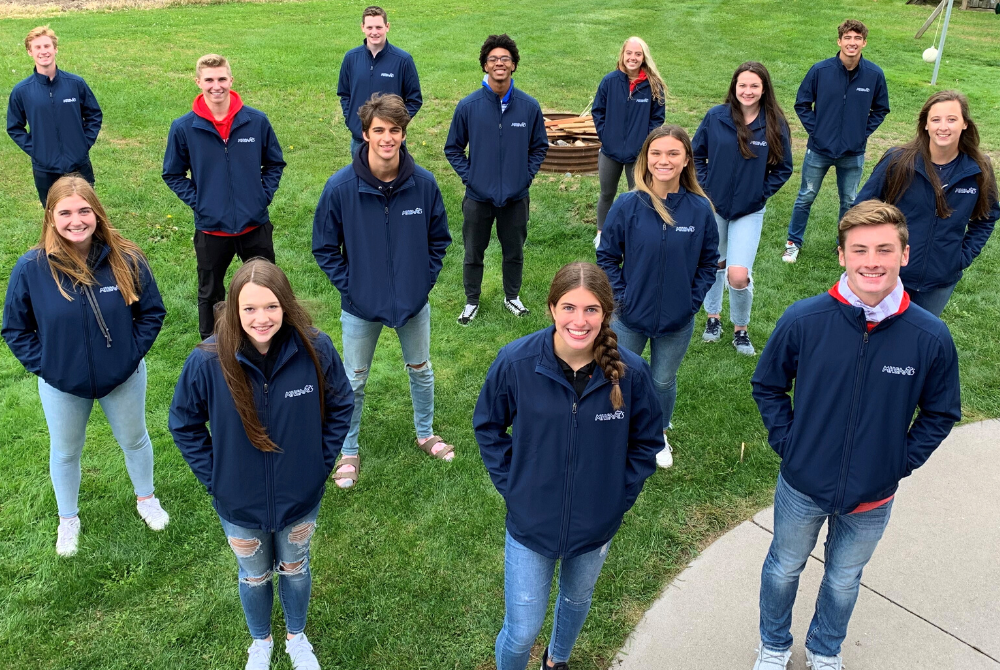
Four boys and four girls from the Class of 2023 will be selected to two-year terms, and will meet on matters related to maintaining and promoting a proper perspective and sensible scope for high school sports in Michigan. Eight members from the Class of 2022 already are serving on the Council, while eight members from the Class of 2021 are leaving the Council this spring.
To be eligible for the committee, candidates must be a member of the Class of 2023, complete the official application including answering the three short-answer questions, submit a letter of recommendation from a school administrator, have a cumulative GPA of at least 3.0 (on a 4.0 scale) and be available for all scheduled meetings.
In addition, candidates should show a history of leadership on athletic teams as well as with other extracurricular activities, community service projects, or in the workplace; and show an understanding of the role of school sports and have ideas for promoting a proper perspective for educational athletics.
Applications are due to the MHSAA by 4:30 p.m. on April 28. Applications can be downloaded from the Student Advisory Council page of the MHSAA Website and must be returned via e-mail.
The Student Advisory Council meets six times each school year, and once more for a 24-hour leadership camp. In addition to assisting in the promotion of the educational value of interscholastic athletics, the Council discusses issues dealing with the 4 S’s of educational athletics: scholarship, sportsmanship, safety (including health and nutrition) and the sensible scope of athletic programs. A fifth S – student leadership – is also a common topic. Members contribute in planning Sportsmanship Summits, Captains Clinics and other student leadership events, and assist with medal ceremonies at MHSAA championship events.
Newly-chosen members will join the following from the Class of 2022: Brinlee Barry, Caledonia; Faith Breinager, Frankenmuth; Amina Ferris, Dearborn; Nicolas Johnson, Britton Deerfield; Brenna Kosal, Peck; Ashton McNabb, Three Oaks River Valley; Brock Porter, Orchard Lake St. Mary's; and Melik Williams, Ypsilanti Lincoln.
The eight new members of the Student Advisory Council will be notified by May 7. The 2021-22 meetings are tentatively scheduled for Aug. 29, Oct. 3, Dec. 5, Feb. 13, April 24 and May 15. Meetings will take place at the MHSAA Office in East Lansing. Additional video meetings will also be scheduled throughout the year. For more information, contact Andy Frushour at the MHSAA – 517-332-5046 or [email protected].
PHOTO: The MHSAA Student Advisory Council stands together socially distanced during its first in-person meeting of the 2020-21 school year.