


Teaching ABC's of Pressure Situations
October 30, 2013
 By Eric Martin
MSU Institute for the Study of Youth Sports
Coaches have seen the signs: Athletes having too much or not enough energy prior to a game, quickening breathing, sweating more than usual, being unable to focus on important details, and having their minds wander from the present to “what if” scenarios and past mistakes.
Athletes deal with pressure in many ways. Although some handle it well, many do not have the tools to perform to their full abilities in these situations. Most athletes place a high importance on succeeding in sport, and when athletes reach regional, district, or state championships, the pressure they feel may become overwhelming.
How athletes handle this increased pressure can often mean the difference between winning and losing. Therefore, helping athletes deal with it is something coaches should consider prior to athletes encountering these high-stakes situations.
Unfortunately, there is no magic elixir for helping your athletes work under pressure. But if these ABC’s of pressure situations are followed, your athletes will be much better equipped to cope, and the chances of their performance levels dropping significantly will be reduced.
1. Act the Part
How you as coaches act influences your athletes. For better or worse, athletes notice your emotions in response to these situations and take cues from how you handle pressure.
You are a demand on your players’ attention – you can add or reduce your players’ perceived stress by how you act. Understanding the demand you place on players requires self-awareness. How do you respond when a key call goes against you? Do you have nervous habits that athletes may notice? What messages are you providing to your athletes – both verbally and non-verbally? Athletes pick up on these non-verbal cues, so you must be aware of how you respond to these situations.
It is important to remember emotions are not always negative – rather acting differently than normal can be a signal to your athletes that you are stressed. Strive to be consistent in your actions – whether you are coaching during a preseason match or championship contest. These situations are stressful for you too, but you need to be the constant your athletes look to for stability.
2. Breathing – Remember to do it
It seems like a simple thing, but when athletes’ emotions are running high, they forget how to breathe – or, at least, forget how to breathe properly. Worse, they often think they are breathing normally but don’t notice breaths are becoming shorter and shallower. Teaching athletes to breathe properly when not in pressure situations will help them have the tools to rely on when they encounter more intense scenarios.
For proper breathing, athletes need to do so from the belly and not the chest. The pace of this breathing should be 6-2-7; that is, have athletes take a deep breath from the abdomen for six seconds, hold for two seconds, and then finally slowly exhale completely for seven seconds. This breathing strategy is ideal for pregame situations to quiet nerves and help athletes get ready to play, but a condensed version (3-2-3) can also be used for quick breaks in the action like a timeout or court change.
3. Control the controllables
During times of high pressure, athletes sometimes feel they do not have control over their own performances. It is important to help athletes focus on things they can control and not worry about those that cannot be changed or are outside their influence.
Instead of athletes dwelling on aspects that are out of their control like unusual game times for championship finals or a referee’s bad call, help them focus on completing their warm-up preparations and how they can respond to poor calls. Helping focus athletes’ attention on things they can control will help them better handle pressure situations and leave them feeling less helpless
Athletes’ emotions are typically out of their control, but how they view them and respond to these emotions are under their control. Author and preacher Charles R. Swindoll said, “Life is 10 percent what happens to you and 90 percent how you react to it!” Be sure your athletes know how to respond when difficult situations arise.
Conclusion: Fearlessness is an assembly
Not all athletes react to pressure situations in the same manner, but all athletes can benefit from these simple suggestions. Remember to ACT THE PART of how you want your athletes to act, teach your athletes proper BREATHING techniques, and help athletes focus on CONTROLLING THE CONTROLLABLES.
Good preparation is the key to performance. Increase self-monitoring and give athletes the tools to succeed in pressure situations; they, in turn, can be in a better position to succeed. However, like any skills, they must be practiced accordingly, and one session will not solve all issues. Devote the time to train athletes in these skills, and when the need arises they will have them ready to use.
Good luck this season!
Martin is a third-year doctoral student in the Institute for the Study of Youth Sports at Michigan State University. His research interests include athlete motivation and development of passion in youth, sport specialization, and coaches’ perspectives on working with the millennial athlete. He has led many sessions of the MHSAA Captains Leadership Clinic and consulted with junior high, high school, and collegiate athletes. If you have questions or comments, contact him at [email protected].
Martin Brings LA Marathon Championship Experience Home as Jackson High Coach
By
Doug Donnelly
Special for MHSAA.com
April 23, 2026
Nathan Martin has the best possible example a coach can give when it comes to the old phrase, “It’s never over, until it’s over.”
 Last month, the Jackson cross country head coach and track assistant captured national attention when he miraculously came from behind to win the Los Angeles Marathon.
The winning margin was one hundredth (0.01) of a second.
“I didn’t really know if I won,” said Martin. “I tried not to get too emotional or celebrate too much. Then people around me started confirming it.”
Martin, 36, was running his race when, with about five miles to go, he had a surge and passed the pack he was with to get comfortably into second place.
“There was only one guy to catch at that point; he was so far ahead,” Martin said. “I couldn’t even see him. At that point, it was like, ‘Okay, let’s push, let’s finish, be strong, and all that kind of stuff.”
Slowly, the leader came into focus.
“Within the last mile, I’d say, he came into view,” Martin said. “By 800 meters to go I thought I had a serious shot to try and win.
“I made one final surge. That last 800 was super painful. I was thinking to myself maybe I’ll catch him, maybe I won’t, but I definitely wanted to make sure I crossed that finish line with no regrets, knowing I left everything out there.”
As he and the leader, Michael Kimani Kamau of Kenya, approached the finish, the crowed braced for the finish.
“It was the last 50 to 80 meters where the true opportunity to win presented itself and I took full advantage of it,” Martin said. “When I crossed the line, it was so close. I was trying to hold back the excitement and emotions and all of that kind of stuff. People started confirming it, and it was surreal. I just started absorbing the moment and everything going on.”
He credits his own coach, James McCurdy, with preparing him with everything from the right nutrition to handling the Los Angeles heat to the running strategy.”
“It was painful, but I still had something left in the tank,” he said. “If the race would have been a couple miles longer, I would have been okay (to finish).”
Martin finished with a personal best time of 2 hours, 11 minutes, 16.5 seconds. It was the closest finish in LA Marathon history.
 “It was pretty special,” Martin said.
Martin was born in Chicago Heights, Ill., and moved with his family to Three Rivers before he started school. He began running in middle school and competed throughout high school. He ran the mile in high school and the 5K in college.
“I had a lot of success in my running journey,” he said. “Eventually, my coach thought I had what it takes to run a marathon.”
It wanted until late in his college career at Spring Arbor University that Martin ran his first marathon. He was 23.
“I won the 10K, then 36 hours later I won the marathon,” he said. “My coach was like, ‘Okay, you need to do this.’”
Martin is now a professional runner and has sponsors. He was at the Boston Marathon on Monday making appearances and connecting with people in the running community.
After college he began substitute teaching while trying to advance his running career. That’s when he launched his coaching career.
“There was a year where I was substitute teaching and going to races to try and place well,” he said. “By year two or three, I was coaching and I’ve continued that on.”
Martin said coaching is rewarding, “Especially seeing a kid overcome some kind of challenge.
“It’s being able to use my experiences to give back,” he added. “I want to help kids along their running journey. Even if they don’t become a big-time runner, I hope the types of lessons they learn, they can apply in life.
“Just see them be able to fight through something makes me feel like I am making a positive impact in the world.”
Martin has run fewer than 20 marathons in his life. “If you are training at an insanely high level, you usually look at doing one, maybe two or three a year,” he said.
He has taken some time away from marathon training recently as he’s made several national appearances.
And an assistant at Jackson this year, he said he’s noticed a buzz around the distance runners.
“There’s way more interest in distance running,” he said. “Normally they give me my two minutes of fame, then they are back to being high school students. This has been different. They’ve made me feel like definitely I’ve done something.”
He will begin ramping up his training and plans on competing in a half marathon soon, then has set his sights on either the New York or Chicago Marathon.
“It’s been pretty cool,” he said of the running community in Jackson. “They’ve been showing me a lot of love, and they are super proud. If I did Chicago, I imagine I would get a chunk of people down to watch. I’ve had so many people supporting me. It’s a really good feeling.”
 Doug Donnelly has served as a news and sports reporter at the Adrian Daily Telegram and the Monroe News for 30 years, including 10 years as city editor in Monroe. He's written a book on high school basketball in Monroe County and compiles record books for various schools in southeast Michigan. He is now publisher and editor of The Blissfield Advance, a weekly newspaper. E-mail him at [email protected] with story ideas for Jackson, Washtenaw, Hillsdale, Lenawee and Monroe counties.
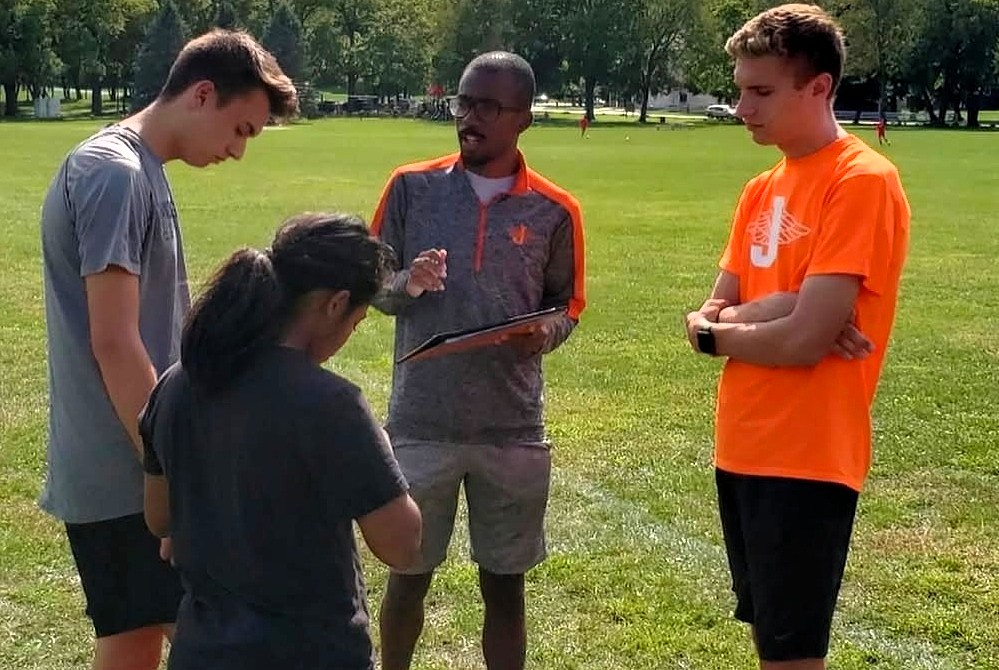
PHOTOS (Top) Nathan Martin, middle with clipboard, coaches his Jackson distance runners. (Middle) Martin poses for a photo with a community award he received from the school. (Photos courtesy of Nathan Martin.)