

Eventually, the sun will shine ...
April 25, 2013
By Geoff Kimmerly
Second Half editor
 We all believe that, right?
Rain – and snow for some – has been the buzzword of this spring sports season. Just about every newspaper is writing about it and every athletic director, coach, player and parent is dreading it on a now-daily basis.
But eventually, we expect the weather to clear up and teams to play catch-up. To that end, there are limitations teams in some sports face when attempting to make up their games – but also opportunities to take advantage of while trying to fill out their regular-season schedules.
- Girls soccer and girls and boys lacrosse teams may play only three games during a week, Monday through Sunday. A weekend tournament – which generally includes 2 to 3 shortened games – counts as only one in this equation.
- Baseball and softball teams can play as many games as they want in a week, but no more than two on a school day – and baseball pitchers must not pitch for two days following their 30th out in a week.
- For tennis, an individual may not play more than three matches in one day – unless she or he is playing in a league championship tournament featuring more than eight schools for which a fourth match would decide the championship. That player also could not have played more than six sets that day heading into that fourth and final match.
- Golf and Track and Field do not have weekly contest limitations. Track and field athletes can compete in only four events per day.
As expected, a number of teams – especially for baseball and softball – are scheduling to smash in as many contests as possible into the next four weeks. Postseason play for tennis and lacrosse begins May 16 – three weeks from today.
But teams do have options.
One rarely used but anticipated to be used more this spring is an opportunity to continue playing regular-season contests through the final day of the MHSAA tournament in that sport. For example, a baseball team can continue making up games through June 15, the day of the MHSAA Finals in Battle Creek. A tennis team can play regular-season matches through June 1, etc.
Also, the MHSAA Executive Committee approved Thursday to allow for this spring two additional multi-team tournament dates for soccer and lacrosse, which will give those teams an opportunity to get in a few more games. That means soccer teams will be allowed to play in four multi-team tournaments instead of two, boys lacrosse four instead of two and girls lacrosse five instead of three.
Teams will have to do some juggling, no doubt, and all other tournament stipulations still apply (games generally are shortened so more can be played, etc.). But with a little creativity, teams could at least get in a few of their make-up games in this way.
Also, the Executive Committee approved a motion to waive the four-contest MHSAA tournament entry requirement for all Upper Peninsula schools in all sports this spring. As of the weekend, snow still covered parts of the U.P.
Gaps shrinking
Much has been discussed about minimums for all four MHSAA classes for 2013-14, and how they are the lowest student totals in at least a decade.
It’s true. The floor in Class A is 893 (down from 911 this school year), Class B starts at 429 (down from 449), Class C at 207 (down from 217) and Class D at 206 (down from 216).
However, there is a better way to crunch the numbers: Consider the shrinking gaps between the largest and smallest schools in each class.
For 2013-14, the gap in Class A is 1,888 students – 261 students fewer than 2007-08 and nearly 900 students fewer than in 2005-06. The gaps between largest and smallest in Classes B, C and D also are trending smaller – which means each class actually includes schools more similar in size, instead of a perceived other way around.
SAC 2013-14 on the way
We’re thankful for a valuable group of students who help us throughout the school year – our 16-member Student Advisory Council, made up of eight seniors and eight juniors from all over the state who are charged with providing feedback on issues impacting educational athletics from a student’s perspective, while also assisting at MHSAA championships and with special projects like the “Battle of the Fans.”
Selecting the next class to join is a highlight of every spring – but hardly an easy process.
A six-member selection committee, myself included, considered 62 sophomore applicants today from all over the Lower and Upper Peninsulas, representing all four of our classes and nearly every sport we sponsor.
Every candidate is impressive for a variety of reasons. That’s what makes this difficult – we could pick any number of combinations to make up our new SAC class, and no doubt leaders galore will emerge from another impressive group.
But there are only eight spots on the council. And we’ll announce who received them later next week.
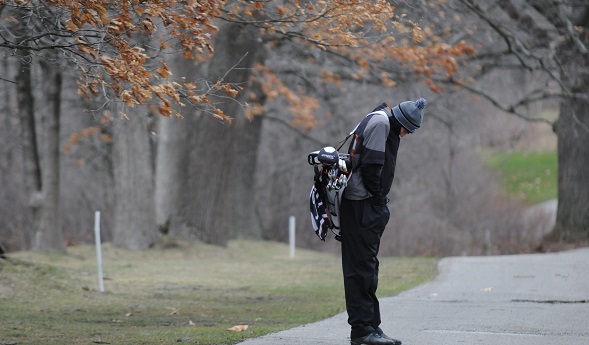
PHOTO: A golfer attempts to keep warm during a round on a dreary day earlier this season. (Click to see more at HighSchoolSportsScene.com.)
Grand Rapids Catholic Central's Gant Adds Name to 4-Time Champions List
By
Drew Ellis
Special for MHSAA.com
March 8, 2026
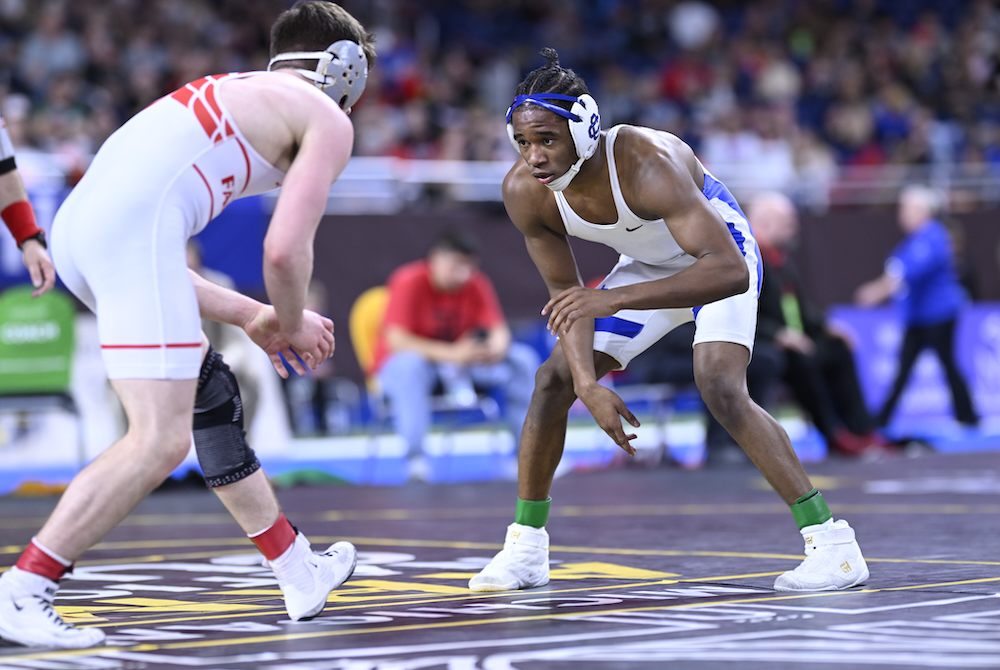
Grand Rapids Catholic Central senior Dale Gant became the latest member of the exclusive Individual Wrestling Finals four-time champion club Saturday.
Gant took home the 138-pound title in Division 3 at Ford Field with a 10-4 win over Constantine senior Bear Geibe.
Following the victory, Gant displayed a picturesque backflip in celebration.
“I can tell you that I’ve felt every emotion leading up to this point,” Gant said of the pressure of going for a fourth-straight title. “I was happy, sad, scared, nervous, angry – I was everything. Just to be able to get that over, it is like a weight I just lifted off my shoulders, and it’s just a great, great feeling.”
Gant (40-1) won titles at 113 pounds, 120 pounds, and 126 pounds before completing his run Saturday at 138. In the final he scored a takedown in the second period to get a 3-1 lead, then added two more in the third to hold off his opponent.
“I was just sticking to myself and remembering all the training that I’ve done and knowing that I’ve worked for this,” Gant said. “It was just about staying composed and just wrestling.”
106
Champion: Dylan Phillips, Laingsburg, Fr. (52-1)
Decision, 9-2, over Dom Sindone, Dundee, Fr. (34-9)
The Laingsburg freshman was in control throughout his 106-pound final, using a six-point second period to keep Sindone at bay and win his first championship.
“I’ve put in a lot of work for this and have trained hard every day with a lot of great partners,” Phillips said.
The freshman suffered just one loss on the year and finished with 52 wins to establish himself as a strong threat in the future.
“I just stayed focused and didn’t put any of my opponents on a pedestal,” Phillips said. “I was confident that I was the better wrestler and relied on my training.”
113
Champion: Braxton Shaffer, Ida, Soph. (53-4)
Fall (4:00), over Jude Rosas, Blissfield, Sr. (42-13)
Shaffer made the most of his opportunity, as a reversal in the second period led to him scoring a pinfall right as the frame concluded.
The two were tied 0-0 after one period and neither was gaining an advantage until Shaffer turned up the effort when he saw an opening, securing his first Finals title.
“I saw there were only 10 seconds left and I was getting my (chicken) wing early in the match, and I didn’t want it to get to a third period,” Shaffer said. “I wasn’t even sure the mat slap was for me when it happened. I looked around to make sure it wasn’t another mat. I was just really excited when I realized it was for me.”
120
Champion: Mason Haines, Dundee, Sr. (40-7)
Decision, 1-0, over Danny Vaneeckhoutte, Erie Mason, Jr. (42-9)
In a battle of 2025 champions, Haines repeated at this weight with a hard-fought win over the 2025 106-pound champion.
Haines would be the first of eight champions on the night for Dundee, matching an MHSAA record the program also set in 2021 and 2025.
“I knew it was going to be a tough match and I just knew I had to play it smart and not be too aggressive and put myself in a bad position,” Haines said. “It was about winning and making sure I did what I had to do.”
Haines got the lone point in the third period on an escape after he rode Vaneeckhoutte for the entire second period.
126
Champion: Bryan Sterling, Dundee, Sr. (40-6)
Technical Fall (2:30), 18-3, over Mackey McClelland, Yale, Soph. (55-7)
Sterling closed out his Dundee career with his first individual title, doing so in convincing fashion.
He scored five takedowns in the match to earn a technical fall early in the second period.
“I knew with this being my last year, I wanted to get it done, and that has been my mindset all season and all weekend,” Sterling said. “Last year I let myself get lazy and I knew that I could win (a state title), so I stayed focused and didn’t let myself slip up.”
132
Champion: Mason Katschor, Dundee, Jr. (42-7)
Decision, 4-2, over Logan Rhodes, Yale, Jr. (50-8)
Katschor earned his third championship, this time doing it at 132 pounds after winning at 113 pounds in 2025 and 106 in 2024.
The match was tied 1-1 in the third period before Katschor scored the lone takedown and then kept Rhodes from matching him the rest of the way.
“The first two titles were great, so every time I get another one, it feels even better,” Katschor said. “I knew this one was going to be a grind and I needed to do a better job of moving my feet, but it’s a tough environment to compete in.”
144
Champion: Braden Broderick, Dundee, Sr. (45-7)
Decision, 1-0, over Ryan Woods, Belding, Sr. (57-2)
Broderick won his second consecutive title Saturday after winning at 132 pounds a year ago.
He scored the lone point with an escape in the second period, then rode Woods for the entire third to hang on for the win.
“We do a lot of extra work at the end of practice so you can dig deep in those close moments,” Broderick said. “I told myself it was going to take a little something extra in that third and I dug deep, and it paid off. It feels great to be able to go out with another state title.”
150
Champion: Stone Redmon, Dundee, Soph. (23-4)
Decision, 18-6, over Van Wirtz, Olivet, Jr. (48-5)
After dealing with a hip injury during parts of the season, Redmon overcame adversity to earn his first Finals title after finishing runner-up at 144 pounds in 2025.
“It’s a true blessing, and I’m grateful to be in this position,” Redmon said. “I worked hard to come back strong after the hip injury, and it feels great to be able to keep adding to the success of the Dundee program.”
Redmon had four takedowns in the first period and controlled his match throughout.
157
Champion: Blake Cosby, Dundee, Sr. (44-2)
Technical Fall (5:46), 21-5, over Grason Weber, Leslie, Sr. (57-7)
Cosby closed his prep career with a third individual championship after winning at 144 pounds in 2024 and 150 pounds in 2025.
He had three takedowns in the first period to set the pace of the match and continued to add to his lead throughout until scoring the tech fall late.
“I’ve been here and I’ve done this, so I didn’t have many nerves for this one,” Cosby said. “I just went out and wrestled. It means a lot to be able to go out on a high note.”
165
Champion: Donny Beaufait, Dundee, Sr. (38-1)
Technical Fall (2:34), 16-1, over Carson Warner, Napoleon, Jr. (42-4)
Beaufait secured his second-consecutive title, repeating as the 165-pound champion.
He was relentless from the start, scoring 10 points in the first period and quickly wrapping up the match in the second.
“I knew what it takes to get to this point, and it was just about putting in the work all season,” Beaufait said. “There’s a standard that is set at Dundee, and it’s been fun to be part of that and have the success we’ve had.”
175
Champion: Fred Hammond, Otisville-LakeVille Memorial, Sr. (55-0)
Decision, 2-1 (2 OT), over Max Sundquist, Kingsford, Jr. (25-2)
After winning the 165-pound title in Division 4 last year, Hammond moved to Division 3 and still came home with a championship thanks to an escape during the second overtime.
“I wasn’t worried about moving up a division, I was focused on getting in the gym and getting better each day,” Hammond said. “I knew if I put in the work, things would work out like they did.”
The two were tied 1-1 after three periods with each earning an escape. The first overtime didn’t result in any points and then Hammond got the escape in the first of the two 30-second sessions of the second overtime. Hammond closed out the match by riding Sundquist for the final 30-second period.
“(Sundquist) is a great wrestler and very strong, so I was trying to keep the pace going in those gut-wrenching overtime periods,” Hammond said. “I just wanted to use my endurance.”
190
Champion: Layne Knisley, Bronson, Sr. (55-3)
Decision, 11-5, over Alex Schram, Saginaw Swan Valley, Sr. (51-3)
Knisley used a 7-0 start in the first period to ride his way to a championship.
“My mindset was to go out and do what I do best and get the job done,” Knisley said. “I was really excited early and made a few mistakes, but once I settled in, I felt confident in myself and it feels awesome to be a state champion.”
Schram managed to cut the lead to 7-5 entering the third period, but Knisley got near-fall points in the third to put some cushion on his lead.
215
Champion: Rocco Redmon, Dundee, Sr. (35-11)
Decision, 2-1, over Brady Warner, Napoleon, Sr. (37-5)
Redmon closed out the eight-championship night for Dundee by earning his first title after finishing runner-up at 190 pounds in 2025.
Redmon got a reversal in the second period while on bottom to take a 2-0 lead on Warner. The Napolean senior would get an escape in the third, but couldn’t answer with a takedown.
“(Warner) is a bigger guy, so I knew I had to move my feet and be quick,” Redmon said. “I knew this one would be a grinder, but we put in the work at Dundee, so we get what we deserve.”
285
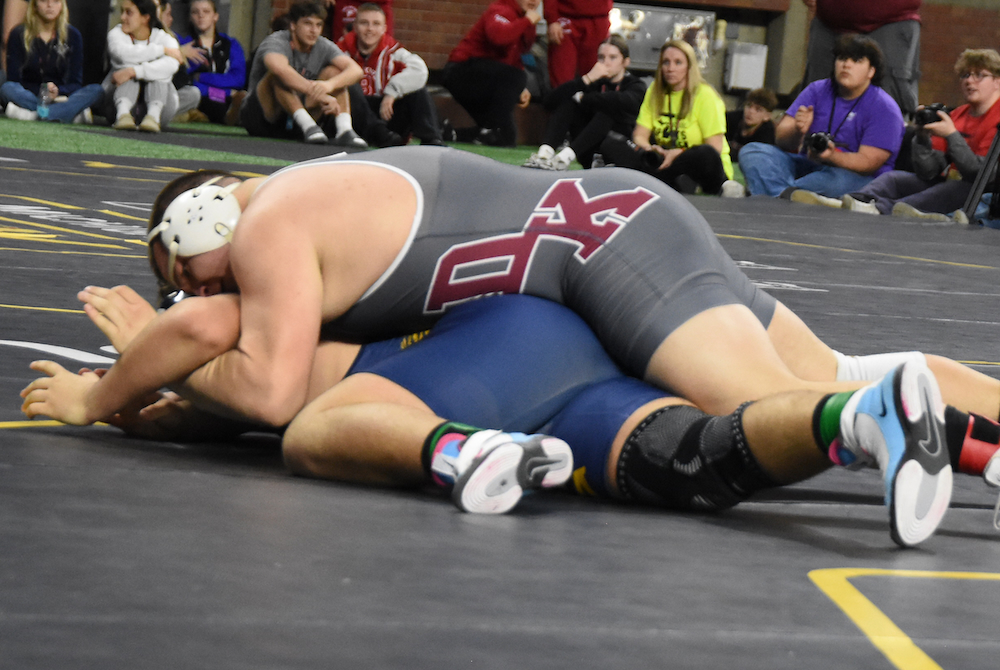
Champion: Mitchell Swift, Delton Kellogg, Sr. (53-3)
Decision, 5-4, over Dylan Boone, Brooklyn Columbia Central, Sr. (46-6)
After finishing fourth at last week’s Regional, with a 9-8 loss to Boone, Swift rebounded this week with his first Finals championship thanks to a 1-point win in his favor this time around.
“I was just wrestling bad last week and didn’t feel good on the mat last week. This week, I got the nerves out and just stuck with what my coaches have told me,” Swift said of the turnaround. “I just came out with the mindset that I had to win, and it feels amazing to be a state champion.”
Swift got a takedown in the first period to lead 3-0, then added an escape in the second to go up 4-0. Boone got an escape and takedown in the third, but Swift answered with an escape late to earn the narrow victory.
PHOTOS (Top) Grand Rapids Catholic Central's Dale Gant, right, prepares for his next move against Constantine's Bear Geibe during their Division 3 championship match Saturday at Ford Field. (Middle) Delton Kellogg’s Mitchell Swift, top, works toward his first championship against Columbia Central’s Dylan Boone. (Click for more from High School Sports Scene.)