

Macomb Lutheran North Standout on Mend After Knee Injury
October 3, 2023
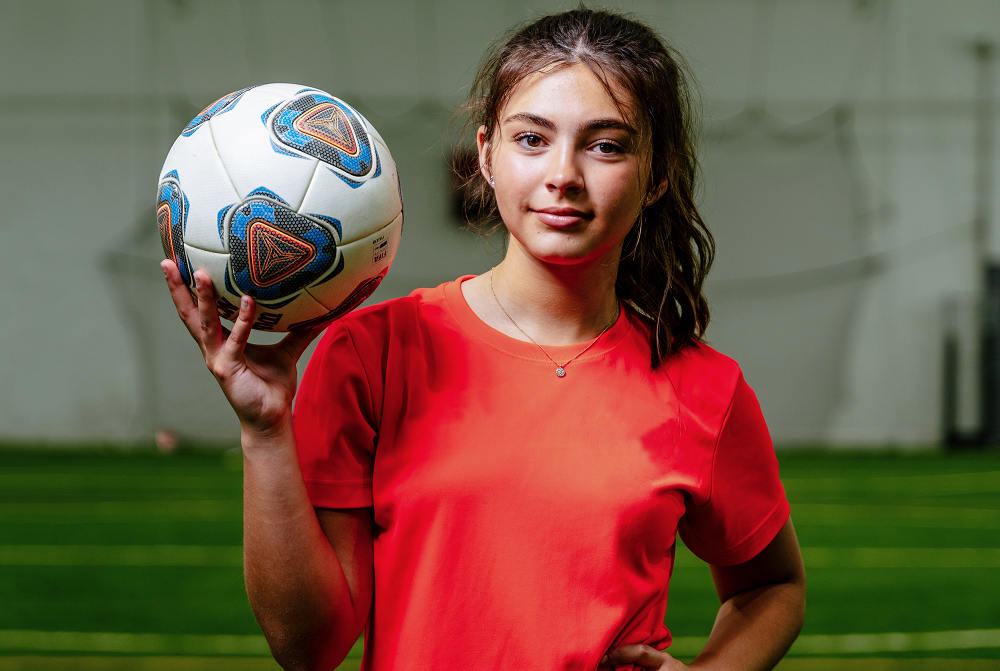
Macomb Lutheran North freshman Emiliana Manzo has already achieved a long list of accomplishments, including a 3.8 grade-point average while juggling two sports she loves.
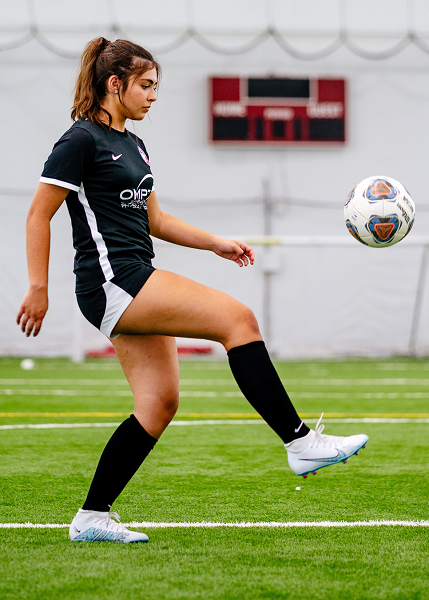
 As a point guard, she led her basketball team to an undefeated season in its division. She is also a center attacking midfielder, sometimes playing forward, on the 2009 Nationals Girls Academy Blue soccer team, ranked No. 1 in Michigan and 14th in the country.
In June of 2022, Emiliana hit a detour on her sports journey when she was participating in a club soccer national championship in Oceanside, Calif. With a few seconds left in the game and her team up 2-1, she ran 20 yards full speed to get to the ball. Hyperextending her left knee, she felt two pops. It was the first time she experienced an injury.
“I was screaming and crying and got taken off the field on a golf cart,” explains Emiliana. The trainer felt she was OK. Fortunately, she had the next day off and her knee was feeling better. The following day she played again, and 20 minutes into the game she knew there was an issue.
“Someone hit me from behind and I heard the pop again. I knew there was a problem.”
Emiliana’s father Vince Manzo said she experienced swelling, and the athletic trainer thought she may have a meniscus injury; however, she was able to continue to walk around during the championship in California before heading home.
Finding the Right Provider
Back in Michigan, Emiliana saw a few surgeons during her evaluation to seek treatment. When she met with Vasilios Bill Moutzouros, MD, chief of Sports Medicine at Henry Ford Health, she felt she met the right match.
“He treated me like an athlete and made me feel really comfortable,” she says.
 Vince adds that both he and Emiliana were also appreciative of something Dr. Moutzouros said during her evaluation: “He emphasized to Emiliana that she was an athlete before this injury, and she would be an athlete after the injury.”
A detailed evaluation by Dr. Moutzouros revealed Emiliana had a complete anterior cruciate ligament (ACL) tear and medial and lateral meniscal tears. The meniscus, a C-shaped piece of tough, rubbery cartilage, acts as a shock absorber between the shinbone and the thighbone. It is one of the most common knee injuries. The ACL, one of the strong bands of tissue that help connect the thigh bone (femur) to the shinbone (tibia), is also prone to injury during sports when there are sudden stops or changes in direction.
Emiliana required physical therapy to get the swelling down and increase mobility before surgical repair.
Dr. Moutzouros reconstructed her ACL with her own patellar tendon graft and repaired her medial meniscus.
“She handled the surgery well and has been working very hard in her rehabilitation,” he says. “Her high-level soccer experience likely helped in her recovery as her range of motion and strengthening advanced so quickly.”
Understandably, Emiliana was nervous and scared when she went into surgery but expressed appreciation for the little things from Henry Ford like hearing “great music” as she was entering surgery, which gave her a sense of calm.
“That’s when I knew I picked the right doctor,” she said.
The Road to Recovery
As part of her recovery, after surgery which took place in July of 2022, Emiliana has undergone six months of physical therapy to increase mobility and strength training to get her leg strong again.
She also participated in the Return to Sport Program at the Henry Ford Center for Athletic Medicine to optimize recovery.
“We loved it,” says Vince. “It gave us peace of mind.”
Dr. Moutzouros explains that ACL prevention and rehabilitation programs are critical, especially for women because they have a four times greater risk of ACL tear than men. He says performance training post-surgery, along with an injury prevention program for those playing cutting sports, can markedly reduce the likelihood of future ACL injury.
“At Henry Ford, we work with physical therapists across the Midwest as well as our own. They do a great job in following our Henry Ford specific post-ACL reconstruction protocol,” he says. “After therapy runs its course, we strongly encourage our athletes to undergo performance training to allow a smooth transition back to sport.”
Nick Parkinson, supervisor of Athletic Training and Sports Performance at Henry Ford Health, emphasizes that the return to sport program is designed to bridge the gap between rehabilitation and returning to full activity in your chosen sport.
“Many times, insurance limits rehabilitation to regaining activities of daily living and not necessarily rebuilding the skills needed to play a sport or return to activity,” Nick says. “This program provides an affordable option to fill this need and return athletes to competition at the highest level.”
As for Emiliana, who hopes to play soccer in college and pursue a career in the medical field, she says this experience has taught her to not be afraid of injuries and treatment. She has also used the experience to volunteer for a program through the Girls Academy which serves as an advisory board to come up with ideas to help with mental and physical issues girls her age may be facing.
“For other kids who experience injuries, I’ve learned that this does not define you,” she said. “You can push through it, recover from it and be way better than you even were before.”
To find a sports medicine doctor or athletic trainer at Henry Ford, visit henryford.com/athletes.
MHSAA Provides Heat & Hydration Reminders with 2026 Fall Practices Soon to Begin
By
Geoff Kimmerly
MHSAA.com senior editor
August 3, 2026
Multiple regions across Michigan approached record-high temperatures this summer, just another reminder of the importance of adhering to hot-weather precautions as schools and families prepare for the start of fall sports practices and competitions this month at Michigan High School Athletic Association member schools.
Each year, the MHSAA provides information to its member schools to help them prepare for hot-weather practice and game conditions during the late summer and early fall. Practices for all Fall 2026 sports – cross country, field hockey, football, Lower Peninsula girls golf, boys soccer, Lower Peninsula girls swimming & diving, Lower Peninsula boys and Upper Peninsula girls tennis, and girls volleyball – may begin Monday, Aug. 10.
The “Health & Safety” page of MHSAA.com has links to several information sources, including the MHSAA preseason publication Heat Ways, which is available for download and includes valuable information on heat management in addition to requirements and resources regarding head injuries, sudden cardiac arrest and emergency action plans.
Heat Ways also again includes a statement on air quality and its potential effects on activity, given conditions across the state especially over the last month resulting from wildfires and smoke they have created.
The first days of formal practices in hot weather should be more for heat acclimatization and instruction than the conditioning of athletes, and practices in such conditions need planning to become longer and more strenuous over a gradual progression of time. Schools also must consider moving practices to different locations or different times of day, or changing practice plans to include different activities depending on the conditions. Furthermore, football practice rules allow for only helmets to be worn during the first two days, only shoulder pads to be added on the third and fourth days, and full pads to not be worn until the fifth day of team practice.
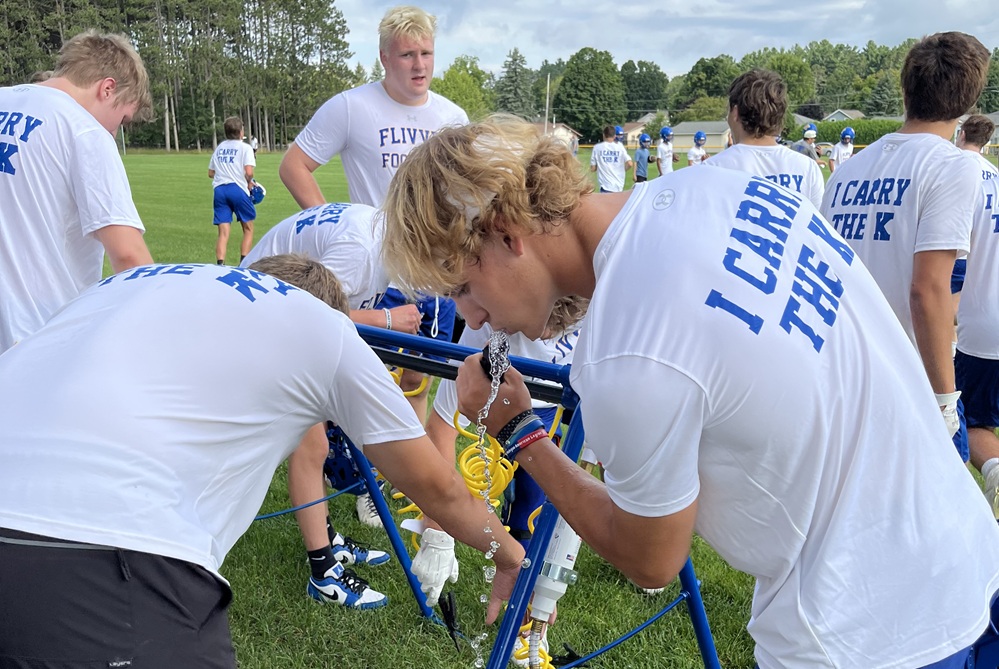
The MHSAA advises student-athletes to make sure to hydrate all day long – beginning before practice, continuing during and also after practice is done. Water and properly-formulated sports drinks are the best choices for hydration. The National Federation of State High School Associations (NFHS) advises that a 6-to-8 percent carbohydrate formulation is the maximum that should be utilized in a sports drink, while fruit juices with greater than 8-percent carbohydrate content and carbonated soda can both result in a bloated feeling and abdominal cramping.
A number of member schools follow the MHSAA’s Model Policy for Managing Heat & Humidity, which while not mandated for member schools was adopted as a rule for MHSAA postseason competition in 2013. The plan directs schools to begin monitoring the heat index at the activity site once the air temperature reaches 80 degrees and provides recommendations when the heat index reaches certain points, including ceasing activities when it rises above 104 degrees. (When the temperature is below 80 degrees, there is no combination of heat and humidity that will result in a need to curtail activity.)
The model heat & humidity policy is outlined in a number of places on the MHSAA Website, including as part of Heat Ways and the football-focused Safety Blitz preseason guide.
PHOTO Kingsford football players hydrate during last season's first day of practice. (Photo by Keith Dunlap.)