


Keep on Coaching
February 1, 2013
By Geoff Kimmerly
Second Half editor
A few weeks ago, I finally got my first chance this season to watch a friend coach his basketball team. After guiding some others at the lower levels, this is his first time running the varsity – something he wasn't sure he wanted to do with a 1-year-old just learning to walk, but a challenge he ended up taking on to the benefit of all those involved.
Simply put, he’s good. I've seen a lot of teams and a lot of coaches over the past 15 years, and although I wouldn't know much of what to do if I were walking the sideline, I felt pretty qualified in telling him I was impressed – even if he didn't buy that I was offering an unbiased opinion. The best news is he’s gone from not sure about this a few months ago to talking about next season.
We know, at least anecdotally, that coaching continues to get more challenging. The time commitment has grown substantially to make running a program a year-round endeavor in a lot of sports at a lot of schools.
That commitment – especially for coaches with children of their own – was a main reason referred to in a New Haven Post-Chronicle story Saturday that noted 23 football coaching openings in Connecticut at one point this offseason. That state has 146 football teams – meaning roughly 15 percent will have new leaders this fall.
And that got me thinking about my friend, about how glad I am he’s given this a shot, and how I've seen so many others either not do so, or not stick around long despite having some pretty nice success.
A study published last winter in Interscholastic Athletic Administration magazine – a product of the National Interscholastic Athletic Administrators Association – noted some predictable results of a study that sought to determine the biggest challenges faced by first-year high school coaches.
The toughest according to the study was balancing the demands of coaching and teaching, experienced by nearly half the respondents – 98 percent of which coached high school teams and 81 percent of which are teachers.
The next six reasons all were noted by at least 30 percent of those in the study – personal fatigue, securing community support, securing and caring for facilities and equipment, parental contact, keeping non-starting players motivated, dealing with schedule interruptions and motivating athletes to achieve consistent, peak performance.
Nothing there is earth-shaking, and most if not all of these challenges are faced by high school coaches regardless of how long they've been in the field. But I got a little more perspective from some of the 32 items that ranked as least challenging to the first-year leaders – keeping in compliance with state and league regulations, dealing with substance abuse issues, teaching sport skills and creating a positive team atmosphere – things that seem most important, and yet appear to be easiest to do. I’m not sure what that tells us – but I think it tells us something.
Click to check out the entire three-page breakdown of the study, plus the researchers’ recommendations to remedy some of what first-year coaches face.
Giving back to Saginaw
I love reading about high-level athletes – like a star-studded group of alums from Saginaw – giving back to where they got their starts.
Pittsburgh Steelers star LaMarr Woodley made a big impact before the start of this school year by donating $60,000 to cover all participation fees for athletes in his former school district. The Saginaw News’ Hugh Bernreuter writes today about how Woodley (Saginaw High), the Philadelphia 76ers’ Jason Richardson (Saginaw Arthur Hill) and former Oakland Raiders standout Stu Schweigert (Saginaw Heritage) have combined to give more than $865,000 back to their home communities.
Bernreuter also mentions the non-monetary contributions of the Golden State Warriors’ Draymond Green (Saginaw High) and former Indianapolis Colts receiver Blair White (Saginaw Nouvel).
Click to read more about it.
Quote(s) of the Week
While rifling through more papers on my desk, I found an article from the Washington Post from Sept. 2011 titled “How high school sports save our schools.” I was drawn to it in part because I spent more than a decade in a newsroom, and it was a piece by a reporter covering education who instead of reporting on school boards and the like, delved into the importance of interscholastic athletics to education as a whole.
He spoke of how participation continues to grow even as resources dwindle, and of data supporting that extracurriculars like sports are more effective than academic classes in teaching leadership, teamwork, time management and “other skills crucial for success in the workplace.” Later, he mentioned a study noting that those who participate in extracurriculars earned more a decade later.
Click here to read the entre piece. These passages struck me most.
“Coaches might be the only faculty members still allowed by our culture and educational practice to get tough with students not making the proper effort. They have the advantage of teaching what are essentially elective non-credit courses. They can insist on standards of behavior that classroom teachers often cannot enforce because the stakes of dismissing or letting students drop their courses are too high. …
“Students do better in activities they choose. If we provide more of them, led by committed adults … that can make a difference. We know the bad news about education. Dropout rates are high. Achievement scores are stagnant. But sports participation is going up, despite pressure to cut it back. Let’s cheer about that and look for a way to draw in more students.”
1st & Goal: 2026 Week 1 Preview
By
Geoff Kimmerly
MHSAA.com senior editor
August 27, 2026
If recent numbers hold true this season, 33,000 Michigan high school football players are waking up this this week at the dawn of another season.
 The most-played high school sport across the state kicks off again over these next few days, with 184 games tonight, 112 on Friday and six Saturday.
There will be showcases to enjoy, including the Amazon Prep Kickoff Classic at Wayne State, the Battle at the Big House at Michigan, and the Vehicle City Gridiron Classic at Flint’s Atwood Stadium. There are also two rematches of 2025 MHSAA Finals, and we highlight those below among our glances at top games from every region.
The great majority of varsity games are scheduled to be broadcast this weekend on the NFHS Network. Follow the MHSAA Scores page all weekend – and all season – for scores as they’re submitted.
Bay & Thumb
Goodrich (12-1) vs. Frankenmuth (10-2) at Michigan Stadium – Thursday
These two will meet at Michigan Stadium for the second time in four years as this opener continues to set a nice tone for two of the state’s most annually successful programs – the Eagles have reached double-digit wins six straight seasons, and Goodrich has done the same all of the last four. Frankenmuth has a 3-2 edge in this recent series, but Goodrich won last year’s matchup 17-14.
Keep an eye on these THURSDAY Harbor Beach (14-0) at Cass City (6-4), Belleville (7-3) at Grand Blanc (10-1), Detroit Country Day (4-5) at Saginaw Swan Valley (10-2). FRIDAY Saginaw Heritage (4-5) vs. Mount Pleasant (13-1) at Michigan Stadium.
Greater Detroit
Hudsonville Unity Christian (12-2) at Dearborn Divine Child (13-1) – Friday
This is a rematch of last season’s Division 4 Final, won by Divine Child 23-22 as the teams traded touchdowns and leads during the fourth quarter and the Falcons stopped a Unity two-point conversion try with 6:44 to play and then ran out most of the rest of the clock. That final quarter no doubt has stuck with both programs through the offseason, and this might be the most intriguing game statewide this weekend.
Keep an eye on these THURSDAY Saginaw Nouvel Catholic Central (8-3) at Allen Park Cabrini (11-2), Muskegon Mona Shores (5-5) at Orchard Lake St. Mary’s (11-2). FRIDAY Macomb Dakota (7-4) at Bloomfield Hills Brother Rice (6-5), Jackson Lumen Christi (11-3) at Detroit Edison (9-3).
Mid-Michigan
DeWitt (14-0) vs. Grand Rapids Kenowa Hills (8-2) at Wayne State – Thursday
The reigning Division 3 Panthers are looking to extend a run that has seen them lose only once over the last two seasons, and after both of those teams ranked among the highest scoring in MHSAA history. DeWitt’s backfield will have some changes as it enters this Amazon Prep Kickoff Classic matchup, but expectations will be high again. Kenowa Hills is coming off a league title and will turn to Michigan prospect Lundon Hampton to again carry a significant offensive load.
Keep an eye on these THURSDAY Traverse City West (5-5) at Howell (9-2), Lansing Sexton (6-4) at Lansing Everett (5-5), Mount Pleasant Sacred Heart (5-5) at Ithaca (8-4). FRIDAY North Muskegon (7-4) at Pewamo-Westphalia (11-1).
Northern Lower Peninsula
East Jordan (7-4) at Charlevoix (8-2) – Friday
These two took last season off from facing each other, but Charlevoix has won their last 10 matchups going back to 2014 and will look to kick things off in a big way again after winning their first eight games a year ago. Like the Rayders, East Jordan has made the playoffs every season this decade and would love to take major momentum into Northern Michigan Football Conference play, which lasts the rest of the regular season as the league is one division with eight league games this fall.
Keep an eye on these THURSDAY Croswell-Lexington (4-5) at Petoskey (5-4). FRIDAY Freeland (7-3) at Ogemaw Heights (11-2), Novi (3-6) at Traverse City Central (7-5), Mancelona (5-5) at Maple City Glen Lake (9-2).
Southeast & Border
Rockford (8-3) at Saline (10-2) – Friday
These two Division 1 powers will lock up on opening night for the second-straight season after Saline coach Kyle Short led the Hornets to a 37-28 opening win over his alma mater a year ago. Saline went on to reach the Regional Finals before falling to eventual Division 1 runner-up Detroit Cass Tech, while Rockford is coming off a run that ended with a District Final loss to rival Hudsonville.
Keep an eye on these THURSDAY Harper Woods (11-1) at Chelsea (9-2), Brighton (7-4) at Dexter (12-2). FRIDAY Hudson (13-1) at Hanover-Horton (9-3), Monroe St. Mary Catholic Central (8-3) at Ottawa Lake Whiteford (8-2).
Southwest Corridor
Kalamazoo United (9-3) at Constantine (6-4) – Thursday
These rivals are meeting after United won the Southwestern Athletic Conference Lakeshore and Constantine finished second a year ago, thanks to a Titans 34-7 win in Week 6. The SAC is playing as only one division this fall, with all nine games against league opponents, and this matchup could set an early tone in what should be a highly-competitive league race.
Keep an eye on these THURSDAY Jenison (4-6) at Kalamazoo Central (6-4), Caledonia (4-5) at Portage Northern (7-3), South Haven (5-4) at Lawton (8-3). FRIDAY McBain (8-3) at Edwardsburg (6-4).
Upper Peninsula
Escanaba (9-2) at Kingsford (7-4) – Thursday
A 21-18 win over Kingsford in last season’s opener no doubt helped propel Escanaba early on the way to its best finish since 2018, and was the program’s first win over the Flivvers since 2019. Although the longtime Great Northern Conference rivals now go separate ways for league play, this one could still end up playing out this season as a matchup among two of the best north of the Mackinac Bridge.
Keep an eye on these THURSDAY Negaunee (6-4) at Marquette (6-4), West Iron County (4-5) at L’Anse (5-5). FRIDAY Marinette, Wis. (6-4) at Menominee (14-0), Houghton (2-7) at Calumet (7-3).
West Michigan
East Grand Rapids (9-3) at Lowell (10-3) – Thursday
After arguably losing a little bit of its punch for a few seasons, this annual rivalry game will have a lot of eyes again with EGR coming off its winningest season since 2017 and Lowell its best since 2016. The Red Arrows won last year’s matchup 40-7, breaking the Pioneers’ previous three-year hold on the series.
Keep an eye on these THURSDAY Hudsonville (11-1) at Byron Center (7-4). FRIDAY Paw Paw (6-4) at Big Rapids (10-2), Zeeland West (8-4) at Cedar Springs (8-2), Grand Rapids West Catholic (13-1) at Grand Rapids Northview (5-4).
8-Player
Blanchard Montabella (11-2) at Martin (13-0) – Thursday
This is another 2025 championship game rematch, as Martin downed Montabella 52-8 in last season’s Division 1 Final. The Clippers have won three of the last four Division 1 titles, and despite graduating some significant playmakers return 1,000-yard rusher Seth Toris. Montabella also returns some of its best on both sides of the ball. The Mustangs plan to return to 11-player football in 2027, but will finish this run through 8-player with one of the most competitive early-season schedules all-time as they also take on reigning Division 2 champ Portland St. Patrick in Week 2.
Keep an eye on these THURSDAY Pittsford (7-3) at Britton Deerfield (9-2). FRIDAY Climax-Scotts (8-3) at Concord (5-4), Hillman (6-4) at Indian River Inland Lakes (9-1). SATURDAY Merrill (8-3) at Newberry (6-3).
MHSAA.com's weekly “1st & Goal” previews and reviews are powered by MI Student Aid, a division within the Department of Lifelong Education, Advancement, and Potential (MiLEAP). MI Student Aid encourages students to pursue postsecondary education by providing access to student financial resources and information. MI Student Aid administers the state’s scholarship and grant programs that help make college Accessible, Affordable and Attainable for you. Click to connect with MI Student Aid and find more information on Facebook and Twitter @mistudentaid.
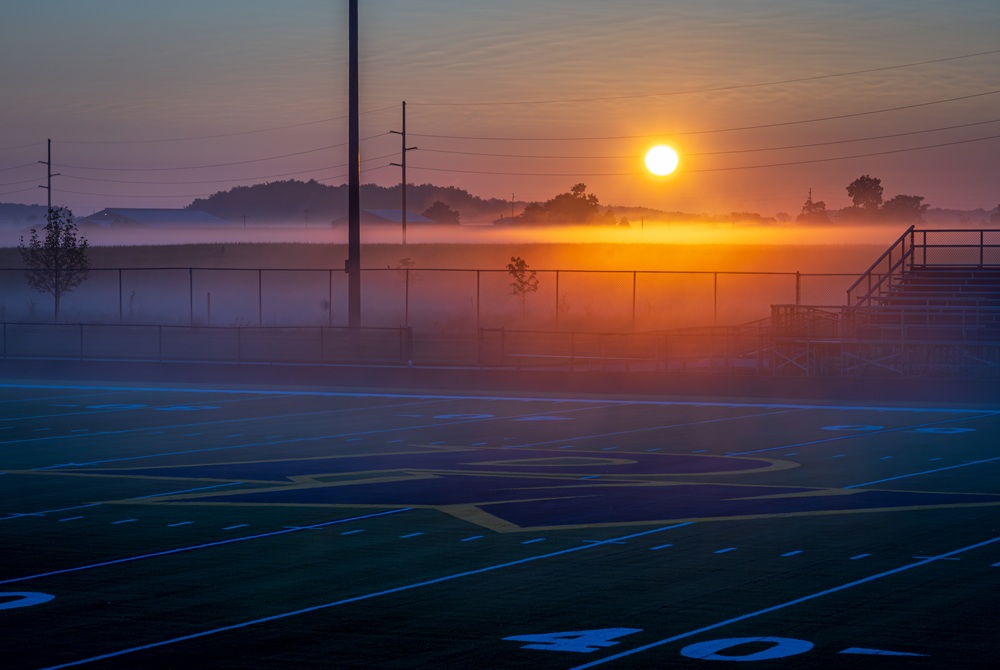
PHOTO The sun rises on the new stadium turf at Pewamo-Westphalia this summer. (Photo by James Pivarnik.)