

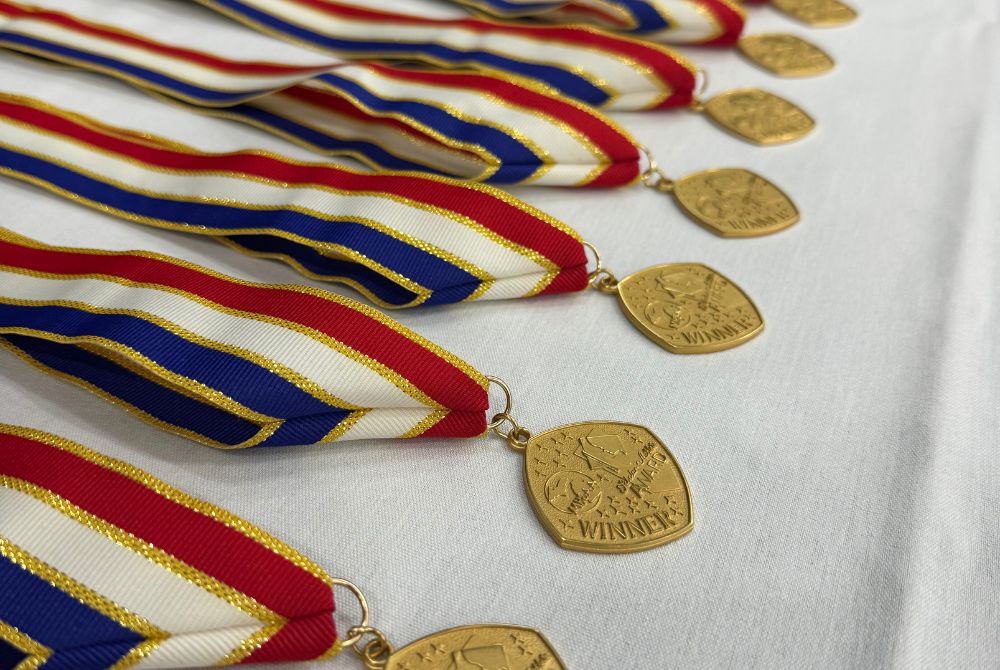
Finalists Announced for 2024-25 MHSAA/Farm Bureau Insurance Scholar-Athlete Awards
By
Geoff Kimmerly
MHSAA.com senior editor
January 21, 2025
The 120 finalists for the Michigan High School Athletic Association's Scholar-Athlete Awards for the 2024-25 school year, presented by Farm Bureau Insurance, have been announced.
 The program, in its 36th year, has recognized student-athletes since the 1989-90 school year and again this winter will honor 32 individuals from MHSAA member schools who participate in at least one sport in which the Association sponsors a postseason tournament.
Farm Bureau Insurance underwrites the Scholar-Athlete Awards and will present a $2,000 scholarship to each recipient. Since the beginning of the program, 960 scholarships have been awarded.
Scholarships will be presented proportionately by school classification, with 12 scholarships to be awarded to Class A student-athletes, six female and six male; eight scholarships awarded to Class B student-athletes, four female and four male; six scholarships awarded to Class C student-athletes, three female and three male; and four scholarships awarded to Class D student-athletes, two female and two male. In addition, two scholarships will be awarded at-large to minority recipients, regardless of school size.
Every MHSAA member high school could submit as many applications as there are scholarships available in its classification and could have more than one finalist. Birmingham Seaholm has six finalists this year, while Munising and Whitehall have four, and Bloomfield Hills Cranbrook Kingswood, Midland Dow and West Bloomfield each have three finalists. Eight schools have two finalists: Ann Arbor Greenhills, Ann Arbor Huron, Bloomfield Hills, Detroit Catholic Central, Grosse Pointe South, Kingsford, Olivet, and Saline.
Multiple-sport participation remains the norm among applicants. The average sport participation rate of the finalists is 2.88. There are 75 three-plus sport participants in the finalists field, and all but one of the 28 sports in which the MHSAA sponsors postseason tournaments are represented.
Of 431 schools which submitted applicants, 25 submitted the maximum allowed. This year, 1,513 applications were received. All applicants will be presented with certificates commemorating their achievement. Additional Scholar-Athlete Award information, including a complete list of scholarship nominees, can be found on the Scholar-Athlete page.
The applications were judged by a 65-member committee of school coaches, counselors, faculty members, administrators and board members from MHSAA member schools. Selection of the 32 scholarship recipients will take place in early February. Class C and D scholarship recipients will be announced Feb. 4, Class B scholarship recipients will be announced Feb. 11 and Class A scholarship recipients will be announced Feb. 18. All announcements will be made on the MHSAA Website.
To be eligible for the award, students must have a cumulative grade-point average of 3.50 (on a 4.0 scale) and previously have won a varsity letter in at least one sport in which the MHSAA sponsors a postseason tournament. Students also were asked to respond to a series of short essay questions and submit two letters of recommendation and a 500-word essay on the importance of sportsmanship in educational athletics.
Farm Bureau Insurance of Michigan was founded in 1949 by Michigan farmers who wanted an insurance company that worked as hard as they did. Those values still guide the company today and are a big reason why it is known as Michigan’s Insurance Company, dedicated to protecting the farms, families, and businesses of this great state. Farm Bureau Insurance agents across Michigan provide a full range of insurance services—life, home, auto, farm, business, retirement, Lake Estate®, and more—protecting nearly 500,000 Michigan policyholders.
The MHSAA is a private, not-for-profit corporation of voluntary membership by more than 1,500 public and private senior high schools and junior high/middle schools which exists to develop common rules for athletic eligibility and competition. No government funds or tax dollars support the MHSAA, which was the first such association nationally to not accept membership dues or tournament entry fees from schools. Member schools which enforce these rules are permitted to participate in MHSAA tournaments, which attract more than 1.3 million spectators each year.
2024-25 Scholar-Athlete Award Finalists
GIRLS CLASS A
Clara Freeth, Ann Arbor Huron
Katherine Ma, Ann Arbor Huron
Avery Allen, Birmingham Seaholm
Ella Gifford, Birmingham Seaholm
Grace Johnson-Sears, Birmingham Seaholm
Selina Lin, Birmingham Seaholm
Madeline Day, Bloomfield Hills Cranbrook Kingswood
Sophia Y. Tang, Bloomfield Hills Cranbrook Kingswood
Sydney Law, Byron Center
Nadine Fayad, Dearborn
Alaa Selman, Dearborn Heights Crestwood
Eleni Michos, Dexter
Grace Tykocki, Grand Blanc
Kylie Pung, Howell
Bomin Koo, Jenison
Kortney Osborn, Mason
Ayesha Middha, Midland Dow
Chikanma Okoisor, Midland Dow
Tara Creekmore, Plymouth
Katherine McLaughlin, Portage Central
Grace Roth, Saline
Madeline Bildeaux, Traverse City West
Carly Lyons, West Bloomfield
Natalie Weissman, West Bloomfield
BOYS CLASS A
Sean Wesolek, Bay City John Glenn
Milan Patel, Birmingham Seaholm
Carson J. Wright, Birmingham Seaholm
Noah Kaplan, Bloomfield Hills
Asher Langwell, Bloomfield Hills
Calvin Meeker, Bloomfield Hills Cranbrook Kingswood
Nicholas Leiter, Detroit Catholic Central
Peter Sanin, Detroit Catholic Central
Lucas Groulx, Flint Kearsley
Elijah Lipke, Grand Rapids Forest Hills Central
Gruhith Yerramalli, Grosse Pointe North
Jack J. Lupo, Grosse Pointe South
James Michelotti, Grosse Pointe South
Joseph Spada, Kalamazoo Central
Andrew Creedon, Livonia Churchill
Nimai Patel, Midland Dow
Cameron McVittie, Northville
Nathan Beemer, Okemos
Drew F. Cady, Oxford
Hunter Easton, Saline
Auben Wesley, South Lyon
Owen Przybylski, Temperance Bedford
Asher Paul, Traverse City Central
Brady Scheidt, West Bloomfield
GIRLS CLASS B
Hannah Lee, Ann Arbor Greenhills
Eleana Zhuang, Ann Arbor Greenhills
Madison Cole, Battle Creek Pennfield
Addison Seemann, Freeland
Lauren Sundquist, Gladstone
Sierra Grooters, Hudsonville Unity Christian
Madelynn Kreider, Kingsford
Nadia Marie Grierson, Ludington
Anna Catherine Boggs, Monroe Jefferson
Marlee Plaxco, Negaunee
Hailey Dodd, Parma Western
Alaina Hanson, Reed City
Alexandrea Komarowski, St. Clair
Scarlet Maison, Standish-Sterling
Camille Kraai, Whitehall
Grace McDowell, Whitehall
BOYS CLASS B
Maxwell Volk, Chesaning
Alan Mrva, Corunna
Isaak E. Rubley, Dundee
Brayden Joslin, Durand
Brayden Bryan Lape, Grass Lake
Corbin Allen, Grayling
Oliver Costello, Haslett
Jayse Peterson, Hastings
Caden James VanHuis, Holland Christian
Gavin J. Trevillian, Kingsford
Nicholas Caldwell, North Branch
Benjamin Kelenske, Olivet
Blair Scott, Olivet
Owen T. Feldpausch, Owosso
Ryan Goodrich, Whitehall
Brady Tate, Whitehall
GIRLS CLASS C
Baylee Goddard, Alcona
Kaylee A. Kranz, Clinton
Kelcie Jo Pung, Fowler
Alexyn DuBois, Hanover-Horton
Grace Hayhurst, Harbor Springs
Allie Nowak, Johannesburg-Lewiston
Dayne Behning, Munising
Kate Mattson, Munising
Ashlyn Orr, New Lothrop
Tess Tillman, Royal Oak Shrine Catholic
Makayla Zelinko, St. Charles
BOYS CLASS C
Lucas Hall, Bark River-Harris
Owen Heath, Bridgman
Jason Zarate, Brighton Charyl Stockwell Prep
Matthew Mellendorf, Cass City
Korbyn Russell, East Jordan
Isaiah Kabban, Harbor Beach
Carson Kienitz, Munising
Trevor Nolan, Munising
Ian Weldon, Reese
Ben Denlinger, Roscommon
Wheatley Rodammer, Saginaw Valley Lutheran
Landon Pestrue, St. Louis
GIRLS CLASS D
Keira Jean Graham, Bessemer
Molly Coppens, Chesterfield Austin Catholic
Sarah Bradley, Clarkston Everest Collegiate
Ella Grace Gasperich, Crystal Falls Forest Park
Leah Durfee, Fife Lake Forest Area
Ella Knudsen, Leland
Mallory Rich, Muskegon Catholic Central
Kaitlyn Miros, Saginaw Nouvel
BOYS CLASS D
Seth Davis, Adrian Lenawee Christian
Owen Plum, Britton Deerfield
Joshua Gaunt, Dollar Bay
Dakota Malek, Fulton
Andrew Spiegel, Hillsdale Academy
Carter Kosinski, Kinde North Huron
Alex Tyndall, Mason County Eastern
Grady Pieratt, Mount Pleasant Sacred Heart

2018-19 Concussion Data Reinforces Trends
September 26, 2019
By Geoff Kimmerly
Second Half editor
Data on student-athlete concussions collected by the Michigan High School Athletic Association from member high schools during the 2018-19 school year further reinforced findings from the first three years of reporting, and will contribute significantly as a number of MHSAA-associated groups work during the coming year to reduce the incidence of those injuries.
The 2018-19 concussion report found student-athletes at MHSAA member high schools encountered a total of 3,686 head injuries during the past school year – 3.0 percent more than in 2017-18. But that slight increase barely affected two key ratios. The number of injuries per member school was 4.9, up just a tenth of a percent from 2017-18, and for the second straight year only 1.3 percent of participants in MHSAA sports experienced a head injury, still down from 1.4 in 2016-17 and 1.6 percent the first year of the study. Total participation in MHSAA sports for 2018-19 was 281,992 – with students counted once for each sport they played.
The MHSAA has continued to invite Michigan’s universities, health care systems and the National Federation of State High School Associations (NFHS) to take part in analyzing the data and resulting questions that have arisen during the past three years. The 2018-19 results will be examined by the MHSAA’s newly-formed Sports Medicine Advisory Committee and also undergo analysis by representatives of Michigan State University’s Institute for the Study of Youth Sports. Furthermore, the MHSAA is directing its sport committees to study the data as they consider adjustments that could be made to rules for practice and competition.
“The 2018-19 concussion survey further reinforced the findings and trends we have seen emerge; not only in specific sports, but across all of our activities – and this latest set of results also raises new questions,” MHSAA Executive Director Mark Uyl said. “We must continue to look at how changes to playing rules and improvements in equipment may be beneficial moving forward, and also how we can further educate administrators, coaches, athletes and parents to identify and provide treatment for these injuries as soon as possible. We also are excited for the opportunity to have more eyes on these results as we continue to explore more ways to make our games safer.”
As first mandated in 2015-16, member schools are required to report head injuries to the MHSAA identifying the sport that each student-athlete was participating in and whether the injury was sustained during practice or competition. Schools also are required to designate at which level – varsity, junior varsity or freshman – the injury occurred.
The full report of all head injuries experienced during 2018-19 by student-athletes at MHSAA member high schools – including percentages by sport (per 1,000 participants), gender and team level, as well as data tracking when athletes returned to play – is available on the Health & Safety page of the MHSAA Website.
Keeping with the first three years of this survey, the MHSAA continued to receive data from more than 99 percent of its member high schools after the fall, winter and spring seasons. Member junior high and middle schools also were allowed, although not mandated, to report their head injuries; and those findings are not part of the published report.
Boys in 2018-19 experienced 2,404 – or 65 percent – of concussion injuries, just a percent less than during 2017-18, and not surprisingly as boys have a much higher participation in contact sports. More than half of head injuries – 59 percent – were experienced by varsity athletes, a slight increase of three percent from the previous year. A total of 2,441 head injuries – or 66 percent – came in competition as opposed to practice. Just more than half took place during either the middle of practice or middle of competition as opposed to the start or end, and 51 percent of injuries were a result of person-to-person contact.
The MHSAA also asked schools to report the number of days between the head injury and the athlete’s return to activity – and the two largest groups returned to activity after either 6 to 10 days of rest (24 percent) or 11 to 15 days (23 percent). All of these findings were within 1-3 percent of those discovered from the 2017-18 data.
Contact sports again revealed the most head injuries. Ranking first was football, 11 and 8-player combined, with 44 head injuries per 1,000 participants – an increase of three per 1,000 from 2017-18 but the same ratio as 2016-17 and still down from 49 head injuries per 1,000 football participants shown by the first study in 2015-16. Ice hockey again revealed the second-most injuries per 1,000, with 35 (also up three from a year ago but still down from 36 injuries per 1,000 from 2016-17 and 38 per 1,000 in 2015-16), and girls soccer was third with 25 head injuries per 1,000 participants for the second year in a row. Wrestling followed with 22 head injuries per 1,000 participants.
Continuing a noticeable trend of the last few years, the next three sports to show the highest incidences of head injuries were girls sports – girls lacrosse, competitive cheer and basketball also revealed 20 per 1,000 participants, although basketball was down two injuries per 1,000 participants or nearly 10 percent from the previous year. Boys lacrosse (16), boys soccer (14), girls volleyball (11), softball (11) and gymnastics (10) also showed double-digit head injuries per 1,000 participants.
Females again reported significantly more concussions than males playing the same or similar sports – soccer, basketball and baseball/softball. Female soccer players reported nearly double the concussions per 1,000 participants as male soccer players (25 to 14), while female basketball players reported nearly triple the number of concussions per 1,000 participants (20 to 7). Softball players also reported nearly triple the concussions per 1,000 participants of baseball players (11 to 4).
Schools report possible concussions online via the MHSAA Website. Reports are then examined by members of the MHSAA staff, who follow up with school administrators as those student-athletes continue to receive care and eventually return to play. Student privacy is protected.
The reporting of concussions is part of a three-pronged advance by the MHSAA in concussion care begun during the 2015-16 school year. The MHSAA completed in spring 2017 the largest-ever state high school association sideline concussion testing pilot program, with a sample of schools from across the state over two years using one of two screening tests designed to detect concussions. The MHSAA also was the first state association to provide all participants at every member high school and junior high/middle school with insurance intended to pay accident medical expense benefits – covering deductibles and co-pays left unpaid by other policies – resulting from head injuries sustained during school practices or competitions and at no cost to either schools or families.
Previously, the MHSAA also was among the first state associations to adopt a return-to-play protocol that keeps an athlete out of activity until at least the next day after a suspected concussion, and allows that athlete to return to play only after he or she has been cleared unconditionally for activity by a doctor (M.D. or D.O.), physician’s assistant or nurse practitioner.
In addition, the MHSAA’s Coaches Advancement Program – which includes courses that must be completed by all varsity head coaches hired for the first time at a member school – provides substantial instruction on concussion care. Separately, rules meetings that are required viewing for high school varsity and subvarsity head and assistant coaches at the start of each season include detailed training on caring for athletes with possible head injuries.