


Hockey Penalties Toughened for 2014-15
December 4, 2014
By Geoff Kimmerly
Second Half editor
Seasons are underway for teams participating in 12 winter sports for which the Michigan High School Athletic Association sponsors postseason tournaments, with stronger penalties for excessive contact in ice hockey highlighting rules changes taking effect with the beginning of competition.
Eight sports including ice hockey began play during the final two weeks of November, with the remaining four sports beginning competition over the next 10 days – Lower Peninsula Boys Swimming and Diving on Dec. 6, Boys Basketball on December 8 and Boys and Girls Skiing on Dec. 13. Upper Peninsula Girls and Boys Bowling teams began competition on Nov. 29, and Lower Peninsula teams may begin Dec. 6.
Changes to ice hockey penalties resulting from opponents being forced into the boards continue a focus on improving safety by establishing different levels of severity based on the flagrance and violence of the offending act.
Any excessive contact – including checking, cross-checking, elbowing, charging or tripping – that causes an opponent to be thrown violently into the boards will receive a 5-minute major penalty; previously this boarding infraction resulted only in a 2-minute minor penalty unless the contact was flagrant. If the flagrant or violent check causes a player to crash headfirst into the boards, a 5-minute major will be assessed as well as either a 10-minute misconduct or game disqualification depending on the severity of the offending check. Players disqualified from ice hockey games are not allowed to play in the next two games as well.
A 5-minute major penalty also will be assessed to any player who pushes, charges, cross-checks or body-checks an opponent from behind in open ice. Previously, this excessive contact came with a 2-minute minor penalty and 10-minute misconduct.
A handful of notable rules changes also go into effect for girls and boys basketball:
Intentional fouls were redefined to include excessive contact with any opposing player – not just the shooter – while the ball is live or until an airborne shooter returns to the floor. All excessive contact committed by any player will be ruled intentional.
Also, additions to the definition of personal foul were added to eliminate excessive contact on ball handlers outside of the lane area. The following additions constitute a foul when committed against the ball handler/dribbler: placing two hands (fronts or backs of hands) on the player, placing an extended arm bar (forearm away from the body) on the player, placing and keeping a hand on the player, and contacting the player more than once with the same hand or alternating hands.
The rule for players releasing to the lane on a free throw attempt was changed to its previous version; a player occupying a marked lane space again may enter the lane on the release of the ball by the free throw shooter. Players behind the free throw line extended and 3-point arc behind the free throw line must wait until the free throw attempt touches the ring or backboard or has ended (touches the floor) before entering the lane. This was the rule prior to the 1994-95 season.
Players may wear arm sleeves, knee sleeves, lower leg sleeves and tights, but all sleeves and tights must be black, white, beige or the predominant color of the team’s uniform. All team members wearing sleeves or tights must wear the same color. Knee braces do not count as part of this uniform regulation.
A significant change for wrestling affects team tournaments stretching multiple days, including the MHSAA Finals, for which weigh-ins are conducted each day. An athlete must weigh in at the same weight both days in order to continue competing after the first day of the tournament. Previously, an athlete could compete at whatever weight he or she weighed in at on the first day and then the new weight, if different, on the second day. Beginning this season, that wrestler may not compete the subsequent days of the team event if he or she weighs in at a different weight after the first day.
The 2014-15 Winter campaign culminates with postseason tournaments beginning with the Upper Peninsula Girls and Boys Swimming & Diving Finals on Feb. 21, and wraps up with the Boys Basketball Finals on March 28. Here is a complete list of winter tournament dates:
Boys Basketball
Districts – March 9, 11 & 13
Regionals – March 16 & 18
Quarterfinals – March 24
Semifinals – March 26-27
Finals – March 28
Girls Basketball
Districts – March 2, 4 & 6
Regionals – March 10 & 12
Quarterfinals – March 17
Semifinals – March 19-20
Finals – March 21
Bowling
Team Regionals – Feb. 27
Singles Regionals – Feb. 28
Team Finals – March 6
Singles Finals – March 7
Girls Competitive Cheer
Districts – Feb. 20-21
Regionals – Feb. 28
Finals: March 6-7
Girls Gymnastics
Regionals – March 7
Team Finals – March 13
Individual Finals – March 14
Ice Hockey
Pre-Regionals – March 2-6
Regional Finals – March 7
Quarterfinals – March 10-11
Semifinals – March 12-13
Finals – March 14
Skiing
Regionals – Feb. 9-13
Finals – Feb. 23
Swimming & Diving
U.P. Girls & Boys Finals – Feb. 21
L.P. Boys Diving Regionals – March 5
L.P. Boys Finals – March 13-14
Wrestling
Team Districts – Feb. 11-12
Individual Districts – Feb. 14
Team Regionals – Feb. 18
Individual Regionals – Feb. 21
Team Quarterfinals – Feb. 27
Team Semifinals & Finals – Feb. 28
Individual Finals – March 5-7
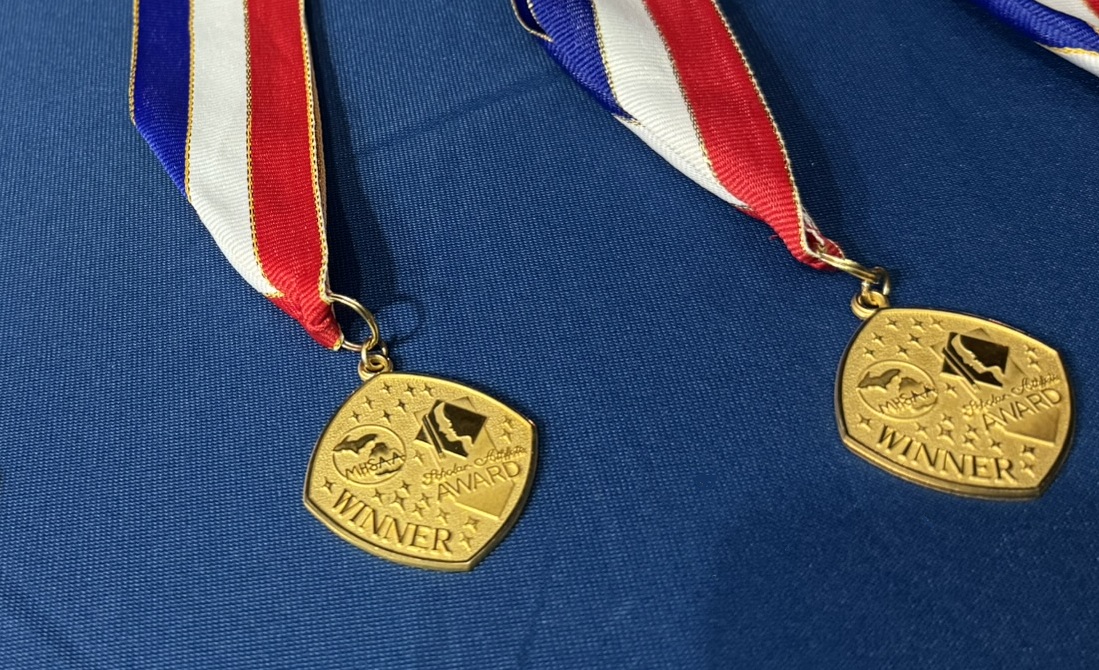
Applications Available for 2026-27 MHSAA/Farm Bureau Insurance Scholar-Athlete Awards
By
Geoff Kimmerly
MHSAA.com senior editor
October 6, 2026
One of the Michigan High School Athletic Association’s most popular programs, the Scholar-Athlete Award, will again with Farm Bureau Insurance present 32 $2,000 scholarships to top student-athletes at member high schools during the 2026-27 school year.

The MHSAA/Farm Bureau Insurance Scholar-Athlete Award highlights the value extracurricular activities play in the total education of high school students, often improving their academic achievements in the process. The Scholar-Athlete Award is in its 38th year. Since the award’s inception in 1988-89, Farm Bureau Insurance has presented more than $1 million in scholarships through this program.
The first 30 scholarships will be presented on a graduated basis across the MHSAA’s traditional class structure. From Class A schools, six boys and six girls will receive scholarships; from Class B schools, four boys and four girls; from Class C schools, three boys and three girls; and from Class D schools, two boys and two girls will be honored. The final two scholarships will be awarded at-large to minority recipients, regardless of school size. The scholarships may be used at the institution of higher learning the recipients attend during the first year at those colleges.
Applications from individual schools will be limited to the number of available scholarships in their enrollment class. Class A schools may submit the names of six boys and six girls, Class B schools may submit four boys and four girls, Class C may submit three boys and three girls and Class D may submit two boys and two girls.
Students applying for Scholar-Athlete Awards must be graduating during the 2026-27 school year, carrying an unrounded 3.5 (on a 4.0 scale) grade-point average and have won a varsity letter in a sport in which the MHSAA sponsors a postseason tournament: baseball, girls and boys basketball, girls and boys bowling, competitive cheer, girls and boys cross country, field hockey, football, girls and boys golf, gymnastics, ice hockey, girls and boys lacrosse, girls and boys skiing, girls and boys soccer, softball, girls and boys swimming & diving, girls and boys tennis, girls and boys track & field, girls and boys volleyball and girls and boys wrestling.
Applicants will be required to show involvement in other school and community activities and submit an essay on the importance of sportsmanship in educational athletics.
Information – including answers to a number of frequently asked questions – and links to the application are available online on the Scholar-Athlete Award page. Applications are available in digital format only and must be submitted online by 4 p.m. Dec. 4.
A committee composed of school administrators from across the state will select finalists and winners in late January, with the winners to be announced throughout February. All applicants, finalists and scholarship recipients will be announced on the MHSAA Website. The 32 scholarship recipients will be recognized during the 2027 MHSAA Boys Basketball Finals at the Breslin Student Events Center in East Lansing.
Farm Bureau Insurance of Michigan was founded in 1949 by Michigan farmers who wanted an insurance company that worked as hard as they did. Those values still guide the company today and are a big reason why it is known as Michigan’s Insurance Company, dedicated to protecting the farms, families, and businesses of this great state. Farm Bureau Insurance agents across Michigan provide a full range of insurance services – life, home, auto, farm, business, retirement, Lake Estate®, and more – protecting more than 660,000 Michigan residents.
The MHSAA is a private, not-for-profit corporation of voluntary membership by more than 1,500 public and private senior high schools and junior high/middle schools which exists to develop common rules for athletic eligibility and competition. No government funds or tax dollars support the MHSAA, which was the first such association nationally to not accept membership dues or tournament entry fees from schools. Member schools which enforce these rules are permitted to participate in MHSAA tournaments, which attract more than 1.4 million spectators each year.