


Multi-Sport Survey Helps Set Benchmark
July 31, 2018
By Geoff Kimmerly
Second Half editor
NOTE: This report includes a revision Aug. 3 to account for incorrect data for Jenison, which previously was listed with the second-highest percentage of multi-sport athletes in Class A. The updated data changed only two percentages updated below (*), and both by only one tenth of a percent.
Nearly 43 percent of athletes at Michigan High School Athletic Association member high schools participated in more than one sport during the 2017-18 school year, according to the first-ever Multi-Sport Participation Survey conducted this spring and inspired by the work of the MHSAA’s Task Force on Multi-Sport Participation.
Early and intense sport specialization has become one of the most serious issues related to health and safety at all levels of youth sports, as overuse injuries and burnout among athletes have been tied to chronic injuries and health-related problems later in life. In early 2016, the MHSAA appointed the Task Force on Multi-Sport Participation as part of a continued effort to promote and protect participant health and address the issues leading to early sport specialization.
While there is a growing amount of research detailing the negative effects of early sport specialization, there is little research on the prevalence of sport specialization, including at the high school level. This MHSAA survey received responses from 79.9 percent of member high schools and will be conducted annually to measure how multi-sport participation exists at schools of different sizes and also the progress being made to increase it at all schools.
“It’s now well-known that students who specialize in one sport year-round are prone to all kinds of health hazards. This is serious business; we have to find out the ways and means to promote the multi-sport experience,” MHSAA Executive Director John E. “Jack” Roberts said. “This survey will help us identify best practices. If I’m an administrator, and another school of the same size and same demographics has twice the multi-sport participation as my school, I want to know why. What are they doing to encourage that culture?”
From schools that responded to this year’s survey, 42.5 percent of students participated in athletics in 2017-18 – 46.3 percent of boys and 38.7 percent of girls. As anticipated, Class D schools enjoyed the highest percentage of athletes among the entire student body, at 55.2 percent, followed by Class C (50.1), Class B (45.1) and Class A (39.1*).
Of those athletes counted by responding schools, 42.8 percent participated in more than one sport – including 44.6 percent of boys and 40.6 percent of girls. Class D again enjoyed the highest percentage of multi-sport athletes, 58.1 percent, followed by Class C (55.2), Class B (46.7) and Class A (35.9*).
Similar results for overall sport participation and multi-sport participation relative to enrollment size were seen by further breaking down Class A into schools of fewer than 1,000 students, 1,000-1,500 students, 1,501-2,000 students and more than 2,000 students. For both sport participation as a whole and multi-sport participation specifically, the smallest Class A schools enjoyed the highest percentages, while percentages then decreased for every larger size group of schools.
The MHSAA Task Force on Multi-Sport Participation also recommended measuring multi-sport participation in MHSAA member schools to recognize “achievers” – that is, schools that surpass the norm given their enrollment and other factors that affect school sports participation. An achievement program is being developed for future years, and this year’s survey results will assist in setting a benchmark for that recognition.
In Class A, Marquette (82.6 percent), Grand Rapids Union (74.1) and Holland West Ottawa (74.0) posted the highest percentages of multi-sport athletes. In Class B, four schools achieved at least 80 percent multi-sport participation – Birch Run (87.1), Gladstone (83.8), Clawson (81.0) and Shepherd (80).
Class C saw 13 schools with more than 80 percent of its athletes taking part in more than one sport, led by Ubly (90.2 percent) and Detroit Southeastern (89.2). Four Class D schools responded at higher than 90 percent multi-sport participation – Brethren (95.4), DeTour (94.3), Jackson Christian (91.7) and Waterford Our Lady (90.8).
The full summary report on the Multi-Sport Participation Survey is available on the “Health & Safety” page of the MHSAA Website.
2021-22 Parade of Champions Features 98 Schools, Multiple 1st-Time Title Winners
By
Geoff Kimmerly
MHSAA.com senior editor
June 27, 2022
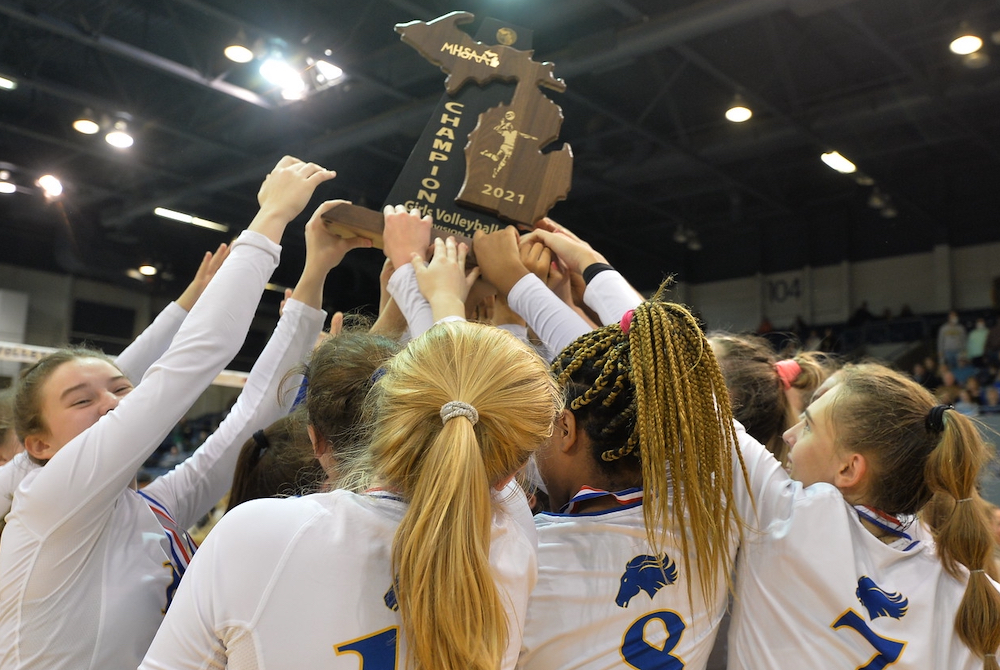
A total of 98 schools won one or more of the 128 Michigan High School Athletic Association team championships awarded during the 2021-22 school sports year, with two teams earning the first Finals championship in any sport in their schools’ histories.
Hillsdale Academy celebrated its first MHSAA Finals championship by winning the Lower Peninsula Division 4 boys cross country title Nov. 6. That same day, Wyoming Potter’s House Christian claimed its first Finals title by winning the Division 4 boys soccer championship.
A total of 21 schools won two or more championships this school year, paced by East Grand Rapids’ five won in girls cross country, girls lacrosse, girls track & field and both girls and boys swimming & diving. Ann Arbor Pioneer and Marquette were next with four Finals championships. Pioneer won in girls cross country, girls tennis and both girls and boys swimming & diving. Marquette won in boys cross country, boys track & field and both girls and boys swimming & diving.
Bloomfield Hills Cranbrook Kingswood and Hudson both won three Finals championships. Winning two titles in 2021-22 were Allen Park, Ann Arbor Greenhills, Brighton, Detroit Catholic Central, Escanaba, Grand Rapids Forest Hills Central, Hart, Hartland, Houghton, Ishpeming Westwood, Lansing Catholic, Munising, Muskegon Western Michigan Christian, Powers North Central, Warren De La Salle Collegiate and Williamston.
A total of 29 teams won first MHSAA titles in their respective sports. A total of 45 champions were repeat winners from 2020-21. A total of 20 teams won championships for at least the third-straight season, while six teams extended title streaks to at least four consecutive seasons. The Lowell wrestling program owns the longest title streak at nine seasons.
Sixteen of the MHSAA's 28 team championship tournaments are unified, involving teams from the Upper and Lower Peninsulas, while separate competition to determine titlists in both Peninsulas is conducted in remaining sports.
Click Here for a sport-by-sport listing of MHSAA champions for 2021-22.