


New Rules, Reminders Promote Safety
By
Geoff Kimmerly
MHSAA.com senior editor
August 6, 2015
The first practices of the 2015-16 school year next week provide a valuable opportunity for reminders on the importance of athletes remaining refreshed during the hottest days of training – and also an opportunity to explain new Michigan High School Athletic Association rules in football aimed at further promoting safety during competition.
The first practices begin next week for approximately 110,000 student-athletes taking part in eight sports in which the MHSAA sponsors postseason tournaments. Football practice for more than 40,000 players can begin at MHSAA schools Monday, Aug. 10, followed by first practices for all other fall sports Aug. 12.
Each year, the MHSAA provides information to its member schools to help them prepare for hot weather practice and game conditions in the late summer and early fall. Those resources – including the MHSAA’s Model Policy for Managing Heat & Humidity– are available on the revamped MHSAA.com Health & Safety web page.
This also will be the second season for football practice changes made last fall to promote heat acclimatization and limit helmet-to-helmet contact. And earlier this week, 70 MHSAA high schools from across Michigan received training to take part in one of two sideline concussion testing pilot programs expected to benefit 20,000 student-athletes over multiple sports.
“There’s been a lot of attention focused on football regarding head safety, but the fact is all school sports need attention to the safety of student-athletes,” MHSAA Executive Director John E. “Jack” Roberts said. “We’re addressing all sports at all levels, practice and competition, to make sure our staff, who are interacting with the young people, know the best practices for safety in school sports. And we’re trying to communicate to the public that school sports really are safer than ever.”
The final weeks of July were another reminder of the importance of adjusting to hot weather as practices begin. The MHSAA Representative Council adopted in 2013 the Model Policy for Managing Heat & Humidity that, while not mandated for member schools, has been adopted by many at the local level. The plan directs schools to begin monitoring the heat index at the activity site once the air temperature reaches 80 degrees and provides recommendations when the heat index reaches certain points, including ceasing activities when it rises above 104 degrees.
The model policy is outlined in a number of places, including the publication Heat Ways, which is available for download from the MHSAA Website. Roberts reminded that the first days of formal practices in hot weather should be more for heat acclimatization than the conditioning of athletes, and that practices in such conditions need planning to become longer and more strenuous over a gradual progression of time. He added schools also must consider moving practices to different times of day, different locations, or change practice plans to include different activities depending on the conditions.
To assist in acclimatization, the football practice rule changes of 2014 allow for only helmets to be worn during the first two days, only shoulder pads to be added on the third and fourth days, and full pads to not be worn until the fifth day of team practice.
Practice in football must begin on Aug. 10 for all schools wishing to begin regular-season games the weekend of Aug. 27-29. Schools must have 12 days of preseason practice at all levels before their first game, and those 12 days of practice may not occur before 16 calendar days.
Practice sessions for all other sports begin Wednesday (Aug.12). In golf and tennis, competition may commence no earlier than after three separate days of team practice, and not before seven calendar days. The first day competition may take place in golf and tennis is Aug. 19. In all other fall sports, contests can take place after seven days of practice for the team and not before nine calendar days. The first day competition may take place in cross country, tennis, soccer, swimming and diving, and volleyball is Aug. 21.
This fall, two football dates precede Labor Day, and a number of MHSAA schools will play their first varsity games on Thursday, Aug. 27. In Week 1, 123 varsity games will be played on Thursday, 176 contests will be played on Friday, and 14 games will be played on Saturday.
Continuing the focus on player safety, additional rules changes were made in football for 2015 that again focus on minimizing injury risk:
- The definition of unnecessary roughness was expanded to include excessive contact with an opponent, including a defenseless player, which incites roughness. A defenseless player can be considered one no longer involved in a play, a runner whose progress has been stopped, a player focused on receiving a kick or a receiver who has given up on an errant pass, or a player already on the ground. Unnecessary and excessive contact can include blindside blocks and players leaving their feet to contact an airborne receiver attempting to secure the ball.
- The grabbing of a quarterback’s facemask by a defensive player, if it does not including the twisting, pulling or turning of the facemask, will be ruled incidental and result in a five-yard penalty instead of a roughing-the-passer penalty and automatic first down.
- A 2014 rule change stated that the kicking team must have at least four players on each side of the kicker when ready-for-play is signaled; a change this season states four players must be lined up on each side of the kicker when the ball is kicked. That fourth player may shift after ready-for-play but before the kick to comply with this formation rule, but may not go in motion more than five yards behind the ball. If the shifting player travels more than five yards behind the ball, it is a dead-ball foul for encroachment.
A few notable changes will go into effect for other fall sports:
- In cross country, the loosening on what runners are allowed to wear during competition continued after a ban on jewelry was lifted in 2014. Runners also now may wear sunglasses, and previous restrictions have been eliminated for specific styles of head gear – ski bands, head bands, stocking caps and hoods attached to other clothing. Previously, those head gear had to meet criteria including color and size of brand logos displayed.
- In swimming and diving, the ban on wearing jewelry has been lifted. The National Federation of State High School Associations deemed the ban unnecessary because there is little risk of injury to the competitor or opponents.
The 2015 Fall campaign culminates with postseason tournaments beginning with the Upper Peninsula Girls Tennis Finals the week of Sept. 28, and wraps up with the 11-Player Football Playoff Finals on Nov. 27 and 28. Here is a complete list of fall tournament dates:
Cross Country:
U.P. Finals – Oct. 24
L.P. Regionals – Oct. 30 or 31
L.P. Finals – Nov. 7
11-Player Football:
Selection Sunday – Oct. 25
Pre-Districts – Oct. 30 or Oct. 31
District Finals – Nov. 6 or 7
Regional Finals – Nov. 13 or 14
Semifinals – Nov. 21
Finals – Nov. 27-28
8-Player Football:
Selection Sunday – Oct. 25
Regional Semifinals – Oct. 30 or Oct. 31
Regional Finals – Nov. 6 or 7
Semifinals – Nov. 14
Finals – Nov. 20 or 21
L.P. Girls Golf:
Regionals – Oct. 7 or 8 or 9 or 10
Finals – Oct. 16-17
Soccer:
Boys L.P. Districts – Oct. 19-24
Boys L.P. Regionals – Oct. 27-31
Boys L.P. Semifinals – Nov. 4
Boys L.P. Finals – Nov. 7
L.P. Girls Swimming & Diving:
Diving Regionals – Nov. 12
Swimming/Diving Finals – Nov. 20-21
Tennis:
U.P. Girls Finals – Sept. 30-Oct. 3
L.P. Boys Regionals – Oct. 8 or 9 or 10
L.P. Finals – Oct. 16-17
Girls Volleyball:
Districts – Nov. 2-4 & 5, 6 or 7
Regionals – Nov. 10 & 12
Quarterfinals – Nov. 17
Semifinals – Nov. 19-20
Finals – Nov. 21
The MHSAA is a private, not-for-profit corporation of voluntary membership by more than 1,400 public and private senior high schools and junior high/middle schools which exists to develop common rules for athletic eligibility and competition. No government funds or tax dollars support the MHSAA, which was the first such association nationally to not accept membership dues or tournament entry fees from schools. Member schools which enforce these rules are permitted to participate in MHSAA tournaments, which attract more than 1.4 million spectators each year.
2026 MHSAA Football Playoff Pairings Announced
By
Geoff Kimmerly
MHSAA.com senior editor
October 25, 2026
Here are the pairings for the 2026 MHSAA Football Playoffs, which begin Oct. 30 and 31 with District Semifinals in the 11-Player Playoffs and Regional Semifinals in the 8-Player Playoffs.
Teams were divided into divisions before the start of play this fall. The top 32 teams in each division in 11-player and top 16 per division in 8-player, based on playoff-point average, were selected to the field.
For 11-player, qualifiers were then divided into four regions with eight teams apiece, then placed into four-team Districts based on their seeds within the region. The 8-player qualifiers were divided into four regions with four teams in each.
Pairings for the first three weeks of the tournament are based on regular-season playoff-point averages, with the highest-ranked team hosting, regardless of the distance between the two schools. For 11-Player District Semifinals, the top-seeded team will host the eighth-seeded team, the second-seeded will host the seventh-seeded, the third-seeded with host the sixth-seeded, and the fourth-seeded team will host the fifth-seeded team. For 8-Player Regional Semifinal play, the top-seeded team in each bracket will host the fourth-seeded team, and the second-seeded team will host the third-seeded team.
District Finals for 11-player and Regional Finals for 8-player will follow during the weekend of Nov. 6-7, and the weekend of Nov. 13-14 will have Regional Finals in the 11-Player Playoffs and Semifinals in the 8-Player Playoffs. The 8-Player Semifinals will pair the winners of Region 1 vs. Region 2 and the winners of Region 3 vs. Region 4 at neutral sites assigned by the MHSAA.
Semifinal games in the 11-Player Playoffs will take place Nov. 20-21, pairing the winners of Region 1 vs. Region 2 and the winners of Region 3 vs. Region 4. The MHSAA also will assign 11-Player Semifinals at neutral sites.
All playoff tickets except for Finals (both 11 and 8-player) will be sold online only via GoFan.
For 11-Player, tickets to District Semifinals and District Finals cost $8, tickets to Regional Finals are $10, and tickets to Semifinals cost $12. For 8-player, tickets for Regional Semifinals are $8, tickets for Regional Finals are $10, and tickets for Semifinals cost $12.
The 8-Player Finals will take place Nov. 21 at Northern Michigan University’s Superior Dome in Marquette, and the 11-Player Finals will be played Nov. 27 and 28 at Ford Field in Detroit. An all-day ticket for 8-Player Finals costs $12 and includes admission to both games, and an all-day ticket for the 11-Player Finals costs $20 and includes admission to that day’s four games.
The 11-Player Finals schedule will be as follows:
Friday, Nov. 27
9:30 a.m. - Division 8
12:30 p.m. - Division 4
4 p.m. - Division 6
7 p.m. - Division 2
Saturday, Nov. 28
9:30 a.m. - Division 7
12:30 p.m. - Division 3
4 p.m. - Division 5
7 p.m. - Division 1
Pairings for both the 11 and 8-Player brackets are as follows:
11-Player Pairings
DIVISION 1
REGION 1
DISTRICT 1
Grandville (4-5) 54.778 at Howell (9-0) 87.000
Hudsonville (6-3) 66.778 at Portage Central (8-1) 72.667
DISTRICT 2
Brighton (5-4) 58.000 at East Kentwood (9-0) 83.667
Rockford (5-4) 61.444 at Grand Ledge (9-0) 75.111
REGION 2
DISTRICT 1
Bloomfield Hills (5-4) 52.222 at Clarkston (8-1) 82.889
Hartland (7-2) 71.556 at Grand Blanc (9-0) 78.139
DISTRICT 2
Lake Orion (4-5) 53.889 at Detroit Catholic Central (8-1) 79.681
Davison (7-2) 63.583 at Oxford (7-2) 78.778
REGION 3
DISTRICT 1
Plymouth (4-5) 51.333 at Detroit Cass Tech (9-0) 76.861
Belleville (6-3) 70.667 at Dearborn Fordson (7-2) 71.333
DISTRICT 2
Dearborn (5-4) 55.667 at Saline (9-0) 76.778
Brownstown Woodhaven (7-2) 66.000 at Northville (7-2) 74.000
REGION 4
DISTRICT 1
New Baltimore Anchor Bay (5-4) 54.778 at Romeo (9-0) 83.667
Macomb Dakota (5-4) 64.667 at Rochester (6-3) 67.444
DISTRICT 2
Macomb L'Anse Creuse North (6-3) 54.889 at Rochester Hills Stoney Creek (7-2) 72.111
Utica (6-3) 56.444 at Rochester Adams (6-3) 70.000
DIVISION 2
REGION 1
DISTRICT 1
Muskegon (4-5) 47.444 at Byron Center (7-2) 71.667
Portage Northern (5-4) 59.000 at Traverse City West (6-3) 63.889
DISTRICT 2
East Lansing (4-5) 48.667 at Caledonia (7-2) 70.903
Traverse City Central (4-5) 49.667 at Muskegon Mona Shores (8-1) 69.833
REGION 2
DISTRICT 1
Midland (4-5) 47.222 at Milford (8-1) 73.333
Walled Lake Western (7-2) 65.333 at Midland Dow (7-2) 66.222
DISTRICT 2
Flushing (5-4) 49.778 at South Lyon (7-2) 72.000
Saginaw Heritage (6-3) 60.917 at South Lyon East (7-2) 68.333
REGION 3
DISTRICT 1
Roseville (4-5) 53.778 at Bloomfield Hills Brother Rice (7-2) 66.889
North Farmington (6-3) 59.111 at Ferndale (7-2) 61.000
DISTRICT 2
Birmingham Groves (5-4) 54.556 at Orchard Lake St. Mary's (6-3) 65.667
Birmingham Seaholm (5-4) 56.444 at St. Clair Shores Lakeview (7-2) 62.111
REGION 4
DISTRICT 1
Detroit Mumford (5-4) 47.333 at Gibraltar Carlson (9-0) 77.444
Livonia Franklin (7-2) 63.111 at Allen Park (7-2) 64.111
DISTRICT 2
Dearborn Heights Crestwood (5-4) 53.556 at Grosse Pointe South (8-1) 71.889
Livonia Churchill (5-4) 54.889 at Temperance Bedford (7-2) 64.889
DIVISION 3
REGION 1
DISTRICT 1
Petoskey (6-3) 49.556 at Mount Pleasant (8-1) 69.556
Marquette (6-3) 54.000 at Cadillac (7-2) 58.222
DISTRICT 2
Lowell (6-3) 53.556 at DeWitt (7-2) 67.111
East Grand Rapids (6-3) 53.556 at Coopersville (8-1) 65.556
REGION 2
DISTRICT 1
Zeeland East (5-4) 45.889 at St. Joseph (7-2) 65.889
Coldwater (6-3) 48.333 at Middleville Thornapple Kellogg (6-3) 52.556
DISTRICT 2
Niles (4-5) 46.111 at Zeeland West (7-2) 61.972
Battle Creek Central (5-4) 47.556 at Battle Creek Harper Creek (6-3) 52.889
REGION 3
DISTRICT 1
Waterford Mott (5-4) 47.111 at Chelsea (9-0) 70.556
Linden (6-3) 56.889 at Redford Thurston (8-1) 57.111
DISTRICT 2
Dexter (4-5) 52.444 at Mason (8-1) 67.000
Holly (7-2) 55.444 at Fenton (7-2) 64.333
REGION 4
DISTRICT 1
New Boston Huron (6-3) 48.000 at Port Huron (9-0) 75.222
Warren De La Salle Collegiate (5-4) 55.524 at Trenton (5-4) 57.000
DISTRICT 2
Warren Fitzgerald (6-3) 48.556 at Harper Woods (7-2) 72.333
Grosse Pointe North (6-3) 52.333 at Detroit Martin Luther King (6-3) 66.556
DIVISION 4
REGION 1
DISTRICT 1
Grand Rapids Christian (4-5) 43.667 at Grand Rapids Kenowa Hills (8-1) 66.333
Fruitport (7-2) 47.778 at Ludington (7-2) 48.111
DISTRICT 2
Big Rapids (5-4) 44.111 at Ada Forest Hills Eastern (8-1) 60.556
Spring Lake (5-4) 46.333 at Hudsonville Unity Christian (5-4) 52.778
REGION 2
DISTRICT 1
Vicksburg (7-2) 58.889 at Edwardsburg (9-0) 66.111
Paw Paw (8-1) 62.778 at Portland (9-0) 63.778
DISTRICT 2
Hastings (7-2) 60.556 at Stevensville Lakeshore (8-1) 66.000
Marshall (8-1) 60.889 at Grand Rapids South Christian (8-1) 65.222
REGION 3
DISTRICT 1
Williamston (5-4) 45.444 at Goodrich (9-0) 66.667
Ortonville Brandon (6-3) 49.556 at St. Johns (7-2) 51.222
DISTRICT 2
Lansing Sexton (6-3) 46.333 at Dearborn Divine Child (8-1) 63.556
Tecumseh (6-3) 49.000 at Adrian (8-1) 59.778
REGION 4
DISTRICT 1
Detroit Southeastern (6-3) 45.667 at Marysville (5-4) 52.556
Macomb Lutheran North (8-1) 50.556 at Detroit East English (7-2) 51.333
DISTRICT 2
St. Clair (7-2) 47.444 at Detroit Cody (8-1) 52.556
Detroit Country Day (6-3) 48.000 at Madison Heights Lamphere (5-4) 51.667
DIVISION 5
REGION 1
DISTRICT 1
Howard City Tri County (5-4) 38.222 at Kingsford (9-0) 56.889
Negaunee (5-4) 40.556 at Shepherd (7-2) 46.222
DISTRICT 2
Remus Chippewa Hills (7-2) 39.778 at Muskegon Orchard View (7-2) 49.222
Reed City (6-3) 40.111 at Ogemaw Heights (7-2) 46.778
REGION 2
DISTRICT 1
Comstock Park (4-5) 38.111 at Grand Rapids Catholic Central (7-2) 65.194
Berrien Springs (8-1) 51.333 at Lake Odessa Lakewood (8-1) 54.000
DISTRICT 2
Wyoming Godwin Heights (7-2) 47.667 at Grand Rapids West Catholic (7-2) 59.556
Kalamazoo Hackett Catholic Prep (9-0) 48.613 at Hopkins (8-1) 56.000
REGION 3
DISTRICT 1
Whitmore Lake (6-3) 39.000 at Frankenmuth (8-1) 56.222
Armada (5-4) 45.889 at Flint Powers Catholic (7-2) 48.667
DISTRICT 2
Pontiac Notre Dame Prep (5-4) 40.333 at Saginaw Swan Valley (8-1) 52.889
Corunna (4-5) 41.222 at Imlay City (7-2) 49.222
REGION 4
DISTRICT 1
Flat Rock (3-6) 33.444 at Monroe Jefferson (8-1) 55.556
Ida (7-2) 43.444 at Detroit Voyageur College Prep (6-3) 43.819
DISTRICT 2
Ann Arbor Father Gabriel Richard (5-4) 40.222 at Romulus Summit Academy North (6-3) 49.778
Detroit Denby (6-3) 40.444 at Redford Union (5-4) 46.000
DIVISION 6
REGION 1
DISTRICT 1
Mason County Central (5-4) 31.222 at Kingsley (9-0) 49.806
Calumet (6-3) 39.000 at Traverse City St. Francis (6-3) 41.000
DISTRICT 2
Elk Rapids (6-3) 33.986 at Sanford Meridian (9-0) 49.278
Harbor Springs (8-1) 36.778 at Gladwin (5-4) 43.444
REGION 2
DISTRICT 1
Flint Elite (5-4) 32.444 at Almont (9-0) 61.111
Midland Bullock Creek (5-4) 37.278 at Algonac (6-3) 41.667
DISTRICT 2
New Haven (6-3) 34.111 at Marine City (9-0) 56.667
Durand (6-3) 35.667 at Montrose (7-2) 44.000
REGION 3
DISTRICT 1
Brooklyn Columbia Central (6-3) 36.000 at Jackson Lumen Christi (7-2) 58.222
Napoleon (8-1) 41.444 at Buchanan (7-2) 41.556
DISTRICT 2
Adrian Madison (6-3) 37.444 at Belding (7-2) 49.889
Kent City (7-2) 37.778 at Olivet (6-3) 45.778
REGION 4
DISTRICT 1
Dearborn Heights Robichaud (5-4) 34.333 at Detroit Edison (8-1) 52.778
Clawson (6-3) 43.444 at Clinton (8-1) 49.667
DISTRICT 2
Detroit Communication Media Arts (5-4) 36.333 at Ecorse (8-1) 52.333
Warren Michigan Collegiate (5-4) 39.222 at Detroit Central (8-1) 49.778
DIVISION 7
REGION 1
DISTRICT 1
Lakeview (5-4) 28.222 at Menominee (8-1) 52.778
Manton (7-2) 32.889 at Manistee (4-5) 36.889
DISTRICT 2
Oscoda (6-3) 31.222 at Charlevoix (6-2) 41.361
Harrison (7-2) 32.708 at McBain (7-2) 39.472
REGION 2
DISTRICT 1
Cass City (6-3) 31.778 at Pewamo-Westphalia (8-0) 43.264
Elkton-Pigeon-Bay Port Laker (7-2) 39.556 at Burton Bendle (9-0) 40.111
DISTRICT 2
Clinton Township Clintondale (3-6) 32.444 at Millington (9-0) 42.889
Saginaw Valley Lutheran (6-3) 33.444 at Ithaca (8-1) 40.778
REGION 3
DISTRICT 1
Saranac (7-2) 31.083 at Constantine (8-1) 46.169
Cassopolis (8-1) 37.000 at Ravenna (7-2) 42.222
DISTRICT 2
Galesburg-Augusta (7-2) 33.000 at Schoolcraft (7-2) 44.905
Lawton (5-4) 33.058 at North Muskegon (8-1) 43.625
REGION 4
DISTRICT 1
Leslie (4-5) 30.778 at Monroe St. Mary Catholic Central (8-1) 54.778
Bronson (7-2) 34.778 at Ottawa Lake Whiteford (7-2) 35.292
DISTRICT 2
Jonesville (5-4) 31.444 at Hanover-Horton (7-2) 41.222
Union City (7-2) 32.333 at Detroit Community (8-1) 37.444
DIVISION 8
REGION 1
DISTRICT 1
Beaverton (4-4) 24.458 at Beal City (9-0) 44.778
East Jordan (7-2) 34.764 at Iron Mountain (7-2) 35.778
DISTRICT 2
L'Anse (4-5) 25.222 at Bark River-Harris (7-2) 37.958
Frankfort (5-4) 28.889 at Maple City Glen Lake (7-2) 36.333
REGION 2
DISTRICT 1
Vestaburg (6-3) 26.778 at New Lothrop (8-1) 46.000
Saginaw Michigan Lutheran Seminary (6-3) 31.736 at Mount Pleasant Sacred Heart (6-3) 32.319
DISTRICT 2
Vassar (5-4) 27.222 at Ubly (6-3) 33.444
Saginaw Nouvel Catholic Central (5-4) 29.889 at Unionville-Sebewaing (7-2) 32.889
REGION 3
DISTRICT 1
Sand Creek (5-4) 26.444 at Hudson (8-1) 49.556
Fowler (6-3) 33.750 at Manchester (7-2) 34.333
DISTRICT 2
Vermontville Maple Valley (5-4) 27.333 at Decatur (9-0) 47.000
Saugatuck (6-3) 32.222 at Springport (8-1) 37.444
REGION 4
DISTRICT 1
Sterling Heights Parkway Christian (5-4) 24.333 at Madison Heights Madison (7-2) 45.111
Burton Atherton (6-3) 30.111 at Southfield Bradford Academy (6-3) 33.444
DISTRICT 2
Marine City Cardinal Mooney (6-3) 25.889 at Royal Oak Shrine Catholic (8-1) 39.778
Allen Park Cabrini (5-4) 26.889 at Clarkston Everest Collegiate (8-1) 39.111
8-Player Pairings
DIVISION 1
REGION 1
Mio (6-3) 31.619 at Pickford (7-2) 36.736
Ishpeming (7-2) 32.111 at Rudyard (7-2) 33.569
REGION 2
Kingston (5-4) 30.639 at Dryden (9-0) 38.750
Marlette (7-2) 31.111 at Deckerville (8-1) 33.639
REGION 3
Concord (6-3) 30.125 at Climax-Scotts (7-2) 35.236
Bridgman (8-1) 33.306 at Colon (8-1) 33.681
REGION 4
Fulton (6-3) 31.952 at Merrill (8-1) 36.556
Blanchard Montabella (8-1) 33.889 at Dansville (7-2) 35.111
DIVISION 2
REGION 1
Powers North Central (7-2) 32.444 at Lake Linden-Hubbell (9-0) 38.000
St. Ignace (8-1) 35.556 at Gaylord St. Mary (9-0) 35.833
REGION 2
Onekama (6-3) 29.333 at Portland St. Patrick (9-0) 38.333
Grand Rapids Sacred Heart (8-1) 32.889 at Marion (9-0) 35.333
REGION 3
Adrian Lenawee Christian (4-5) 27.778 at Mendon (9-0) 40.458
Marcellus (6-3) 29.750 at Litchfield (8-1) 31.681
REGION 4
Peck (6-3) 27.845 at Bay City All Saints (8-1) 34.984
Britton Deerfield (7-2) 30.778 at Kinde North Huron (7-2) 31.861
The MHSAA is a private, not-for-profit corporation of voluntary membership by more than 1,500 public and private senior high schools and junior high/middle schools which exists to develop common rules for athletic eligibility and competition. No government funds or tax dollars support the MHSAA, which was the first such association nationally to not accept membership dues or tournament entry fees from schools. Member schools which enforce these rules are permitted to participate in MHSAA tournaments, which attract more than 1.4 million spectators each year.
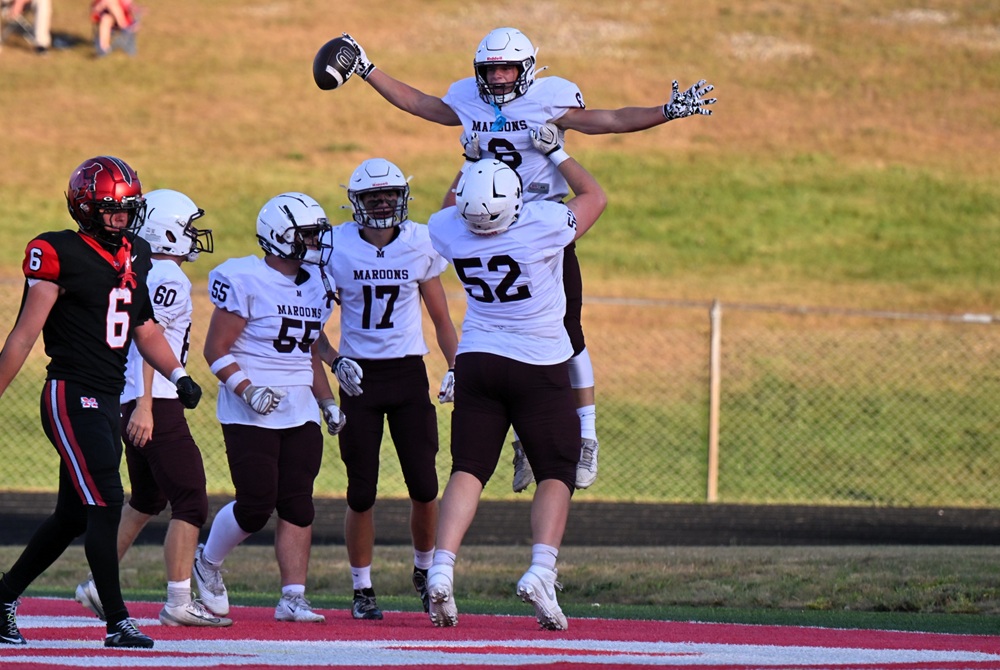
PHOTO Menominee's Kahne Clarke (52) lifts Jackson Myszak (6) after Myszak runs for the first touchdown of the game during a Sept. 3 win at Marquette. (Photo by Cara Kamps.)