

NFHS Introduces Updated Logo
July 17, 2019
Special from NFHS
As the National Federation of State High School Associations (NFHS) heads into the next 100 years of leading high school sports and other activity programs nationwide, it will be doing so with a new logo.
 The new logo was unveiled to the membership earlier this month at the close of the NFHS Centennial Celebration. The NFHS and its 51-member state high school associations celebrated the organization’s accomplishments at the 100th Annual Meeting at the JW Marriott in downtown Indianapolis.
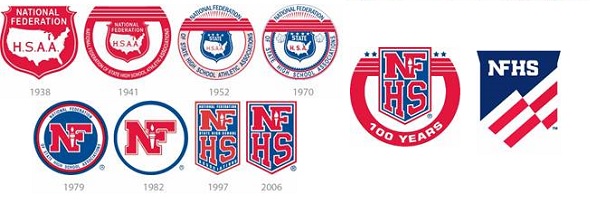
The organization will continue to be branded as the NFHS in the new logo, and the N and F are connected as has been the case since 1979. However, the entire acronym is together on one line as opposed to the previous logo with the NF and HS on separate lines. While red and blue will continue to be the predominant colors, the new logo mixes white with red and blue to suggest a flag waving in the wind. The direction of the flag is pointing upward to symbolize forward-thinking and advancement.
The new design maintains a resemblance to the shield that has been a part of the NFHS logo since 1997. However, the logo is flared at the top, and the bottom of the logo does not have definitive borders, which suggests the organization has moved past its first 100 years and is expanding its reach as the national leadership organization for high school sports and performing arts programs in the United States.
While the organization’s logo from 1952 had four stars to signify the four charter members of the NFHS, the four stripes within the new logo represent the four homes of the organization during the first 100 years.
“We wanted to retain NFHS as the central component of the new logo because the organization’s national presence has continued to spiral upward in the 22 years since the NFHS acronym was adopted,” said Dr. Karissa Niehoff, NFHS executive director. “However, as we celebrated our first 100 years, we felt it was important to establish a new look that would signify our ever-increasing role as the national leader in high school sports and performing arts programs.”
Counting the Centennial logo that was used during the 2018-19 school year, the new logo will be 10th used by the organization since the first one was adopted in the 1930s. The new logo was created by Section 127, an Indianapolis-based design company.
The NFHS was started in 1920 and had offices in Chicago until 1971, when it moved to Elgin, Illinois. The organization moved to Kansas City, Missouri, in 1979, and then in 2000 to Indianapolis, where it remains today.
The Michigan High School Athletic Association is a member of the NFHS, and Michigan is one of the four founding states of the national association.
Marquette, Saginaw, Ann Arbor & Grand Rapids to Host MHSAA Sportsmanship Summits
By
Geoff Kimmerly
MHSAA.com senior editor
October 13, 2026
The MHSAA’s annual Sportsmanship Summit series will return this November with four stops across the Lower Peninsula, providing training on sportsmanship topics affecting students both on and off the field of play.
The MHSAA has conducted Sportsmanship Summits across Michigan for 30 years. This year’s series kicks off Nov. 9 in Marquette and finishes Nov. 18 in Grand Rapids.
MHSAA staff, with assistance from school administrators and the MHSAA Student Advisory Council, conduct Sportsmanship Summits. Up to 800 students are expected to take part in the four workshops, where they will discuss the line that separates good from bad sportsmanship, both as athletes during competition and while participating in off-field activities including as spectators at sporting events.
Workshop sessions will include discussions and hands-on activities on topics including working with game officials, building appropriate student cheering sections, social media behavior and parent conduct at school sports events. Summits also will feature a session developed and instructed by members of the Student Advisory Council. At the end of the day the delegation from each participating school will meet to develop a school sportsmanship campaign.
Sessions will take place at the following:
• Marquette – Nov. 9 – Northern Center at NMU – 9 a.m. - 1:30 p.m.
• Saginaw – Nov. 12 – The Conference Center at Saginaw Valley State University – 9 a.m. - 1:30 p.m.
• Ann Arbor – Nov. 16 – Sheraton Ann Arbor – 9 a.m. - 1:30 p.m.
• Grand Rapids – Nov. 18 – Sheraton Grand Rapids – 9 a.m. - 1:30 p.m.
The Sportsmanship Summit schedule rotates locations every year. In 2025, MHSAA staff conducted summits in Lansing, Troy, Traverse City and Kalamazoo.
Schools are welcome to bring as many as 10 total representatives, including two administrators. For additional registration information, contact Andy Frushour at the MHSAA office – [email protected] or (517) 332-5046. Registration information also is available on the Sportsmanship Resources page.