

NFHS Introduces Updated Logo
July 17, 2019
Special from NFHS
As the National Federation of State High School Associations (NFHS) heads into the next 100 years of leading high school sports and other activity programs nationwide, it will be doing so with a new logo.
 The new logo was unveiled to the membership earlier this month at the close of the NFHS Centennial Celebration. The NFHS and its 51-member state high school associations celebrated the organization’s accomplishments at the 100th Annual Meeting at the JW Marriott in downtown Indianapolis.
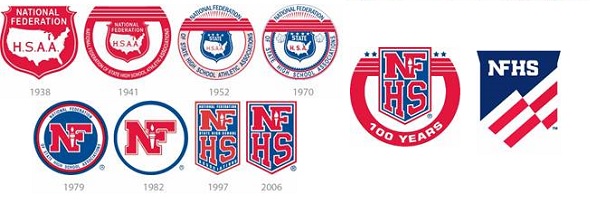
The organization will continue to be branded as the NFHS in the new logo, and the N and F are connected as has been the case since 1979. However, the entire acronym is together on one line as opposed to the previous logo with the NF and HS on separate lines. While red and blue will continue to be the predominant colors, the new logo mixes white with red and blue to suggest a flag waving in the wind. The direction of the flag is pointing upward to symbolize forward-thinking and advancement.
The new design maintains a resemblance to the shield that has been a part of the NFHS logo since 1997. However, the logo is flared at the top, and the bottom of the logo does not have definitive borders, which suggests the organization has moved past its first 100 years and is expanding its reach as the national leadership organization for high school sports and performing arts programs in the United States.
While the organization’s logo from 1952 had four stars to signify the four charter members of the NFHS, the four stripes within the new logo represent the four homes of the organization during the first 100 years.
“We wanted to retain NFHS as the central component of the new logo because the organization’s national presence has continued to spiral upward in the 22 years since the NFHS acronym was adopted,” said Dr. Karissa Niehoff, NFHS executive director. “However, as we celebrated our first 100 years, we felt it was important to establish a new look that would signify our ever-increasing role as the national leader in high school sports and performing arts programs.”
Counting the Centennial logo that was used during the 2018-19 school year, the new logo will be 10th used by the organization since the first one was adopted in the 1930s. The new logo was created by Section 127, an Indianapolis-based design company.
The NFHS was started in 1920 and had offices in Chicago until 1971, when it moved to Elgin, Illinois. The organization moved to Kansas City, Missouri, in 1979, and then in 2000 to Indianapolis, where it remains today.
The Michigan High School Athletic Association is a member of the NFHS, and Michigan is one of the four founding states of the national association.

Update: Attendance, Broadcast Information
March 12, 2020
By Geoff Kimmerly
Second Half editor
Postseason events sponsored by the Michigan High School Athletic Association and scheduled for March 12-14 will be conducted as scheduled. However, attendance will be restricted at all events through this weekend, with updates to be announced Monday, March 16, for the remainder of the girls and boys basketball tournaments.
The MHSAA Ice Hockey Semifinals and Finals will be played March 12-14 at USA Hockey Arena, with Lower Peninsula Boys Swimming & Diving Finals beginning Friday, March 13 and concluding March 14 at Oakland University and Holland Aquatic Center. Girls Gymnastics at Rockford High School also will be competed Friday and Saturday this weekend. Girls Basketball Regionals Finals are scheduled for tonight, March 12, across the state, as are Boys District Finals on Friday, March 13.
Based on recommendations from Gov. Gretchen Whitmer suggesting attendance limitations, no spectators will be allowed for the three Swimming & Diving Finals, both days, or Saturday’s Girls Gymnastics Individual Finals. These events have the highest number of participants of this weekend’s events.
However, for Hockey Semifinals and Finals and Gymnastics Team Finals – events with far fewer participants – a limited number of spectators will be allowed, as determined by participating schools, to include only parents, legal guardians and essential administrators. Basketball games during the next two days also will allow only limited spectators, as determined by participating schools and following these same restrictions. Each competing school will provide the entry list of parents, legal guardians and essential administrators to the host site prior to each contest.
To recap, here is a breakdown of sport-by-sport attendance stipulations and broadcast information.
Boys Swimming & Diving Finals
Rounds: Preliminaries on March 13, Finals on March 14
Attendance: No on-site spectators allowed.
Broadcast: Live streaming of prelims and Finals on MHSAA.tv.
Girls Gymnastics Finals
Rounds: Team Finals on March 13, Individual Finals on March 14
Attendance: Limited to parents, legal guardians and essential administrators on March 13. No on-site spectators allowed March 14.
Broadcast: Live streaming of Team and Individual Finals on MHSAA.tv.
Boys Ice Hockey Semifinals and Finals
Rounds: Semifinals on March 12-13, Finals on March 14
Attendance: Limited to parents, legal guardians and essential administrators.
Broadcast: Live streaming of all nine games on MHSAA.tv. Live audio on MHSAA Network.
Girls Basketball Regional Finals
Rounds: All scheduled for March 12.
Attendance: Limited to parents, legal guardians and essential administrators.
Broadcast: Live streaming of some games, with subscription, on MHSAA.tv.
Boys Basketball District Finals
Rounds: All scheduled for March 13.
Attendance: Limited to parents, legal guardians and essential administrators.
Broadcast: Live streaming of some games, with subscription, on MHSAA.tv.
Bands, cheerleaders and gatherings in parking lots or elsewhere on-site will not be allowed. Restrictions on noisemakers, etc., will continue to be upheld for those fans who will attend.
For those allowed to be present, there will be no admission charged at any of these five events. Online ticket sales have been stopped, and all tickets that have been purchased are voided and will be fully refunded.
Fans not allowed to attend will have the opportunity to watch coverage of all three of this weekend’s Finals live on MHSAA.tv. Complete streaming of all nine Hockey Semifinals and Finals is scheduled, as is streaming of both the Team and Individual Gymnastics Finals and both preliminaries and Finals for swimming & diving. MHSAA.tv also will carry a number of girls and boys basketball games this weekend as part of its usual subscription coverage by members of the School Broadcast Program.
The streaming of all three divisions of the MHSAA Swimming & Diving Finals and both Team and Individual Gymnastics Finals will be provided FREE OF CHARGE. More details about access to these free feeds will be provided in the next update this afternoon. Also, free live audio of the Hockey Semifinals and Finals will be available on the MHSAA Network.
This remains a fluid situation, and another update will be released today, March 12, at 2 p.m. Updates will be posted to the MHSAA Website.
The MHSAA is a private, not-for-profit corporation of voluntary membership by more than 1,500 public and private senior high schools and junior high/middle schools which exists to develop common rules for athletic eligibility and competition. No government funds or tax dollars support the MHSAA, which was the first such association nationally to not accept membership dues or tournament entry fees from schools. Member schools which enforce these rules are permitted to participate in MHSAA tournaments, which attract more than 1.4 million spectators each year.