

Ottinger's 'Organ Game' a Slam Dunk
May 23, 2017
By Geoff Kimmerly
Second Half editor
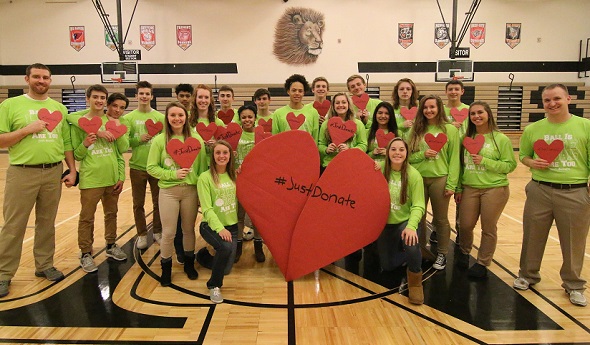
Every time Justice Ottinger sees one of the neon green T-shirts he designed on a student in the hallways at Newaygo High, he remembers fondly the “Ball Is Life, Organs Are Too” basketball game he planned this winter as an intern in the school’s athletic office.
 Much more frequently, the Lions’ senior gives thanks for the family friend who inspired the event by giving Ottinger a kidney last June.
Ottinger is a recipient of an MHSAA/Lake Trust Credit Union “Community Service Award” for his creation of the “Ball Is Life, Organs Are Too” event on Jan. 20 that raised more than $4,000 for Gift of Life Michigan and provided an opportunity for 13 people to register as organ donors.
As noted, the event started as an assignment from Newaygo athletic director Kristen Melvin to create and organize some sort of benefit game. It turned into an opportunity for Ottinger to not only spread the word about something that’s given him a better life, but also a chance to honor donor “Uncle” Tom Linsley for doing so.
“As soon as she said it, I said ‘organ game.’ There was nothing else. Organs mean so much,” Ottinger said. “There are a lot of people waiting for organs, and I don’t think people know the seriousness of this as much as they should. (I did it) just to get people to be aware of that, that organ transplants are a big deal, organ donation is a big deal, and I’m a believer everyone should be signed up to be organ donors.”
The Community Service Awards recognize contributions by Michigan’s high school student-athletes away from the field. Ottinger, a three-sport athlete, will user the $1,000 award as a scholarship toward his education at Cornerstone University, where he’ll begin studies toward his goal of becoming a doctor. Six honorees total are receiving awards this spring; Second Half is featuring one a day this week.
Just last weekend, Ottinger won Lower Peninsula Division 3 Regional championships in the 110 and 300-meter hurdles, advancing to next week’s MHSAA Track & Field Finals in both events. It was a performance that showed how much the kidney has affected him physically. His 15.43 time in the 110 race was a personal record and 1.4 seconds faster than his best all of last year. His 300 time of 41.38 was his second-fastest this spring and more than three seconds faster than his best in 2016. He’s undefeated in the 300 this season.
Compare that to a year ago, when Ottinger “was doing it, but not doing it very good. I was still putting forth my best effort, and stuff like that, but the closer I got to the transplant date, in basketball and track more I could tell. I’d fall asleep all the time,” he said.
“Once I had a transplant, it was the total opposite.”
Ottinger’s family knew he’s need a kidney transplant eventually since he was 2 years old. Although it was a slow process, his kidneys gradually lost their ability to function over the next 15 years; by last summer, they were down to functioning at only six perfect effectiveness.
 He was set to begin dialysis last summer when a donor was found – Linsley, who Justice affectionately calls “Uncle,” his dad’s best friend from when they attended Newaygo a generation ago.
Ottinger returned to play soccer in the fall and basketball in the winter, and set up his event for the Lions’ home game against Grant. Local businesses sponsored the event, and players and coaches wore the neon green shirts Ottinger designed. So did plenty of other people.
With Justice on the court, his mother Julie Long took over running the fundraiser during the game. But she had to get her son’s OK during warm-ups to order an additional 300 shirts – the first batch had sold out.
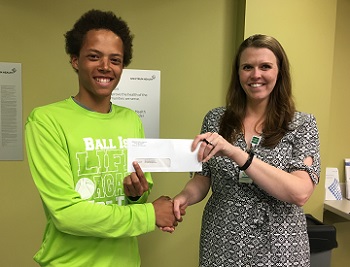
Gift of Life also sent a representative to sign up new donors on the spot, and Ottinger said the monetary donation will be used to help people who have had transplants pay hospital bills and for other costs that come with receiving a new organ.
He’s hopeful Newaygo will put on the event again next season, and Ottinger would like to do something similar at Cornerstone, where he’s set to join the track & field team.
His desire to become a doctor is boosted by what he’s experienced medically. But it’s rooted in something he’s already begun to fulfill.
“I’ve been in the hospital a lot, so I’d say that’s partially (the motivation),” Ottinger said. “But partially, I always have this urge to help people, make life better for people, and that’s driven me to do it too.”
The Community Service Awards are sponsored by the Michigan High School Athletic Association and Lake Trust Credit Union to recognize student-athletes' efforts to improve the lives of others in their communities. In addition to the $1,000 award, the Lake Trust Foundation is awarding an additional $500 to each honoree, to be donated to a non-profit, 501 (c)(3) organization of the awardee’s choice.
PHOTOS: (Top) Justice Ottinger (center of photo) and some of his many Newaygo supporters hold up #JustDonate hearts while wearing T-shirts he designed for his “Ball Is Life, Organs Are Too” event. (Middle) Ottinger presents a check to Gift of Life Michigan. (Photos courtesy of Justice Ottinger.)
2017 Community Service Awards
Sunday: Colon "Yard Squad" - Read
Monday: Bailey Brown, Brighton - Read

Rep Council Wrap-Up: Spring 2016
May 13, 2016
By Geoff Kimmerly
Second Half editor
The Representative Council of the Michigan High School Athletic Association continued to create opportunities for participation in high school athletics during its annual Spring Meeting, May 1-2, in Glen Arbor, with a pair of actions designed to assist more schools in forming cooperative programs.
The Spring Meeting of the 19-member legislative body of the Association’s more than 1,400 member schools is generally the busiest of its three sessions each year. The Council considered 18 committee proposals and also dealt with a variety of eligibility rule, postseason tournament and operational issues.
Among proposals approved was a recommendation by the MHSAA Classification Committee designed to promote opportunities for schools demonstrating a long-standing lack of participation in baseball, bowling, competitive cheer, cross country, golf, soccer, softball, tennis and wrestling – provided those schools are part of the same public school district or fall under the same governing body. The new exception will allow, by Executive Committee approval, eligible schools to form cooperative programs regardless of enrollment limits placed on other schools and in other sports – currently, schools forming a co-op program in these sports must have an enrollment of fewer than 1,000 students.
The Council also voted to add opportunities for cooperative programs in all sports at the subvarsity level for schools showing a history of lack of participation. Again with Executive Committee approval, two or more member high schools may form a cooperative at the subvarsity level only regardless of student enrollment restrictions that would prevent the same cooperative at the varsity level. Students on these subvarsity cooperative teams would have varsity eligibility only with their school of actual enrollment should they be brought up to a varsity team.
The Council continued its work on health and safety that has been emphasized during the past seven years of an eight-year campaign focused on “4 H’s” – Health Histories, Heads, Heat and Hearts.
The Council approved enhancements to the MHSAA Physical Exam/Clearance/Consent Forms that in part include an annual requirement that students and parents acknowledge reading concussion education information. This enhancement is consistent with requirements of the Michigan Department of Health and Human Services.
A number of changes regarding rules meeting requirements for coaches beginning in 2017-18 also were authorized. Concussion education will be the focus of the meetings’ health and safety section every other year, with other health and safety topics (including overuse injuries, sudden cardiac arrest and heat illness) alternating in off years. High school assistant and subvarsity coaches will be required to complete the same rules/risk management meeting as high school varsity head coaches after previously having additional options by which to satisfy the requirement. At all levels, coaches will not be allowed to coach in the MHSAA tournament for that sport in that season if they do not comply with the rules meeting requirement.
For football, the Council approved a Football Committee recommendation stating that teams, after their first game, should partake in no more than 90 minutes of collision practice per week. Currently, teams are allowed two days of collision practice after their first game, but this new recommendation suggests a minute limit as well. During other days of practice, players still may wear helmets and other protective pads (although neither is mandatory) and practice blocking and tackling technique against pads, shields, sleds or dummies.
The Council also heard plans for the second year of the MHSAA’s sideline concussion testing pilot program and received a summary of the first meeting of the MHSAA Task Force on Multi-Sport Participation.
Here is a summary of other actions taken by the Representative Council at the Spring Meeting, which will take effect during the 2016-17 school year unless noted:
Handbook/Administrative Matters
• Out-of-season coaching rules were adjusted to allow teams of both genders playing the same sport to both host four-player skill group sessions with different coaches but at the same facility at the same time. Currently, only one four-player group in each sport, per school, can train at a facility at one time.
• Additional language regulating competition against out-of-state opponents prohibits MHSAA schools from participating in events involving teams from other states unless all of those teams at the event are bona fide school teams (not sports academy, club or community teams) and are members of their respective National Federation of State High School Associations (NFHS) member high school associations, if eligible.
Sport Matters
• In bowling, the number of athletes allowed on an MHSAA Regionals and Finals roster was reduced from eight to seven after past seasons showed the eighth bowler rarely was involved in competition. Teams may bowl up to five during competition and may still have up to two substitutes, but the roster reduction should reduce congestion in the competition area of bowling centers during events.
• In competitive cheer, the Council approved two committee recommendations intended to make uniforms more consistent for all teams: Beginning during the 2017-18 season, all hair bows must be one solid color and not include adornments; and beginning in 2019-20, all uniforms must be free from cutouts and adornments including sequins, rhinestones, studs, glitter, etc.
• For football, in addition to the collision practice recommendation, the Council voted to allow MHSAA staff to request permission from the National Federation to experiment with using a 40-second play clock for the 2016 season. If granted, individual schools, with agreement of opponents and/or their leagues, may request MHSAA permission to conduct a contest using this timing option. Teams automatically would have 40 seconds to snap the ball from the end of the previous play, rather than the current 25 seconds after the official sets the ball and signals for the play clock to begin. (If play has been stopped by a timeout or penalty, the offense still will have 25 seconds to snap from the time the referee sets the ball and starts the play clock.)
• In golf, the Council approved a committee recommendation to add a sixth Regional tournament for the Lower Peninsula for both girls and boys, allowing for three more teams and three more individual players to qualify for the Lower Peninsula Finals. In adding the sixth Regional, the Council also voted to eliminate Lower Peninsula Districts from the boys tournament, pursuant to the Golf Committee’s recommendation. However, while eliminating one round of play for the boys, the addition of another Regional for both boys and girls will bring the field to 108 players for each gender for the MHSAA championship rounds.
• In ice hockey, an additional option to MHSAA overtime procedures was approved that will allow teams playing a two-game total-goal series to proceed to an overtime shootout after the second game to determine a series winner if the total goals are tied at the end of the two games. Schools must receive MHSAA approval prior to the series start.
• In boys lacrosse, a tournament with eight Regionals advancing champions to four Quarterfinals was approved; the current bracket includes only four Regionals and advances those champions to Semifinals in each division.
• In volleyball, the Council approved an adjustment that standardizes where Class C and D Quarterfinals will be played when including one Upper Peninsula and one Lower Peninsula team. In even years, the Quarterfinal will be played in the Lower Peninsula for Class C and the Upper Peninsula for Class D. In odd years, Class C will be played in the Upper Peninsula and Class D in the Lower Peninsula.
The Council also reviewed reports on membership, with 755 senior high schools and 705 junior high/middle schools in 2015-16; eligibility advancement applications, which totaled five for the year; the use of Educational Transfer Forms, which again held steady this year; school violations, attendance at athletic director in-service workshops and Coaches Advancement Program sessions, officials’ registrations, rules meetings attendance and officials reports submitted for the past three sports seasons. The Association’s $10.7 million budget for the 2016-17 school year also was approved.
The Representative Council is the 19-member legislative body of the MHSAA. All but five are elected by member schools. Four members are appointed by the Council to facilitate representation of females and minorities, and the 19th position is occupied by the Superintendent of Public Instruction or designee.
The MHSAA is a private, not-for-profit corporation of voluntary membership by more than 1,400 public and private senior high schools and junior high/middle schools which exists to develop common rules for athletic eligibility and competition. No government funds or tax dollars support the MHSAA, which was the first such association nationally to not accept membership dues or tournament entry fees from schools. Member schools which enforce these rules are permitted to participate in MHSAA tournaments, which attract more than 1.4 million spectators each year.