


Pay-to-Play Use Hovers at 50 percent
By
Geoff Kimmerly
MHSAA.com senior editor
July 30, 2019
By Geoff Kimmerly
Second Half editor
Half of MHSAA member high schools continued to assess sports participation fees during the 2018-19 school year, according to a survey that has measured the prevalence of charging students to help fund interscholastic athletics annually over the last 15 years.
Of the 604 schools which responded to the 2018-19 survey, exactly half – 302 – assessed a participation fee, while 302 did not during the past school year. This year’s survey results are in line with those of the last two schools years, which saw 49.7 percent of schools charging participation fees for 2016-17 and 49 percent in 2017-18. For the purposes of the survey, a participation fee was anything $20 or more regardless of what the school called the charge (registration fee, insurance fee, transportation fee, etc.).
The MHSAA conducted its first participation fee survey during the 2003-04 school year, when 24 percent of responding schools reported they charged fees. The percentage of member schools charging fees crossed 50 percent in 2010-11 and reached a high of 56.6 percent in 2013-14 before falling back below 50 percent in 2016-17.
A record number of member high schools responded to the survey for the second straight year – 81 percent of the MHSAA’s 750 member schools provided data for 2018-19. Class A schools again remained the largest group charging fees, with 69 percent of respondents doing so. Class B and Class C schools followed, both with 48 percent charging fees, and Class D schools also remained in line with the previous year with 35 percent charging for participation.
Charging a standardized fee for each team on which a student-athlete participates – regardless of the number of teams – remains the most popular method among schools assessing fees, with that rate at 45 percent of schools. Schools charging a one-time standardized fee per student-athlete remained constant at 28 percent. A slight uptick was seen in the percentage of schools assessing fees based on tiers of the number of sports a student-athlete plays (for example, charging a larger fee for the first team and less for additional sports), with 20 percent of responding schools charging in this way compared to 15 percent a year ago.
The amounts of most fees remained consistent or similar as well during 2018-19. The median annual maximum fee per student of $150 and the median annual maximum family fee of $300 both remained constant for at least the fifth straight year, while the median fee assessed by schools that charge student-athletes once per year held steady at $125 for the third straight school year. The median per-team fee increased slightly, $5, to $80 for 2018-19.
The survey for 2018-19 and surveys from previous years can be found on the MHSAA Website.
The MHSAA is a private, not-for-profit corporation of voluntary membership by more than 1,500 public and private senior high schools and junior high/middle schools which exists to develop common rules for athletic eligibility and competition. No government funds or tax dollars support the MHSAA, which was the first such association nationally to not accept membership dues or tournament entry fees from schools. Member schools which enforce these rules are permitted to participate in MHSAA tournaments, which attract more than 1.4 million spectators each year.
Lessons Learned Keep Paying Off
February 8, 2013
By Terri Finch Hamilton
Reprinted with permission of CMUChippewas.com
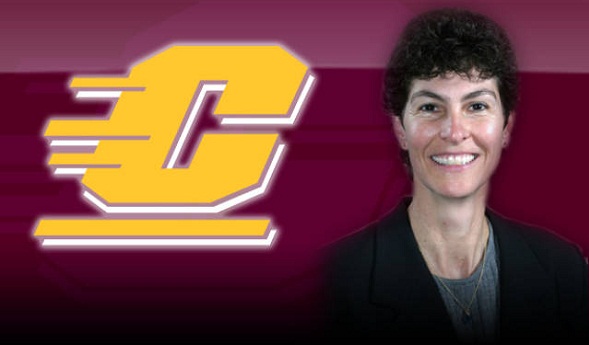
Gina Mazzolini's parents taught her to be a good person first, a good student second, and a good athlete after that. But Mazzolini says her involvement in sports at CMU taught her things that went way beyond the classroom.
"At Central, I learned women are just as good as men -- or better," says Mazzolini, assistant director at the Michigan High School Athletic Association. "I learned that if we put our minds to it, we can do anything."
A star athlete in volleyball and basketball at CMU from 1974 to 1978, Mazzolini says college sports helped her soar after the limitations for girls in high school sports in the early 1970s.
"In high school, women were always taking the back seat to men," says Mazzolini, 57. "I didn't see women in leadership positions in high school. Girls couldn't use the weight room -- we had to sneak in, then we'd get kicked out. They'd look at me and say, 'Why would you want to lift weights?'
"When the guys were done with the gym, then we could use it."
As an athlete at St. Johns High School, Mazzolini was just starting to compete competitively, she says. She won the school's first ever female athlete of the year award.
"Then I went to Central Michigan, and my teammates were all the best kids from their high school teams. Suddenly, everybody was good. And everybody we played against was good."
It was eye opening, she says.
"You learn a lot about yourself," she says. "If you can survive a practice, if you can survive playing Michigan State, you get confidence. I realized I was good. I learned how to be competitive, in a good way."
In basketball, she led the Chippewas in scoring and rebounding three straight seasons - averaging in double figures in both categories. After graduating from CMU, Mazzolini went on to teach and coach at the high school and college levels. She was inducted into the CMU Athletic Hall of Fame in 1992.
A few years later, Mazzolini received the 2009-10 Women In Sports Leadership Award by the Representative Council of the MHSAA.
So much of what she learned on the college volleyball and basketball courts prepared her for later success, Mazzolini says.
"In athletics, you can't worry about what just happened," she says. "You control your emotions, you take a deep breath, you move forward."
Good advice on any day, she says.
"You learn that you don't always win, and you learn to take defeat gracefully," she says. "Later, in your business life, you're not going to win everything, either. Sports teaches you how to deal with setbacks, how to work hard and rearrange your goals so that you do better next time.
"You learn if you work together, you can achieve amazing things."
CMUChippewas.com is running a series of stories to celebrate the 40th anniversary of Title IX legislation. Click to see more of the series.