

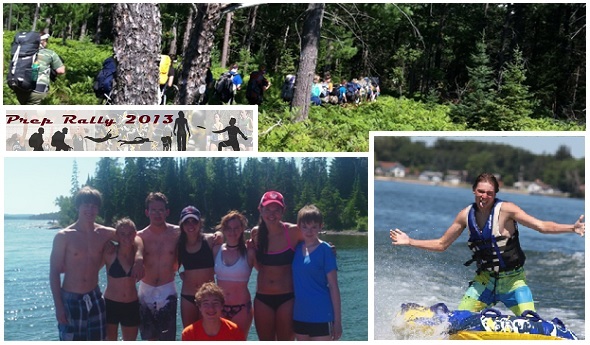
Rally Finalists Prepped for Competition
August 16, 2013
By Geoff Kimmerly
Second Half editor
The MHSAA’s inaugural “Prep Rally” contest was born this spring to help us teach athletes the importance of staying in shape during the offseason – while showing them fun ways to do so.
And like with our MHSAA “Battle of the Fans” contest during the past two winters, we learned a few things from our Prep Rally participants – most notably, that athletes during the school year enjoy staying active during the offseason. And especially if that activity includes a creative challenge or two.
Following are brief stories behind our three finalists for this summer's contest, which was part of the MHSAA’s PLAY (Preparation Lasts All Year) initiative designed to encourage athletes to remain active during the offseason so they are prepared physically and acclimated to warm weather when practice begins in the fall.
Thanks to all who submitted applications – we hope this is just the start of your helping us tell more athletes the best and most enjoyable ways to stay in shape and get ready for competition. The inaugural Prep Rally winner will be announced Monday on Second Half and be awarded tickets to an MHSAA Final of their choice, at which they will be recognized for their accomplishment.
Not surprising given Michigan’s abundance of woods and water, outdoor activities were a dominant theme of the inaugural Prep Rally.
Here’s a look at our finalists:
Beal City: Game Changers
“For many students the summer is simply a time to kick back, relax, hang out on the couch and play video games. However, this is not the case for Beal City athletes,” sophomore Billy Chilman wrote.
 “When we are not training for our championship teams on the field or in the classroom, we are always looking for new ways to stay fit and have fun. Whether it’s going to Coldwater Lake, to boat, knee board, ski or tube, we always seem to find something active to do.”
And that led to ATV tubing.
In essence, a four-wheeler on one bank of a small pond pulls the rider, sitting on a snow sled, across the pond. “It was also a great workout, improving our balance and upper body strength,” Chillman added.
Fenton: Into the Woods
A team that will spend all fall in the pool spends a valuable part of it offseason prep on dry land.
 Fenton girls swimming and diving team journeys away from home leading up to every season. This summer it headed to Pigeon River Country State Forest near Vanderbilt at the northern end of the Lower Peninsula for a three-day “survival trip.”
Plans included a four-mile hike to the first camp, followed by 4-5 mile hikes to each day to a new camp site.
The team also was divided into four smaller squads that competed in challenges as well as setting up camp, building fires and cooking meals.
“The purpose of the trip is to provide some physical conditioning as well as a team-building activity,” Fenton coach Brad Jones wrote in the Tigers’ submission.
Grosse Pointe Woods University Liggett: Crossing the Isle
Seniors Hannah Hodges and Danielle Lorant participate in three sports together during the school year – cross country, hockey and soccer – so staying in shape over the summer is especially key.
 This summer, that included a five-day backpacking trip at Isle Royale National Park as part of a program hosted by Michigan Tech University.
The Knights’ pair hiked 45 miles while carrying 50 pounds of supplies in backpacks. To prepare for the trip, Hodges and Lorant went on weekly hikes closer to home at Stoney Creek Metropolitan Park, Island Lake State Recreation Area and Algonac State Park – which built endurance but also allowed for an opportunity to test their gear.
“Backpacking on Isle Royale granted the chance to interact in nature and connect with other Michigan high school athletes who also participated in the trip, and to stay in good physical condition,” Hodges wrote in her submission.
“This trip demonstrated that there are other ways to stay in shape over the summer besides participating in the sports that we play during the school year.”
Follow the #PrepRally conversation on Facebook and Twitter @MHSAA.

MI Student Aid to Present MHSAA Media
September 1, 2016
By Geoff Kimmerly
Second Half editor
Just as the Michigan High School Athletic Association hopes students will pursue the many benefits of taking part in educational athletics, MI Student Aid – a division of the Michigan Department of Treasury – encourages students to pursue postsecondary educational opportunities by providing financial assistance toward attaining that goal.
 Sharing in the desire to make Michigan students aware of all possibilities available, MI Student Aid has signed on to work with the MHSAA to present the opportunities provided by both to a statewide audience via the MHSAA’s radio, video, social media and online initiatives.
MI Student Aid – a part of the Student Financial Services Bureau located within the Department of Treasury – encourages students to pursue postsecondary education by providing access to student financial resources and information, including various student financial assistance programs to help make college more affordable for Michigan students. MI Student Aid administers the state’s 529 savings programs (MET/MESP) and eight additional aid programs within its Student Scholarships and Grants division.
Among MHSAA broadcast ventures that will be presented by MI Student Aid during the 2016-17 school year are the five-minute “This Week in High School Sports” program that airs on more than 80 radio stations statewide, and the weekly video highlights from Michigan programming produced for the NFHS Network, dispersed to statewide media and published online on the MHSAA Website.
“We value the life lessons learned on the athletic field, and MI Student Aid promotes continuing education for our student-athletes by providing financial assistance in pursuing those opportunities,” said John E. “Jack” Roberts, Executive Director of the MHSAA. “We are always seeking to make students and their families aware of all that can be gleaned from educational athletics, and we’re glad to provide an avenue for MI Student Aid to promote the options available to help in financing the continuation of their studies.”
In addition to radio and video contributions, MI Student Aid will have an on-site presence at MHSAA championship events throughout this school year and serve as the presenting sponsor of weekly football and boys and girls basketball statewide reports on Second Half.
MI Student Aid also will have an opportunity to connect with students and their families through a presence on the MHSAA’s social media platforms.
“We are extremely excited to be partnered with Michigan High School Athletic Association,” said Anne Wohlfert, Director of the Student Financial Services Bureau. “Students and families oftentimes encounter barriers when paying for college, and MHSAA provides a platform that allows our resources and services to be transparent, directly to the audience we are trying to reach. Our mission and values closely align with that of MHSAA, which made this partnership an easy decision. We are looking forward to a long-lasting, successful partnership with them.”
Click for information on MI Student Aid and connect with MI Student Aid via social media on Facebook and Twitter @mistudentaid.