


Rep Council Wrap-up: Fall 2013
December 11, 2013
The addition of a CPR certification requirement for all high school varsity head coaches highlighted actions taken by the Representative Council of the Michigan High School Athletic Association during its annual Fall Meeting on Dec. 6 in East Lansing.
Raising expectations for coaches’ preparedness is one of four current thrusts of the MHSAA’s ongoing focus on health and safety issues in school sports, and this Council action requires all varsity head coaches at the high school level to have a current CPR certification beginning with the 2015-16 school year. High schools will be required to attest that this requirement has been met by all of their varsity head coaches.
This is the second of three actions the Council is considering to enhance the preparation of coaches with respect to health and safety issues. The first action, adopted last May, requires all assistant and subvarsity coaches at the high school level to complete the same rules and risk minimization meeting requirement as high school varsity head coaches beginning with the 2014-15 school year.
The third action, scheduled for the Council’s Winter Meeting in March, would require all persons hired as a high school varsity head coach for the first time at an MHSAA member school after July 31, 2016, to have completed the MHSAA’s Coaches Advancement Program Level 1 or Level 2.
A series of proposals were presented to the Council regarding the eligibility of international students, who by an estimate from the Council on Standards for International Educational Travel (CSIET) numbered more than 3,800 in Michigan in 2012. The proposals address in part concerns over students coming to MHSAA schools for athletic reasons and the potential of undue influence to direct them to specific communities. Compounding problems in terms of competitive equity for school sports is a 1996 Federal law which allows students on F-1 visas to attend non-public schools for multiple years but public schools for only one year and only if full tuition is paid to the school. Finalized proposals could come up for vote at the March meeting.
The Council also approved the creation of a Junior High/Middle School task force to consider how the MHSAA should continue to encourage multi-sport experiences at that level while reviewing policies concerning the grade levels served – including the possibility of allowing 6th-graders to participate – and the number and lengths of contests they are allowed to play. Currently, the MHSAA serves 725 member schools at the 7th and 8th-grade level. The task force will report to the Council within one calendar year or by its Fall Meeting in 2014.
Regarding specific sport matters, the Council authorized the move this spring of the Baseball and Softball Finals to Michigan State University from Battle Creek’s Bailey Park. The MHSAA began playing its Finals at Bailey Park in 1990. In 2014, the Baseball Finals will be played at McLane Baseball Stadium at Kobs Field, and the Softball Finals will be played at Peter F. Secchia Stadium at Old College Field.
Secchia Stadium was completed in 2011. McLane Stadium was completed in 2009 and recently was named Field of the Year by the Sports Turf Managers Association, which has recognized top sporting grounds at the professional, collegiate, schools and parks levels since 1992. A total of $6 million dollars coming mostly in gifts from their namesakes was used to construct the stadiums.
Championship weekend for baseball and softball now will begin with Semifinals on Thursday and Friday, with all four Finals games in both sports played Saturday. Previously, Semifinals for both were played Friday with multiple games in each sport played simultaneously.
“We are pleased to have had the opportunity to play our Finals at Bailey Park for the last 24 seasons, and grateful to the athletic directors, additional staff and volunteers who annually helped make our events an impressive showcase,” MHSAA Executive Director John E. “Jack” Roberts said. “We’ve reached a time now when many of our college facilities have been upgraded, and we have many more options to consider for our Finals than we did decades ago. We believe Michigan State University offers us the best situation and an opportunity to continue playing our Finals for both sports at adjacent venues.”
The Fall Meeting also saw the addition of two members to the 19-person Council. Gobles High School athletic director Chris Miller began a two-year term after being elected earlier this fall to represent Class C and D schools in the southwestern section of the Lower Peninsula. Cheri L. Meier, who serves as principal at Ionia Middle School, was appointed for a two-year term. She previously served as an assistant principal at Mason High School and Hastings High School, and as assistant athletic director at Lansing Everett High School. They fill positions formerly held by Watervliet High School athletic director Ken Dietz and Perry High School principal Paula Steele, whose terms ended. Also, Maureen Klocke, athletic director at Yale High School, was reappointed for a second two-year term.
The Representative Council is the legislative body of the MHSAA. All but five members are elected by member schools. Four members are appointed by the Council to facilitate representation of females and minorities, and the 19th position is occupied by the Superintendent of Public Instruction or designee.
The MHSAA is a private, not-for-profit corporation of voluntary membership by more than 1,500 public and private senior high schools and junior high/middle schools which exists to develop common rules for athletic eligibility and competition. No government funds or tax dollars support the MHSAA, which was the first such association nationally to not accept membership dues or tournament entry fees from schools. Member schools which enforce these rules are permitted to participate in MHSAA tournaments, which attract more than 1.4 million spectators each year.
Applications Available for 2026-27 MHSAA/Farm Bureau Insurance Scholar-Athlete Awards
By
Geoff Kimmerly
MHSAA.com senior editor
October 6, 2026
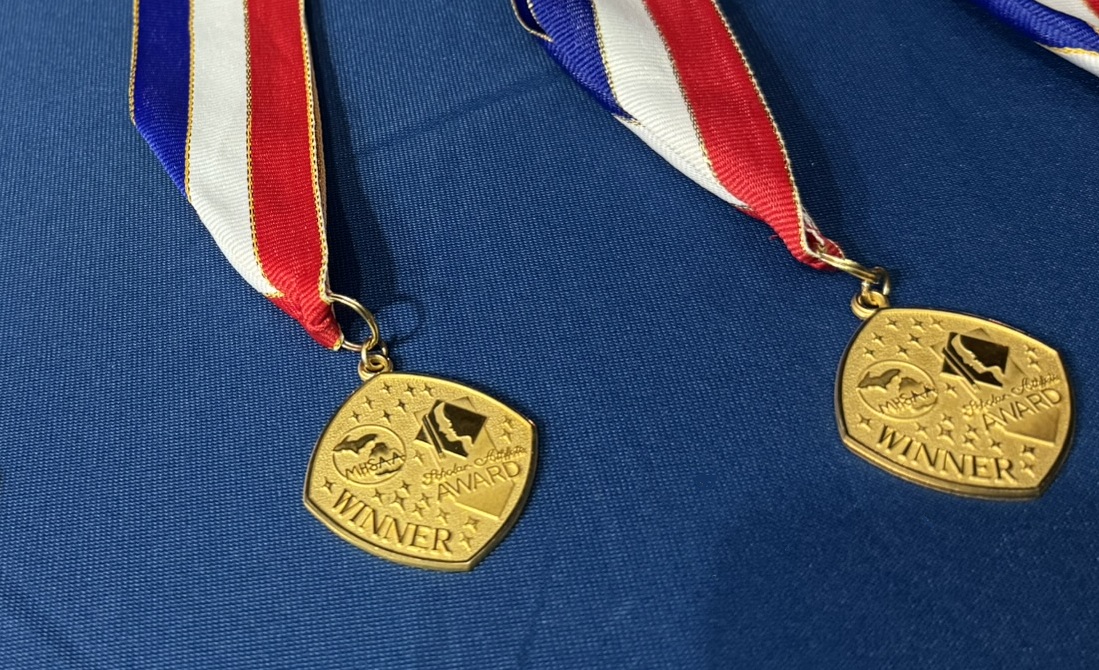
One of the Michigan High School Athletic Association’s most popular programs, the Scholar-Athlete Award, will again with Farm Bureau Insurance present 32 $2,000 scholarships to top student-athletes at member high schools during the 2026-27 school year.

The MHSAA/Farm Bureau Insurance Scholar-Athlete Award highlights the value extracurricular activities play in the total education of high school students, often improving their academic achievements in the process. The Scholar-Athlete Award is in its 38th year. Since the award’s inception in 1988-89, Farm Bureau Insurance has presented more than $1 million in scholarships through this program.
The first 30 scholarships will be presented on a graduated basis across the MHSAA’s traditional class structure. From Class A schools, six boys and six girls will receive scholarships; from Class B schools, four boys and four girls; from Class C schools, three boys and three girls; and from Class D schools, two boys and two girls will be honored. The final two scholarships will be awarded at-large to minority recipients, regardless of school size. The scholarships may be used at the institution of higher learning the recipients attend during the first year at those colleges.
Applications from individual schools will be limited to the number of available scholarships in their enrollment class. Class A schools may submit the names of six boys and six girls, Class B schools may submit four boys and four girls, Class C may submit three boys and three girls and Class D may submit two boys and two girls.
Students applying for Scholar-Athlete Awards must be graduating during the 2026-27 school year, carrying an unrounded 3.5 (on a 4.0 scale) grade-point average and have won a varsity letter in a sport in which the MHSAA sponsors a postseason tournament: baseball, girls and boys basketball, girls and boys bowling, competitive cheer, girls and boys cross country, field hockey, football, girls and boys golf, gymnastics, ice hockey, girls and boys lacrosse, girls and boys skiing, girls and boys soccer, softball, girls and boys swimming & diving, girls and boys tennis, girls and boys track & field, girls and boys volleyball and girls and boys wrestling.
Applicants will be required to show involvement in other school and community activities and submit an essay on the importance of sportsmanship in educational athletics.
Information – including answers to a number of frequently asked questions – and links to the application are available online on the Scholar-Athlete Award page. Applications are available in digital format only and must be submitted online by 4 p.m. Dec. 4.
A committee composed of school administrators from across the state will select finalists and winners in late January, with the winners to be announced throughout February. All applicants, finalists and scholarship recipients will be announced on the MHSAA Website. The 32 scholarship recipients will be recognized during the 2027 MHSAA Boys Basketball Finals at the Breslin Student Events Center in East Lansing.
Farm Bureau Insurance of Michigan was founded in 1949 by Michigan farmers who wanted an insurance company that worked as hard as they did. Those values still guide the company today and are a big reason why it is known as Michigan’s Insurance Company, dedicated to protecting the farms, families, and businesses of this great state. Farm Bureau Insurance agents across Michigan provide a full range of insurance services – life, home, auto, farm, business, retirement, Lake Estate®, and more – protecting more than 660,000 Michigan residents.
The MHSAA is a private, not-for-profit corporation of voluntary membership by more than 1,500 public and private senior high schools and junior high/middle schools which exists to develop common rules for athletic eligibility and competition. No government funds or tax dollars support the MHSAA, which was the first such association nationally to not accept membership dues or tournament entry fees from schools. Member schools which enforce these rules are permitted to participate in MHSAA tournaments, which attract more than 1.4 million spectators each year.