


Rep Council Wrap-Up: Winter 2016
March 31, 2016
By Geoff Kimmerly
Second Half editor
An increased effort to ensure student-athletes and their parents or guardians receive concussion education information was among topics that generated the most attention from the Representative Council of the Michigan High School Athletic Association during its annual Winter Meeting on March 24 in East Lansing.
Most of the Council’s discussion pointed toward possible actions at its Spring Meeting in May, with possible additions to the MHSAA Physical Exam/Clearance/Consent forms among those that may be voted upon when the Council reconvenes. The Council did take a first step, approving a requirement at its Winter Meeting mandating all students and their parent/guardian to sign a post-concussion consent form signifying they have received information on potential risks prior to returning to activity following a concussion.
Continuing its emphasis on the importance of collecting in-depth student-athlete health histories, the Council approved PRIVIT on a two-year trial basis as an electronic-based health history record-keeping tool to serve as an alternative to written communications and forms that accompany pre-participation physical examination of athletes.
The Council also discussed for possible action in May standardizing MHSAA rules/risk management meeting content for assistant and subvarsity coaches and increasing the frequency of in-depth concussion information within those meetings while still giving adequate attention to a variety of other important health and safety topics, including heat illness, sudden cardiac arrest and overuse injuries.
In other ongoing business, the Council reviewed necessary modifications to the MHSAA Membership Resolution and Handbook in advance of a change to the MHSAA Constitution that will permit schools to join the MHSAA at the 6th-grade level beginning in 2016-17. The amendment will allow schools which join the MHSAA at the 6th-grade level to let 6th-graders participate with MHSAA services and support and with and against 7th- and 8th-graders without MHSAA Executive Committee approval. It allows all districts, but requires no districts, to provide athletic opportunities for 6th-graders under the auspices of the MHSAA, either on separate teams or with 7th-and 8th-graders.
The Council considered one sport matter, in track & field, voting to begin this 2016 season to eliminate one preliminary round of the boys 110-meter hurdles, girls 100-meter hurdles and boys and girls 100 and 200-meter dashes at all Lower Peninsula Regionals that use fully automatic time (FAT) to determine race results. The Council also voted to require all Lower Peninsula Regional sites to use FAT beginning in 2017. Both actions were recommended by the MHSAA Cross Country/Track & Field Committee.
The Council also approved an Officials Review Committee recommendation to require all new officials to complete the National Federation of State High School Associations (NFHS) online course “Interscholastic Officiating” in addition to current requirements to complete the MHSAA Officials Guidebook exam and mechanics exams for new officials seeking to work football and basketball games.
The Representative Council is the legislative body of the MHSAA. All but five members are elected by member schools. Four members are appointed by the Council to facilitate representation of females and minorities, and the 19th position is occupied by the Superintendent of Public Instruction or designee.
The MHSAA is a private, not-for-profit corporation of voluntary membership by more than 1,400 public and private senior high schools and junior high/middle schools which exists to develop common rules for athletic eligibility and competition. No government funds or tax dollars support the MHSAA, which was the first such association nationally to not accept membership dues or tournament entry fees from schools. Member schools which enforce these rules are permitted to participate in MHSAA tournaments, which attract more than 1.4 million spectators each year.
Records Set Despite Overall Participation Dip
July 9, 2014
By Geoff Kimmerly
Second Half editor
Participation in high school sports in which postseason tournaments are sponsored by the Michigan High School Athletic Association decreased slightly for the third straight school year in 2013-14, following a continuing trend of declining member school enrollments.
However, nine MHSAA sports saw increases in participation from 2012-13, and four sports set records for the second straight school year.
A total of 288,230 participants took part in the 28 tournament sports offered by the MHSAA during the past year – a 1.9-percent decrease from the 2012-13 figure of 293,810. However, enrollments at member schools also decreased 0.7 percent from 2012-13 and have fallen 10 percent since the 2006-07 school year – while MHSAA participation has fallen only 7.9 percent during that time. This year’s dip was slightly larger than the 1.2-percent decrease from 2011-12 to 2012-13.
Overall boys participation fell 1.7 percent from 2012-13 to 2013-14, while girls participation fell 2.2 percent. The overall MHSAA totals count students once for each sport in which they participate, meaning students who are multiple-sport athletes are counted more than once.
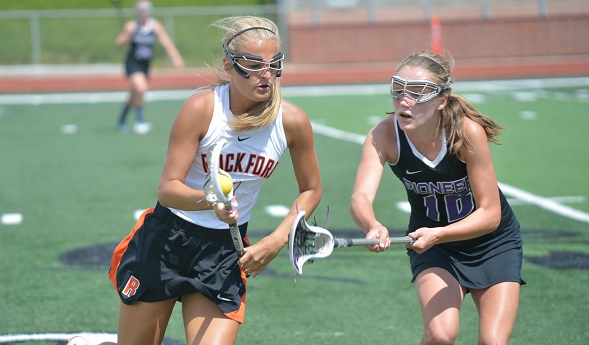
For the second straight school year, both boys and girls lacrosse (5,089 and 2,540, respectively) and boys and girls cross country (8,882 and 8,703) set participation records. Both lacrosse totals have increased annually during their 10 years as MHSAA tournament sports; the girls saw an increase of 1.6 percent from 2012-13. Participation in both boys and girls cross country increased for the fifth straight seasons – the girls this time by 3.9 percent.
Three girls sports rebounded from recent declines. Girls swimming and diving (6,604) broke a two-year downturn in participation with its highest total since 2010-11, while girls golf (3,427) increased by 2.8 percent and girls soccer (13,619) increased one percent after also falling from 2011-12 to 2012-13. Girls track and field (17,259) posted its second straight increase and highest participation total since 2009-10.
However, troubling trends continued in two of the most popular girls sports. Girls basketball participation fell for the eighth straight season to 16,329 participants, the sport’s fewest since records first were kept in 1991-92. The girls basketball total has decreased 14.7 percent since a U.S. District Court decision led to the switching of girls basketball season from fall to winter beginning in 2007-08. Comparatively, girls enrollment at MHSAA schools during that time has fallen 10.4 percent.
The sport that swapped seasons with girls basketball and moved to fall, volleyball, saw a 6.5-percent drop in participation this school year to 18,607 athletes, its fewest since 1993-94 and a decrease of 13.6 percent since its final season as a winter sport.
Also of note in this year’s survey:
- Total, nine sports saw increases in participation in 2013-14 (three boys, six girls), while 19 had decreases (11 boys, eight girls).
- Football participation, 11 and 8-player teams combined, dropped for the sixth straight season but this time by only 2 percent to 40,673 athletes. The drop from 2011-12 to 2012-13 was 3.7 percent.
- Wrestling saw a decrease for the fifth straight year, but also by a smaller percentage than the year before – 2.2 percent versus a 4.8-percent drop from 2011-12 to 2012-13.
- Baseball participation increased for the second straight year, up 0.7 percent to 18,227 participants. But softball saw the third-largest dip in 2013-14, 7.2 percent to 13,443 participants.
- Gymnastics (600) saw a decrease for the second straight year, this time by 11 percent – the largest percentage decrease of any sport this school year. Boys skiing (745) saw the second-largest drop, 9.7 percent.
The participation figures are gathered annually from MHSAA member schools to submit to the National Federation of State High School Associations for compiling of its national participation survey. Results of Michigan surveys from the 2000-01 school year to present may be viewed on the MHSAA Website.
The following chart shows participation figures for the 2013-14 school year from MHSAA member schools for sports in which the Association sponsors a postseason tournament:
BOYS GIRLS
SPORT |
SCHOOLS (A) |
PARTICIPANTS |
SCHOOLS (A) |
PARTICIPANTS (B) |
|
Baseball |
630/646/2 |
18,220 |
- |
-/7 |
|
Basketball |
727/732/2 |
21,504 |
676/723 |
16,321/8 |
|
Bowling |
341/359/1 |
3,573 |
326/357 |
2,939/7 |
|
Competitive Cheer |
- |
- |
311/337 |
7,120 |
|
Cross Country |
591/626/0 |
8,882 |
577/622 |
8,703/0 |
|
Football – 11 player |
596/660/3 |
39,963 |
- |
-/43 |
|
8-player |
36/39/0 |
667 |
- |
- |
|
Golf |
515/542/12 |
6,768 |
317/327 |
3,365/62 |
|
Gymnastics |
- |
- |
56/74 |
600 |
|
Ice Hockey |
219/268/2 |
3,564 |
- |
-/19 |
|
Lacrosse |
125/130/0 |
5,089 |
86/88 |
2,540/0 |
|
Skiing |
81/104/0 |
745 |
78/104 |
662/0 |
|
Soccer |
475/496/12 |
14,242 |
466/478 |
13,619/48 |
|
Softball |
- |
- |
569 |
13,443 |
|
Swimming & Diving |
242/266/1 |
5,243 |
260/274 |
6,064/8 |
|
Tennis |
312/318/2 |
6,464 |
338/347 |
8,856/6 |
|
Track & Field |
648/679/0 |
22,716 |
634/673 |
17,259/0 |
|
Volleyball |
- |
- |
662 |
18,607 |
|
Wrestling |