

New Math: Division & Multiplication Problems
July 25, 2017
By Jack Roberts
MHSAA Executive Director
This is the second part in a series on MHSAA tournament classification, past and present, that will be published over the next two weeks. This series originally ran in this spring's edition of MHSAA benchmarks.
High school tournament classifications went viral before there was social media and most of us knew what “viral” meant.
Much as a virus infects computers today or has created epidemics of disease around the world for centuries, high school tournament classification – once introduced – tends to spread uncontrollably. Once started, it tends to keep expanding and rarely contracts.
While we are still some distance from providing every team a trophy as a result of expanding high school tournament classification across the country, there is criticism nevertheless that we are headed in that direction – a philosophy which is supposed to exist only in local youth sports for our youngest children.
Michigan could be blamed for all this. Michigan is generally accepted as the first state to provide different classifications for season-ending tournaments for different sized schools. It started a century ago. Today, every state has various classifications for its tournaments in most if not all sports. And it is a bit ironic that Michigan – creator of the classification chaos – more than most other states has kept the number of tournament classes or divisions under control.
Yes, there is evidence that tournament classifications have expanded over the years in Michigan, especially with the relatively recent introduction of tournaments in football and the late 1990s’ move from classes to divisions in most MHSAA tournaments. But the MHSAA Representative Council has held true to its word when it expanded the playoffs for football from four classes to eight divisions: this is needed because of unique factors of football, factors that exist in no other sport; and all other sports should be capped at a maximum of four classes or divisions.
Kentucky is the preeminent defender of single-class basketball. All of its 276 high schools compete for the single state championship for each gender. In Indiana, there are still open wounds from its move in 1998 from one to four classes for its 400 schools in basketball.
Multi-class tournaments have tended to increase the number of non-public school champions, which some states are trying to lower through enrollment “multipliers,” and also tend to increase the number of repeat champions, which some states are trying to affect with “success factors” which lift smaller schools into classifications for larger schools if they take home too many trophies.
While there is considerable evidence that state tournaments do as much bad as good for educational athletics, state associations persist in providing postseason tournaments because, on balance, the experiences are supposed to be good for student-athletes. And once we reach that conclusion it is just a small leap to believe that if the tournaments are good for a few, they must be better for more – which leads to creating more and more tournament classifications. One becomes two classes, then three, then four and so forth.
While the argument is that more classifications or divisions provides more students with opportunities to compete and win, it is undeniable that the experience changes as the number of tournament classifications expands. It is not possible for state associations to provide the same level of support when tournament classifications expand to multiple venues playing simultaneously. For example, there is less audio and video broadcast potential at each venue, and less media coverage to each venue. Focus is diluted and fans diminished at each championship.
No one can argue reasonably that today's two-day MHSAA Football Finals of eight championship games has the same pizazz as the one-day, four-games event conducted prior to 1990.
In some states the number of divisions has grown so much that it is difficult to see much difference between the many season-ending state championship games and a regular-season event in the same sport.
It is a balancing act. And Michigan has been studying that balance longer than any other state, and charting a steadier course than most.
Addition by Division
The shift to Divisions for MHSAA Tournament play in numerous sports has added up to a greater number of champions for teams and individuals across the state. Following are the sports currently employing a divisional format, and the procedures for determining enrollment and classification.
In 23 statewide or Lower Peninsula tournaments, schools which sponsor the sport are currently divided into nearly equal divisions. They are:
- Baseball - 4 Divisions
- Boys Bowling - 4 Divisions
- Girls Bowling - 4 Divisions
- Girls Competitive Cheer - 4 Divisions
- LP Boys Cross Country - 4 Divisions
- LP Girls Cross Country - 4 Divisions
- LP Boys Golf - 4 Divisions
- LP Girls Golf - 4 Divisions
- Ice Hockey - 3 Divisions
- Boys Lacrosse - 2 Divisions
- Girls Lacrosse - 2 Divisions
- Boys Skiing - 2 Divisions
- Girls Skiing - 2 Divisions
- LP Boys Soccer - 4 Divisions LP
- Girls Soccer - 4 Divisions
- Girls Softball - 4 Divisions
- LP Boys Swimming & Diving - 3 Divisions
- LP Girls Swimming & Diving - 3 Divisions
- LP Boys Tennis - 4 Divisions
- LP Girls Tennis - 4 Divisions
- LP Boys Track & Field - 4 Divisions
- LP Girls Track & Field - 4 Divisions
- Wrestling - 4 Divisions
Lists of schools for each division of these 23 tournaments are posted on MHSAA.com approximately April 1. Listings of schools in Upper Peninsula tournaments for their sports are also posted on MHSAA.com. The lists are based on school memberships and sports sponsorships in effect or anticipated for the following school year, as known to the MHSAA office as of a date in early March.
In football, the 256 schools which qualify for MHSAA 11-player playoffs are placed in eight equal divisions annually on Selection Sunday. Beginning in 2017, the 8-player divisions will be determined in a like manner on Selection Sunday as well, with 32 qualifying schools placed in two divisions.
Schools have the option to play in any higher division in one or more sports for a minimum of two years.
The deadlines for "opt-ups" are as follows:
- Applications for fall sports must be submitted by April 15
- Applications for winter sports must be submitted by Aug. 15
- Applications for spring sports must be submitted by Oct. 15
Subsequent to the date of these postings for these tournaments, no school will have its division raised or lowered by schools opening or closing, schools adding or dropping sports, schools exercising the option to play in a higher division, or approval or dissolution of cooperative programs.
When the same sport is conducted for boys and girls in the same season (e.g., track & field and cross country), the gender that has the most sponsoring schools controls the division breaks for both genders.
Preview: Golf Finals Celebrations Could Include Pair (or More) by 1st-Time Champions
By
Geoff Kimmerly
MHSAA.com senior editor
October 15, 2026
Two new team champions are guaranteed during this weekend’s Lower Peninsula Girls Golf Finals – and if rankings are right, two teams will raise first-place trophies for the first time.
Grand Rapids Forest Hills Central in Division 2 and Bath in Division 4 entered the postseason with top spots in the weekly coaches polls, and both are pursuing their first Finals titles.
At the same time, Northville is the lead contender in Division 1 after winning the last two championships, and Grand Rapids NorthPointe Christian also is playing to repeat – but in Division 3 after winning in Division 4 a year ago.
Play begins both Friday and Saturday at 10 a.m., and live scoring is available through iWanamaker. See the Girls Golf page for qualifiers, results and more from all four divisions. Below is a glance at several team and individual contenders:
Division 1 at Battle Creek’s Bedford Valley
Top-ranked: 1. Northville, 2. Macomb Dakota, 3. Okemos.
Northville is coming off its second-straight Division 1 championship and claimed last season’s by 29 strokes ahead of Dakota, which is expected to be the main challenger again as it seeks a first Finals championship in this sport. Okemos also is seeking a first Finals title after finishing third a year ago, only two strokes behind Dakota.
Northville: The Mustangs have been ranked No. 1 all but two weeks this season and return their top three from last year’s championship run – senior Naaz Gill, who finished fourth, and juniors Cam Baker and McKenzie Stevens, who tied for seventh. All three tied for eighth at the 2024 Final, as well. Baker finished second, Stevens third, Gill sixth and sophomore Katie Lis fifth as Northville won their Regional last week at nearby Salem Hills by 46 strokes.
Macomb Dakota: Last year’s runner-up finish was Dakota’s highest at a Final, and the Cougars will attempt to take the next step returning four from their 2025 lineup. Senior Marissa Monteith finished second last season and senior Angelina Accuso finished just outside the top 10, and they placed first and fifth, respectively, as Dakota won the Regional at Oakland Township’s Twin Lakes by 39 strokes. Junior Dakota Cooper and freshman Chloe Viars placed fourth and seventh, respectively, at the Regional, and sophomore Madison Mangeno also is returning from last year’s Finals five.
Okemos: The Wolves also will bring back five of six golfers who carded rounds during last season’s championship tournament, where sophomore Saisha Patil placed third and junior Anika Srivastava finished fifth. Okemos is seeking its best team finish since placing second in Division 2 in 2013, and won the Regional at Michigan State’s Forest Akers East by 12 strokes with Patil second, Srivastava third, junior Zoey McArdle tied for eighth and sophomore Ishika Shah tied for 13th. Senior Emma O’Shea tied for 16th and played both rounds at last season’s Final.
Individuals: Utica Eisenhower junior Emanuella Micakovic and White Lake Lakeland sophomore Abigail Ngo also are back after placing sixth and tied for seventh, respectively, in 2025, giving this field eight of its top 10 back but with a new champion guaranteed. Plymouth junior Lauren Abuel was the champion last week at Salem Hills after defeating Northville’s Baker in a playoff, and she was joined among Regional winners by Monteith, Portage Central senior Olivia Griswold, Dearborn senior Calyssa Post, Troy freshman Hannah Kim and Hartland junior Payton Rohrhoff. Utica freshman Victoria McCulloch also could be in the mix; she tied Monteith at their Regional before they went to a playoff.
Division 2 at Michigan State University’s Forest Akers West
Top-ranked: 1. Grand Rapids Forest Hills Central, 2. Bloomfield Hills Cranbrook Kingswood, 3. Battle Creek Harper Creek.
Dexter ended Farmington Hills Mercy’s three-year title run last fall, but Mercy could be back in the hunt ranked No. 4 entering the postseason. Forest Hills Central is seeking its first championship in this sport after tying for third a year ago, and Cranbrook finished second a year ago and in 2023 and is seeking its first team title since placing first in Division 3 in 2021. Harper Creek did not qualify for the Final as a team, finishing fourth at its Regional.
Grand Rapids Forest Hills Central: The Rangers return their top four from last season’s Finals run and won the Regional last week at Eldorado in Mason by 51 strokes. Junior Alivia Offer tied for sixth last season and led the most recent Regional barrage finishing first and followed by senior Caroline Vandervelde in second, junior Camille Tierney and freshman Abigail Offer tied for third and junior Glenna Rinckey tied for seventh.
Bloomfield Hills Cranbrook Kingswood: The Cranes also won their Regional last week, at Pine Knob in Clarkston, by 51 strokes. Senior Josie Vandenhaute finished first, senior Brianna Giudici was second, sophomore Alaina Tato was third and senior Maddie Anderson placed fourth. Vandenhaute and Giudici both played in last season’s Final, Giudici tying for 19th individually.
Farmington Hills Mercy: Senior Megan Guerrera was the medalist at last week’s Regional at Farmington Hills Golf Club and is joined by junior Claire Bores as returning golfers from last season’s sixth-place Finals finisher – which was keyed by Guerrera’s tie for fourth individually. Freshman Carolyn Watson also played a huge role as Mercy finished second at the Regional, placing fifth.
Individuals: Half of last season’s top 10 individual finishers will be back in the field this weekend, with reigning champion Sophia McCollum leading the way coming off a Regional runner-up finish at Muskegon’s Lincoln Golf Club. She, Guerrera and Alivia Offer also are part of that group along with Lowell senior Kaila Richards and Dexter junior Maddy Manning, who tied for eighth a year ago, and Grand Rapids Christian sophomore Eleanor O’Grady was the Division 3 individual runner-up last season. Joining Offer, Vandenhaute, O’Grady and Guerrera as Regional champions last week were Battle Creek Harper Creek junior Haley Willi and South Lyon freshman Presley Kiehler.
Division 3 at Katke at Ferris State University
Top-ranked: 1. Grand Rapids NorthPointe Christian, 2. Montague, 3. Flint Powers Catholic.
Grand Rapids Catholic Central has won the last three Division 3 championships but missed qualifying for this weekend by five strokes. Enter NorthPointe, last season’s Division 4 champion, and Montague, which finished fourth in Division 4 a year ago. Powers finished 15th in Division 3 last year and is expected to make a run at the title, and No. 4-ranked Lansing Catholic also is in the mix after finishing second to NorthPointe by a stroke in Division 4 last season.
Grand Rapids NorthPointe Christian: Three of the team’s top four finishers from last season’s Final will bring that experience to Big Rapids, with sophomore Izzy Duflo having tied for fourth in Division 4 last year. NorthPointe won the Regional last week at Willow Woods in Portland by 47 strokes, with Duflo the medalist, freshman Avery Klein fourth, senior Clara Velting tied for seventh and junior Aila Ellis tied for 17th.
Montague: The Wildcats are seeking their first Finals title since winning Division 4 back-to-back in 2020 and 2021, and they finished 10 strokes behind NorthPointe a year ago. Four of last season’s golfers are back leading this run, with senior Molly Mulder winning last week’s Regional at nearby Old Channel Trail in a playoff and followed by junior Marguerite O’Connell in third and senior Addi Smith in seventh. Senior Brynlee Kessler also is back from last fall’s lineup.
Flint Powers Catholic: The Chargers are seeking their first Finals championship since 2018 and return three golfers from last season’s top five. Powers won the Regional at Cracklewood in Macomb with junior McKenna Kelly tied for second, sophomore Isabelle Mark fourth, junior Laney Applegate tied for eighth and senior Emma Darmafall 10th. Kelly, Applegate and Darmafall were part of the 2025 title pursuit.
Individuals: With O’Grady in Division 2, Detroit Country Day senior Halle Heineman is the highest returning placer from a year ago after tying for seventh. Williamston senior Paige Radebach returns after placing ninth, and Goodrich senior Brookelyn Webb also is back after finishing 10th. Owosso sophomore Samantha Ross joins the mix after tying for eighth in Division 2 last fall. Ross, Webb and Radebach joined Mulder and Duflo as Regional champs last week, as did Pinckney senior Katelyn Sanchez.
Division 4 at The Meadows at Grand Valley State
Top-ranked: 1. Bath, 2. Kalamazoo Christian, 3. Grosse Pointe Woods University Liggett.
Bath finished sixth last season and only two teams (Elk Rapids and Napoleon) that finished ahead of the Bees are in the field this weekend. While Bath is seeking its first championship, Kalamazoo Christian is hoping to earn its second after finishing first in 2024 and seventh a year ago. Liggett also is seeking a first Finals championship in this sport.
Bath: Sophomores Addilyn Duflo and Hattie Lalonde, senior Sophia Perales and junior Mya Vietzke were the team’s leading scorers at last year’s Final, and all four are back with Duflo also coming off a runner-up individual finish. The Bees won their Regional last week at Forest Akers East by 20 strokes ahead of Liggett as Duflo placed first, Perales third and Lalonde tied for fifth.
Kalamazoo Christian: Senior Lillian Locker and juniors Rylee Slater and Sydney Early are returning from last season’s Finals lineup, and Locker also played a Finals round for the championship-winning team in 2024. She and Early shared last week’s medalist honor at their Regional at Cascades in Jackson, with Slater sixth and senior Oliva Hanel tied for ninth.
Grosse Pointe Woods University Liggett: The Knights are back at the Finals for the first time in several seasons thanks to a Regional round that while second to Bath at Forest Akers East was the third-lowest in all of Division 4. Sophomore Olivia Robinson and freshman Maria Saqqa tied for eighth at the Regional, and lone senior Natalie Greene placed 10th.
Individuals: Despite three contending teams moving into Division 3 this season, this tournament will still welcome back four of last season’s top 10 finishers with Duflo joined by Byron junior Adalen Brown (third), Elk Rapids sophomore Piper Smith (tied for fourth) and Fowler senior Noelle Krepps (seventh). Duflo, Locker and Early were joined as Regional champions last week by Piper, Krepps, Cass City senior Lindsey Langenburg and Napoleon junior Katelyn Ault.
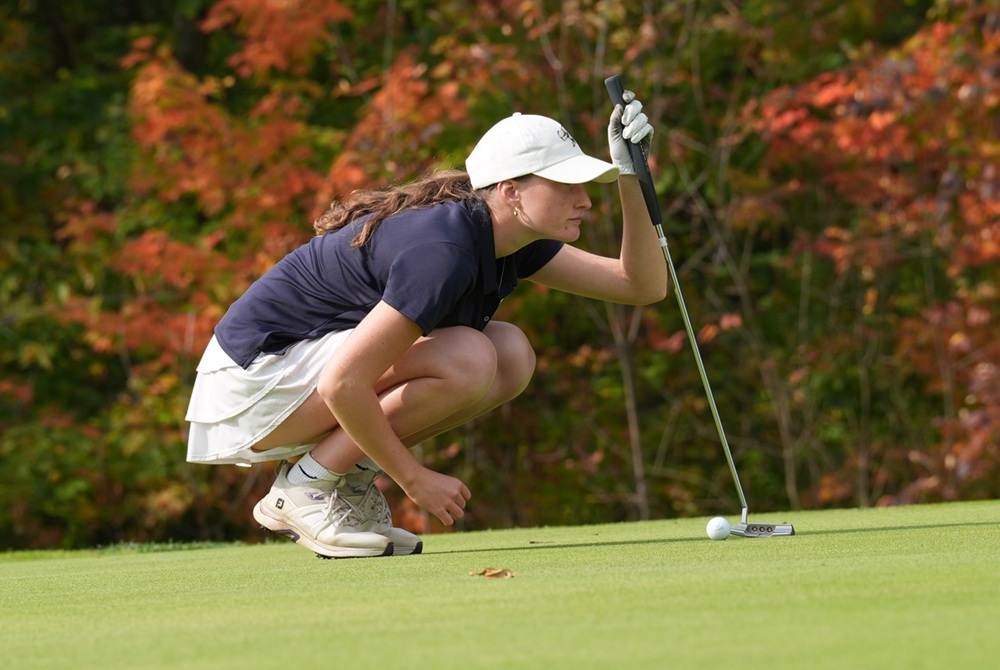
PHOTO Detroit Country Day’s Halle Heineman lines up a putt during last season’s Lower Peninsula Division 3 Final. (Click for more from High School Sports Scene.)