


New Math: Division & Multiplication Problems
July 25, 2017
By Jack Roberts
MHSAA Executive Director
This is the second part in a series on MHSAA tournament classification, past and present, that will be published over the next two weeks. This series originally ran in this spring's edition of MHSAA benchmarks.
High school tournament classifications went viral before there was social media and most of us knew what “viral” meant.
Much as a virus infects computers today or has created epidemics of disease around the world for centuries, high school tournament classification – once introduced – tends to spread uncontrollably. Once started, it tends to keep expanding and rarely contracts.
While we are still some distance from providing every team a trophy as a result of expanding high school tournament classification across the country, there is criticism nevertheless that we are headed in that direction – a philosophy which is supposed to exist only in local youth sports for our youngest children.
Michigan could be blamed for all this. Michigan is generally accepted as the first state to provide different classifications for season-ending tournaments for different sized schools. It started a century ago. Today, every state has various classifications for its tournaments in most if not all sports. And it is a bit ironic that Michigan – creator of the classification chaos – more than most other states has kept the number of tournament classes or divisions under control.
Yes, there is evidence that tournament classifications have expanded over the years in Michigan, especially with the relatively recent introduction of tournaments in football and the late 1990s’ move from classes to divisions in most MHSAA tournaments. But the MHSAA Representative Council has held true to its word when it expanded the playoffs for football from four classes to eight divisions: this is needed because of unique factors of football, factors that exist in no other sport; and all other sports should be capped at a maximum of four classes or divisions.
Kentucky is the preeminent defender of single-class basketball. All of its 276 high schools compete for the single state championship for each gender. In Indiana, there are still open wounds from its move in 1998 from one to four classes for its 400 schools in basketball.
Multi-class tournaments have tended to increase the number of non-public school champions, which some states are trying to lower through enrollment “multipliers,” and also tend to increase the number of repeat champions, which some states are trying to affect with “success factors” which lift smaller schools into classifications for larger schools if they take home too many trophies.
While there is considerable evidence that state tournaments do as much bad as good for educational athletics, state associations persist in providing postseason tournaments because, on balance, the experiences are supposed to be good for student-athletes. And once we reach that conclusion it is just a small leap to believe that if the tournaments are good for a few, they must be better for more – which leads to creating more and more tournament classifications. One becomes two classes, then three, then four and so forth.
While the argument is that more classifications or divisions provides more students with opportunities to compete and win, it is undeniable that the experience changes as the number of tournament classifications expands. It is not possible for state associations to provide the same level of support when tournament classifications expand to multiple venues playing simultaneously. For example, there is less audio and video broadcast potential at each venue, and less media coverage to each venue. Focus is diluted and fans diminished at each championship.
No one can argue reasonably that today's two-day MHSAA Football Finals of eight championship games has the same pizazz as the one-day, four-games event conducted prior to 1990.
In some states the number of divisions has grown so much that it is difficult to see much difference between the many season-ending state championship games and a regular-season event in the same sport.
It is a balancing act. And Michigan has been studying that balance longer than any other state, and charting a steadier course than most.
Addition by Division
The shift to Divisions for MHSAA Tournament play in numerous sports has added up to a greater number of champions for teams and individuals across the state. Following are the sports currently employing a divisional format, and the procedures for determining enrollment and classification.
In 23 statewide or Lower Peninsula tournaments, schools which sponsor the sport are currently divided into nearly equal divisions. They are:
- Baseball - 4 Divisions
- Boys Bowling - 4 Divisions
- Girls Bowling - 4 Divisions
- Girls Competitive Cheer - 4 Divisions
- LP Boys Cross Country - 4 Divisions
- LP Girls Cross Country - 4 Divisions
- LP Boys Golf - 4 Divisions
- LP Girls Golf - 4 Divisions
- Ice Hockey - 3 Divisions
- Boys Lacrosse - 2 Divisions
- Girls Lacrosse - 2 Divisions
- Boys Skiing - 2 Divisions
- Girls Skiing - 2 Divisions
- LP Boys Soccer - 4 Divisions LP
- Girls Soccer - 4 Divisions
- Girls Softball - 4 Divisions
- LP Boys Swimming & Diving - 3 Divisions
- LP Girls Swimming & Diving - 3 Divisions
- LP Boys Tennis - 4 Divisions
- LP Girls Tennis - 4 Divisions
- LP Boys Track & Field - 4 Divisions
- LP Girls Track & Field - 4 Divisions
- Wrestling - 4 Divisions
Lists of schools for each division of these 23 tournaments are posted on MHSAA.com approximately April 1. Listings of schools in Upper Peninsula tournaments for their sports are also posted on MHSAA.com. The lists are based on school memberships and sports sponsorships in effect or anticipated for the following school year, as known to the MHSAA office as of a date in early March.
In football, the 256 schools which qualify for MHSAA 11-player playoffs are placed in eight equal divisions annually on Selection Sunday. Beginning in 2017, the 8-player divisions will be determined in a like manner on Selection Sunday as well, with 32 qualifying schools placed in two divisions.
Schools have the option to play in any higher division in one or more sports for a minimum of two years.
The deadlines for "opt-ups" are as follows:
- Applications for fall sports must be submitted by April 15
- Applications for winter sports must be submitted by Aug. 15
- Applications for spring sports must be submitted by Oct. 15
Subsequent to the date of these postings for these tournaments, no school will have its division raised or lowered by schools opening or closing, schools adding or dropping sports, schools exercising the option to play in a higher division, or approval or dissolution of cooperative programs.
When the same sport is conducted for boys and girls in the same season (e.g., track & field and cross country), the gender that has the most sponsoring schools controls the division breaks for both genders.
Glen Lake Grad Adds Pacific Ocean to Life's Journey in Completing World's Toughest Row
By
Tom Spencer
Special for MHSAA.com
August 18, 2026
Julie (Adams) Bennett has lots of memories from her days at Glen Lake High School. Many are great, some not so great.
 And, while she took all of them with her as she just rowed across the Pacific Ocean, her battle with anorexia was at the top.
“In our culture, thin is beautiful, and it always has been,” said Bennett, a 1982 Lakers graduate. “We grew up in the '70s with all of the magazines and all of the thin models. I was kind of a fat kid in junior high. You know, you get a little chunky, and then you grow taller. Well, I got chunky, but I never grew taller.”
Bennett found herself in a battle with anorexia, leading her to raise funds and awareness for the National Eating Disorders Association as she recently competed in and completed the World's Toughest Row. The crossing occurred after more than a year of preparation, and NEDA was one of four organizations the team supported as part of taking on the challenge.
“I was teased a lot for my weight in high school,” recalled Bennett, who experienced hurtful name-calling. “It isn't the only reason why I became anorexic, but I did. I know people who don't recover from anorexia. It takes their life. I was one of the lucky ones”
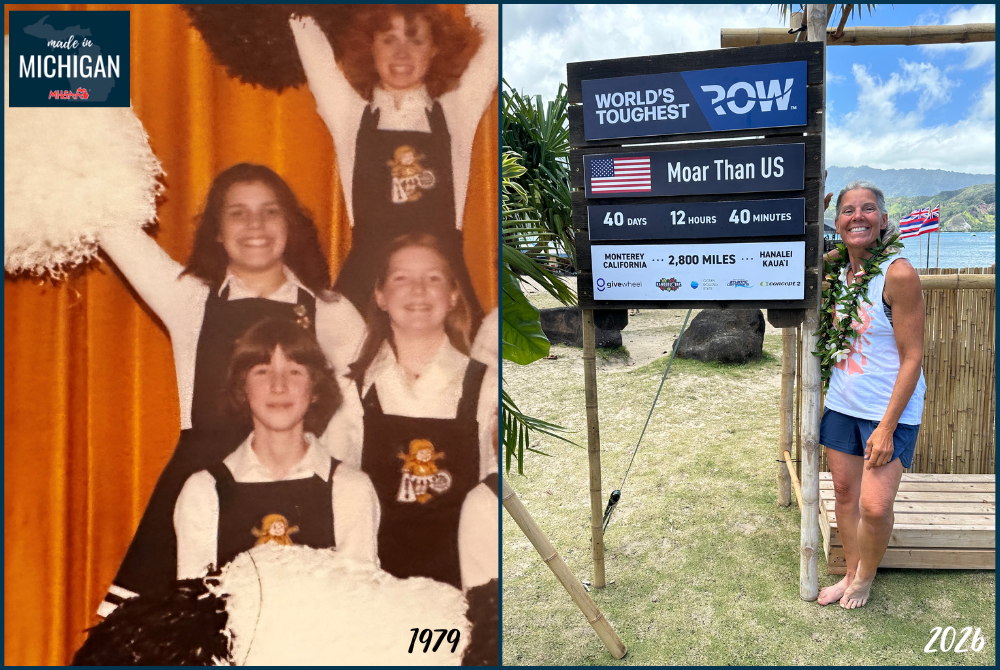
Bennett was a middle distance runner on the Lakers track team and a key member of the cheer team. Fall was spent supporting the football team and winter the basketball team as Title IX was just starting to impact sports opportunities for girls.
“When I was in junior high, there were no competitive girl sports,” Bennett said. “I know a lot of people look at cheerleading and think ‘oh they're just fluffy girls who are really girly and just want to cheer.’ But every summer, we did competitive cheer camps.”
Bennett picked up rowing when her youngest son, Steven, joined the sport as a freshman in high school in the Grand Rapids area. It wasn’t long before she began coaching adults and kids in the sport after years of teaching group fitness and yoga.
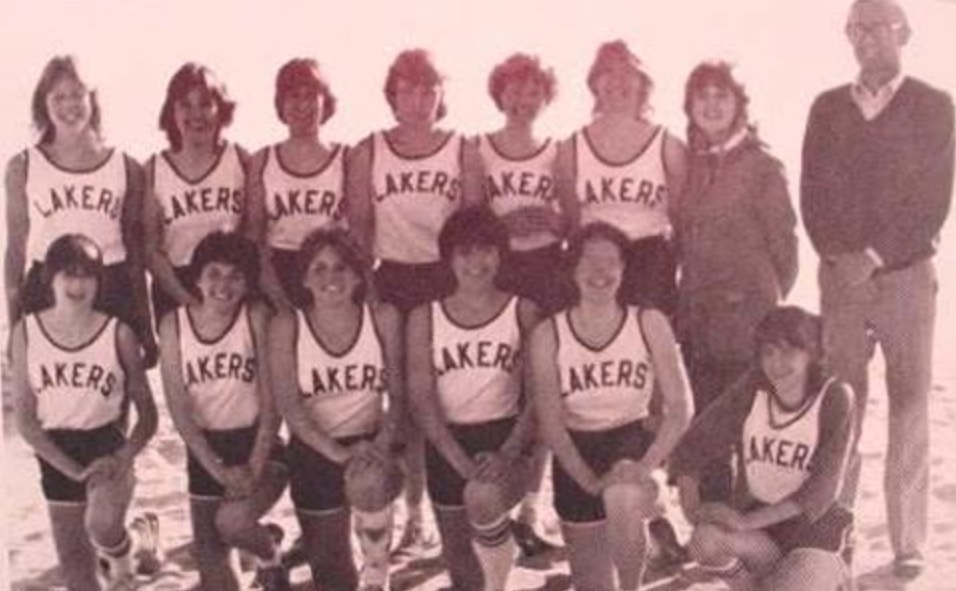 Bennett points to positive role models, like her mother, Pam, and multiple coaches, as having played significant roles in her battle with overcoming anorexia.
“They really put me on a path to make wise decisions about the food that I eat and about physical fitness,” she said. “So I had always just had a much healthier relationship with exercising and food than I could have. I mean, I could have gone off the rails.”
Bennett believes high school sports allow student-athletes learn discipline. It was that same discipline that helped her complete the 2,800-mile trip across the Pacific Ocean just a few weeks ago.
Bennett, along Erin Enk-Wiese, Susan Katt and Jak Kazmarek, left Monterey, Calif., on June 9 after a five-day weather delay. The four rowers landed 40 days later in Kauai, Hawaii.
The average crossing time for crews of all sizes over the history of the World’s Toughest Row is 62 days. The first boat to conquer the world’s deepest ocean this year took 36 days. Bennett’s team, Moar Than Us, was thrilled the trip was pretty much free of challenging weather, injury and other significant incidents.
“The discipline of sports, and the coaching that I got, was what really set me on a path to – not just for rowing, but it really just set me on a path – to be disciplined about my physical fitness,” she said. “You really need the discipline, but you don't think that you do, because you think you know everything when you're 16. All of that discipline really, really helped me mentally and physically and put me on a journey of lifelong physical fitness.”
Bennett’s crew took turns taking two-hour shifts in daylight and three-year shifts in the dark. The boat always had two in the rowing seats and two below resting and recovering. They did start and finish the race with all four crew members playing a role up top.
Bennett, who went on the graduate from Hope College and land her first teaching job at Glen Lake, is quick to identify the key to coaching high school sports today, especially rowing. She’s on the coaching staff of the Grand Rapids Rowing Club, one of just a small number of high school-sponsored rowing clubs in Michigan.
 “You teach them to love the sport, and then you teach them how to do it,” Bennett said. “You have to teach them how to love it. I was an endurance person and rowing certainly is an endurance sport.”
Rowing is a natural sport for the 5-foot-4 former Laker, despite her undergoing hip replacement during her 40s.
She fondly remembers her track experience at Glen Lake. While she mostly ran the 400 and 800 along with relays, her coaches entered her in all field events in hopes she could pick up a point or two.
“I don't have quick-twitch muscles, so I was not good enough to be in the sprints, but I ran sprint relays,” acknowledged Bennett. “Because we were a small team, if there was a third place to be had, coaches would throw me in. I threw shot put a couple of times. I remember throwing shot put against Mesick. They could throw it twice as far, but I got the point in third.”
Bennett noted the Pacific crossing annually attracts sailors and navigators, along with a few others.
“It also attracts just people who are adrenaline junkies,” she said. “People who just want that jolt from doing something amazing.”
Bennett though, did it for other reasons, including raising awareness for anorexia.
“The best message that you can give somebody is that you can be any age, any gender, any size, and do it,” she said. “You can do difficult things, and you shouldn't shortchange yourself by not being mentally ready for that challenge.”
2026 Made In Michigan
Aug. 13: Basketball Takes 'The Judge' Worldwide, Home Again as Love of Game Lives On - Report
Aug. 11: Nearly 25 Years After Leading Unexpected Run, Morton Directing Life-Changing Mission - Report
Aug. 7: Significance of Historic Run, Relationships Formed Live On for 1973 Unity Champs - Report
Aug. 4: Work Ethic Continues to Drive Van Dyk's Endeavors as Co-Owner of Family Farm - Report
July 24: Hackett Mentor's Care Sparked Lifetime in Hoops for BCAM President White - Report
July 24: Mackey Leaving Court with 500+ College Hoops Wins, Many More Lessons Shared - Report
July 16: Country Day Two-Time Champ Moore Building Perennial Winner at Harvard - Report
July 9: Multi-Sport Career at TC West Helps Gillis Thrive as Pro in Game She Once Left Behind - Report
July 2: Inspired by Home, Eager to Give Back, Spencer Hosts Hoop City Alumni Games - Report
PHOTOS (Top) At left, Julie Bennett stands in formation with her Glen Lake cheer team in 1979. At right, Bennett stands next to a sign explaining the accomplishment after completing the Pacific Ocean crossing with her crewmates. (Middle) Bennett, front row and fourth from left, poses for a team photo with her high school track team. (Below) The Moar Than US team rows toward Hawaii, and celebrates its accomplishment. (Glen Lake photos courtesy of the Glen Lake yearbook staff. Moar Than US photos courtesy of World's Toughest Row, More Than US team and Bennett family.)