

New Math: Division & Multiplication Problems
July 25, 2017
By Jack Roberts
MHSAA Executive Director
This is the second part in a series on MHSAA tournament classification, past and present, that will be published over the next two weeks. This series originally ran in this spring's edition of MHSAA benchmarks.
High school tournament classifications went viral before there was social media and most of us knew what “viral” meant.
Much as a virus infects computers today or has created epidemics of disease around the world for centuries, high school tournament classification – once introduced – tends to spread uncontrollably. Once started, it tends to keep expanding and rarely contracts.
While we are still some distance from providing every team a trophy as a result of expanding high school tournament classification across the country, there is criticism nevertheless that we are headed in that direction – a philosophy which is supposed to exist only in local youth sports for our youngest children.
Michigan could be blamed for all this. Michigan is generally accepted as the first state to provide different classifications for season-ending tournaments for different sized schools. It started a century ago. Today, every state has various classifications for its tournaments in most if not all sports. And it is a bit ironic that Michigan – creator of the classification chaos – more than most other states has kept the number of tournament classes or divisions under control.
Yes, there is evidence that tournament classifications have expanded over the years in Michigan, especially with the relatively recent introduction of tournaments in football and the late 1990s’ move from classes to divisions in most MHSAA tournaments. But the MHSAA Representative Council has held true to its word when it expanded the playoffs for football from four classes to eight divisions: this is needed because of unique factors of football, factors that exist in no other sport; and all other sports should be capped at a maximum of four classes or divisions.
Kentucky is the preeminent defender of single-class basketball. All of its 276 high schools compete for the single state championship for each gender. In Indiana, there are still open wounds from its move in 1998 from one to four classes for its 400 schools in basketball.
Multi-class tournaments have tended to increase the number of non-public school champions, which some states are trying to lower through enrollment “multipliers,” and also tend to increase the number of repeat champions, which some states are trying to affect with “success factors” which lift smaller schools into classifications for larger schools if they take home too many trophies.
While there is considerable evidence that state tournaments do as much bad as good for educational athletics, state associations persist in providing postseason tournaments because, on balance, the experiences are supposed to be good for student-athletes. And once we reach that conclusion it is just a small leap to believe that if the tournaments are good for a few, they must be better for more – which leads to creating more and more tournament classifications. One becomes two classes, then three, then four and so forth.
While the argument is that more classifications or divisions provides more students with opportunities to compete and win, it is undeniable that the experience changes as the number of tournament classifications expands. It is not possible for state associations to provide the same level of support when tournament classifications expand to multiple venues playing simultaneously. For example, there is less audio and video broadcast potential at each venue, and less media coverage to each venue. Focus is diluted and fans diminished at each championship.
No one can argue reasonably that today's two-day MHSAA Football Finals of eight championship games has the same pizazz as the one-day, four-games event conducted prior to 1990.
In some states the number of divisions has grown so much that it is difficult to see much difference between the many season-ending state championship games and a regular-season event in the same sport.
It is a balancing act. And Michigan has been studying that balance longer than any other state, and charting a steadier course than most.
Addition by Division
The shift to Divisions for MHSAA Tournament play in numerous sports has added up to a greater number of champions for teams and individuals across the state. Following are the sports currently employing a divisional format, and the procedures for determining enrollment and classification.
In 23 statewide or Lower Peninsula tournaments, schools which sponsor the sport are currently divided into nearly equal divisions. They are:
- Baseball - 4 Divisions
- Boys Bowling - 4 Divisions
- Girls Bowling - 4 Divisions
- Girls Competitive Cheer - 4 Divisions
- LP Boys Cross Country - 4 Divisions
- LP Girls Cross Country - 4 Divisions
- LP Boys Golf - 4 Divisions
- LP Girls Golf - 4 Divisions
- Ice Hockey - 3 Divisions
- Boys Lacrosse - 2 Divisions
- Girls Lacrosse - 2 Divisions
- Boys Skiing - 2 Divisions
- Girls Skiing - 2 Divisions
- LP Boys Soccer - 4 Divisions LP
- Girls Soccer - 4 Divisions
- Girls Softball - 4 Divisions
- LP Boys Swimming & Diving - 3 Divisions
- LP Girls Swimming & Diving - 3 Divisions
- LP Boys Tennis - 4 Divisions
- LP Girls Tennis - 4 Divisions
- LP Boys Track & Field - 4 Divisions
- LP Girls Track & Field - 4 Divisions
- Wrestling - 4 Divisions
Lists of schools for each division of these 23 tournaments are posted on MHSAA.com approximately April 1. Listings of schools in Upper Peninsula tournaments for their sports are also posted on MHSAA.com. The lists are based on school memberships and sports sponsorships in effect or anticipated for the following school year, as known to the MHSAA office as of a date in early March.
In football, the 256 schools which qualify for MHSAA 11-player playoffs are placed in eight equal divisions annually on Selection Sunday. Beginning in 2017, the 8-player divisions will be determined in a like manner on Selection Sunday as well, with 32 qualifying schools placed in two divisions.
Schools have the option to play in any higher division in one or more sports for a minimum of two years.
The deadlines for "opt-ups" are as follows:
- Applications for fall sports must be submitted by April 15
- Applications for winter sports must be submitted by Aug. 15
- Applications for spring sports must be submitted by Oct. 15
Subsequent to the date of these postings for these tournaments, no school will have its division raised or lowered by schools opening or closing, schools adding or dropping sports, schools exercising the option to play in a higher division, or approval or dissolution of cooperative programs.
When the same sport is conducted for boys and girls in the same season (e.g., track & field and cross country), the gender that has the most sponsoring schools controls the division breaks for both genders.
Inspired by Home, Eager to Give Back, Spencer Hosts Hoop City Alumni Games
By
Tom Kendra
Special for MHSAA.com
July 2, 2026
Eddie Spencer now lives more than 1,100 miles away in Dallas, but his thoughts are never far from his hometown of Muskegon Heights.
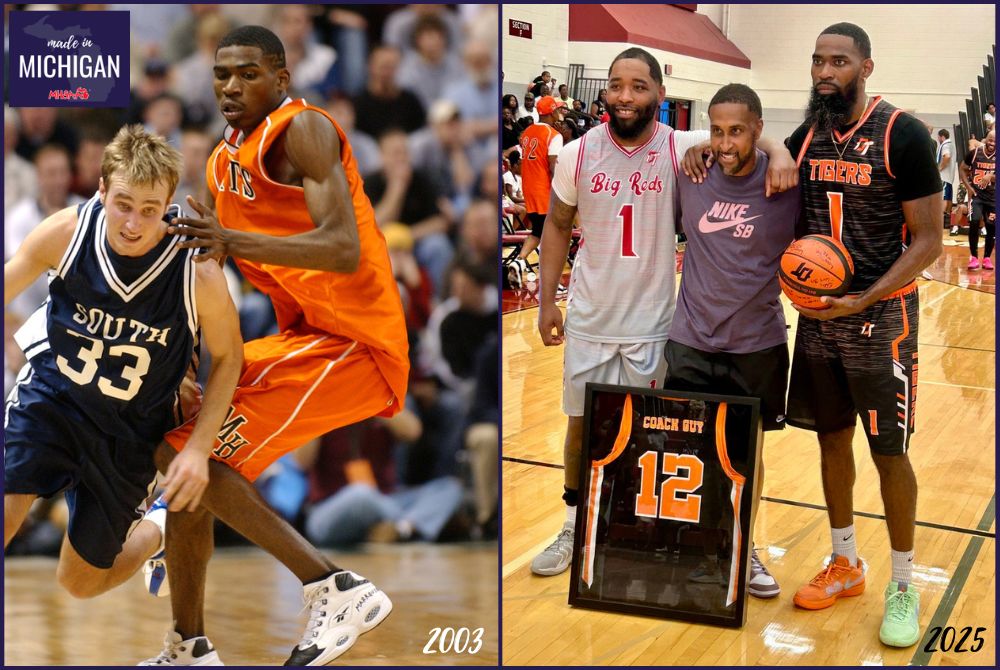
 It was there in “the Heights” where Spencer learned the game of basketball, developing into a 6-foot-5 forward who could shoot and handle the ball – leading Heights to the Class C Semifinals as a junior in 2002 and the Class B Final as a senior in 2003.
Spencer, 41, said the biggest lessons he learned from basketball had nothing to do with shooting or rebounding.
“Playing basketball taught me how to work hard, stay focused and, really, how to be a man,” said Spencer, who went on to become a three-year starter at Central Michigan, graduating in 2008.
“I wanted to find a way to give something back.”
Spencer’s desire to return some love to his hometown led to the Hoop City Alumni basketball tournament, which is set for its third year at Muskegon High School’s historic Redmond-Potter Gymnasium on Aug. 22 with five alumni games – highlighted by the finale, featuring Muskegon vs. Muskegon Heights.
The last two years, the RPG was standing-room-only with more than 2,000 fans for the finale, with Muskegon fans in their trademark cardinal red and Heights fans proudly in their orange and black.
“Honestly, when I walked out of the locker room that first year and saw all of the excitement and pride in that gym, it brought tears to my eyes,” said Spencer. “It really brought back that old feeling of Heights vs. Muskegon, like back in high school.”
A rivalry like no other
Few rivalries in the state can match the history and the intensity of Muskegon vs. Muskegon Heights.
The Big Reds and Tigers played each other in football 55 years in a row from 1922-76, with the most competitive years and largest crowds occurring during the 1940s and 1950s.
In more recent years, the rivalry was on the basketball court, including a run of nine years from 2003 to 2011 when the two schools played the final game of the Muskegon Area Sports Hall of Fame Holiday Classic, with Heights winning six of those nine matchups. The rivalry came to an end in 2011 after a period of upheaval and enrollment losses at Heights.
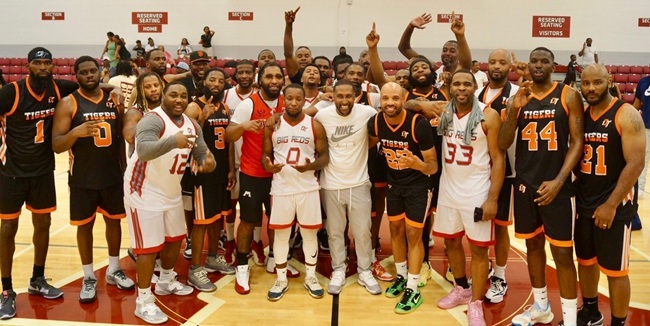 Now, thanks to the efforts of Spencer and his crew (notably Muskegon head coach and athletic director Keith Guy and 2014 Mr. Basketball Award winner DeShaun Thrower from Muskegon) the rivalry has resumed each August at the alumni game.
“It definitely divides the community for a couple of hours,” said Spencer, who also ran cross country at Heights. “There is already a huge buzz about this year’s event and tons of trolling and trash talking.”
Spencer played several years of professional basketball, including overseas, after graduating from CMU. He then returned home and coached basketball for several years at Muskegon Heights under Guy before the latter moved on to lead the Big Reds.
Spencer moved to Dallas eight years ago and has coached AAU basketball and served as a personal trainer, in addition to his work in the mortgage industry. About five years ago, he helped a friend organize an alumni basketball game in the Dallas area – and he knew immediately that he had to do the same back home.
“The first thing I thought was that we have to do this with Muskegon and Muskegon Heights,” said Spencer, who noted that the games also feature alumni cheerleaders.
The event is not designed for recent high school graduates, with most of the teams’ players in their 30s and 40s.
This year’s tournament will begin with Mona Shores vs. Muskegon Orchard View alumni at 2 p.m. and a Muskegon-area girls game (East vs. West) at 3 p.m.
North Muskegon squares off against Muskegon Reeths-Puffer at 4 p.m., followed by the addition this year of ex-standouts from Grand Rapids against Kalamazoo at 5 p.m. – all leading up to the Heights vs. Muskegon finale at 6 p.m.
Spencer expects attendance to be strong all day (admission is $10), but acknowledges the crowds and atmosphere move to a whole different level for the final game. This year’s tournament also will be live-streamed so people can pay to watch the games from anywhere in the world, with those details still being worked out.
Beyond basketball
Spencer knows that beyond the basketball and beneath the banter, the Hoop City Alumni event is really a celebration of two proud communities.
It has become the weekend when many make plans to come back home to Muskegon, not only to relive the glory days, but to celebrate the post-basketball accomplishments of those prep greats – including some who have gone on to become doctors, lawyers, business leaders, coaches and school principals.
“We are really utilizing the game of basketball to help the community,” said Spencer, whose daughter, Nya, graduated from Muskegon High. “When people feel pride in their community, they want to make it better. We want all the kids, especially, to be there and to see how playing sports can be the start of great things for them.”
 The Hoop City games have evolved into a full weekend of events, starting with a Friday back-to-school event with backpacks and school supplies giveaways at Rowan Park in downtown Muskegon Heights, pre- and postgame adult gatherings Friday and Saturday night and a picnic Sunday.
But make no mistake, basketball is the centerpiece.
Heights won the inaugural alumni game in 2024, and Muskegon prevailed at the buzzer last year, making this year’s event (which has been dubbed “The Trilogy”) the rubber match, at least for now, in the latest installment of the decades-old rivalry.
This year’s game will be hard-pressed to match the drama and emotion of last summer’s contest.
In a back-and-forth affair, it was Thrower who forced a turnover at the defensive end and then hit the game-winning shot at the buzzer for Muskegon, leading to a raucous scene as Big Reds fans stormed the court.
It was a highly-emotional moment for Thrower, who was playing his first competitive game in years after a foot injury, and it came just a few months after the death of his mother, Nina Morgan Thrower.
“The way the whole event went and the way it ended, it felt like a movie, for sure,” said Thrower, who has worked alongside Spencer to grow the showcase.
“I know that my mom was with me on that day, in that moment.”
PHOTOS (Top) At left, Muskegon Heights’ Eddie Spencer (1) defends during the 2003 Class B Final against Grand Rapids South Christian; at right, Spencer (far right) stands for a photo at last year’s Hoop City alumni event with former coach Keith Guy and past Muskegon High standout DeShaun Thrower. (Middle) Spencer, far left, poses with the rest of the Muskegon Heights and Muskegon High alumni teams after last season’s Hoop City matchup. (Below) This season’s Hoop City poster advertises five alumni games. (Hoop City photos provided by Eddie Spencer.)