

500 Attend 'Officiate Michigan Day II'
By
Geoff Kimmerly
MHSAA.com senior editor
August 4, 2018
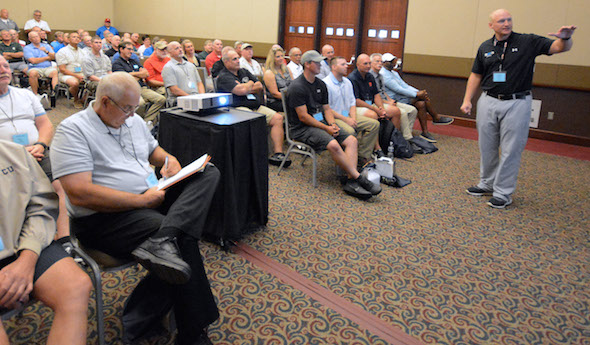
LANSING – More than 500 Michigan officials, from beginners to veterans with decades of experience, gathered Saturday at the Lansing Center for “Officiate Michigan Day II” – an opportunity to learn and train with experts in the avocation and share their passion for playing an irreplaceable role in high school sports.
They were greeted by MHSAA Executive Director and past College World Series baseball umpire Mark Uyl, and sent forth at the conclusion by retired wrestling official James C. McCloughan, who received the Medal of Honor in 2017 for his military service in Vietnam as a combat medic with the U.S. Army.
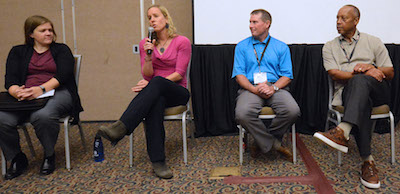 In between, attendees took in multiple sport-specific training sessions. Lunchtime panels provided opportunities to learn and interact on a number of topics, from effective communication to training and mentoring new officials.
“I hope to get a lot of things from a lot of experienced officials,” said Lansing’s Ken Black Jr., a first-year official, as he prepared to dive into the day’s opportunities. “This is my first year doing it, and I want to digest everything they have to say and go from there.”
The first Officiate Michigan Day was conducted in July 2013 as part of the run-up to the National Association of Sports Officials conference in Grand Rapids. NASO will bring its conference back to Michigan in 2021, with Officiate Michigan Day III to be part of those festivities.
Below are a pair of videos from Saturday’s event. The first gives a few glances at what attendees experienced – including a session with recently-hired MHSAA coordinator of officials Brent Rice – and also includes comments from officials explaining why they made the trip.
The second video shows the final minute of McCloughan’s closing, where he salutes veterans in attendance and gives a special musical tribute.
Also, click to see more photos from our Officiate Michigan Day II gallery.
PHOTOS: (Top) Instructor Dave Uyl, far right, presents during Saturday’s Officiate Michigan Day II. (Middle) From left, Rachael Stringer, Margaret Domka, Jeff Servinski and Lamont Simpson explain “Climbing the Ladder” of the officiating ranks. (Photos by John Johnson.) VIDEOS by Jeremy Sampson (top) and John Johnson.

Be the Referee: Trickery & Communication
October 24, 2018
This week, MHSAA officials coordinator Sam Davis explains a key piece of communication that takes place between football referees and coaches during pregame.
Be The Referee is a series of short messages designed to help educate people on the rules of different sports, to help them better understand the art of officiating, and to recruit officials.
Below is this week's segment – Trickery & Communication - Listen
One of the long-time strategies in the game of football is deception. It has lots of other names, and most often goes these days by the name of trickery. Catching an opponent off-guard can break a game wide open. But catching the officiating crew off-guard is something you don’t want to have happen or else your big play may be blown dead inadvertently.
That’s why during the pre-game meeting the officiating crew has with each head coach, one of the questions that will be asked is – “Coach, do you have any trick plays we should be watching for?” And coaches, who are usually tight lipped about a lot of their strategies, will be very open and describe in detail anything fancy that’s in the playbook for that game.
This type of communication gets coaches and officials on the same page and ensures that when trickery comes visiting, only the opponents are surprised.
Past editions
October 18: Punts & Missed Field Goals - Listen
October 11: What Officials Don't Do - Listen
October 4: Always 1st-and-Goal - Listen
September 27: Unique Kickoff Option - Listen
September 20: Uncatchable Pass - Listen
September 13: Soccer Rules Change - Listen
September 6: You Make the Call: Face Guarding - Listen
August 30: 40-Second Play Clock - Listen
August 23: Football Rules Changes - Listen