

Always Aiming to Provide a 'Fair Start'
June 6, 2013
By Geoff Kimmerly
Second Half editor
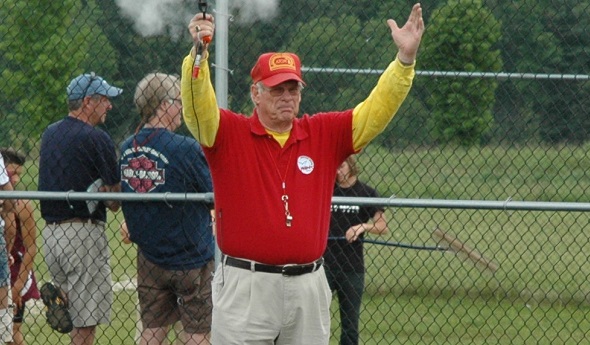
Tom Truscott was glad where he stood as he raised his hands to start the 100-meter boys Regional race at Lansing Sexton in 1987 that featured Corey Pryor of Jackson, Tico Duckett of Kalamazoo Loy Norrix and the host Big Reds’ Alan Haller.
They’d go on a few weeks later to finish first, third and fourth, respectively, in arguably the fastest MHSAA Finals race of all time. And on this afternoon, Truscott was glad he didn’t have to referee at the finish and figure out who crossed the line first.
To be honest, he’s never paid much attention to finishes during 42 years as an MHSAA track and field and cross country official who has launched a few generations of athletes in the classroom, on various playing fields and as one of the best-recognized race starters in the Lansing area.
His philosophy is simple – and surely has stretched across an educational career that began with his first MHSAA officials registration for the 1959-60 school year.
“I start,” Truscott said, “because I want to give the kids a fair start.”
Truscott has officiated for 42 years in addition to the nearly four decades he spent as a coach and athletic director. In keeping with that desire to give a “fair start,” Truscott quietly told organizers of the longtime Lansing Area Honor Roll Track and Field Meet that last Wednesday’s would be his 32nd and last as starter – not because he doesn’t love it still, but because it’s time to give younger officials the opportunity to run the prestigious show.
It’s a decision consistent with a career of creating opportunities – in track speak, starts – through sports.
“That’s typical Tom. He’s a gracious, humble man,” said retired longtime Grand Ledge and Fowler coach Kim Spalsbury, who now serves as director of the Honor Roll Meet. “That’s what Tom’s all about.”
Standing tall
There’s no way Truscott is 75 years old, one might conclude as he stands tall and instructs runners at the start of a race in a smooth baritone voice.
But he’s been involved as a high school athlete, coach, director or official for more than 60 years – and has officiating dates already stamped on his 2013-14 calendar.
 Truscott remains best known in school circles for his more than three decades as a coach and administrator at Potterville High School. A three-sport standout at Lansing Everett from 1953-56 and then two-sport athlete at Hillsdale College, Truscott joined Potterville schools in 1961. He went on to coach Vikings boys basketball teams to more than 300 wins and four District titles during 35 seasons, and he also led the football program for 24 seasons over two tenures – five of his teams won league championships, and he joined the Michigan High School Football Coaches Association Hall of Fame in 1986.
He also served as Potterville High School’s athletic director from 1963-96, even during a brief time when he also coached football as an assistant at Lansing Sexton. Potterville was one of few small schools in the mid-Michigan area with full track and field facilities, so Truscott hosted just about every significant event. He served as meet manager for 16 Regionals and also the 1977 and 1978 Lower Peninsula Class D Wrestling Finals.
Truscott also was a strong advocate as girls sports began to grow after Title IX. Among his best coaching hires was Sheryl Mox – who ended up leading both the girls basketball and volleyball teams to MHSAA championships and also became the athletic director.
“He’s a tall man in stature, and that’s a good way to list his long list of accomplishments,” said Spalsbury, who met Truscott in 1980 as their schools belonged to the same league, the Central Michigan Athletic Conference.
Truscott took an officiating course while at Hillsdale, and soon after debuted as an official for a few Thursday night football games. He was a third base umpire during the inaugural Capital Area Diamond Classic baseball tournament, which finished up its 52nd running this week. Cross country and track and field became his sports of choice for officiating because they best fit into his schedule as a coach and athletic director. He took a break from officiating for most of the 1970s, but has been a consistent presence again for the last three decades.
“You can stay associated with athletics by doing it. And you’re the person that’s going to influence the charisma of the game, how the game goes,” Truscott said, explaining how he'd sell the avocation to someone who might be considering it. “You don’t want to be noticed; you’re there to make a fair call and give kids a fair start.”
Seeing the big picture
That's another way Spalsbury described his longtime colleague.
Truscott continues to love the sports he played and coached. But running sports he officiates have earned a special place in his heart.
“You’re always going to the dugout or the locker room (with other sports). You never socialize with your competitors,” Truscott said. “With track and cross country, that’s the marvel of it; you talk to each other, know each other and then get into the blocks and try to beat each other. Then associate with each other again.”
 History is among Truscott’s favorite non-sports pastimes, although he certainly finds ways to tie the two; he emulated his Everett history teacher and coach Ted Bauer and so became a history teacher as well who often found a way to mix historical context into halftime speeches.
Truscott is an active member of the Michigan Historical Commission and has dedicated roughly 60 landmarks across the state. An officiating experience recently crept into one of those dedications – when placing a marker at Battle Creek’s Kellogg Community College last month, he likened the continuing education aspect of junior college to a Fulton-Middleton runner who despite trailing by laps continued until she had finished her race.
As word began to spread Wednesday that Truscott was retiring from the Honor Roll Meet, a few admirers made sure to pass on what he’d meant to them. Former Lansing Catholic standouts Zach Zingsheim and Jimmy Hicks – now running at Georgetown University and the University of Georgia, respectively – made sure to let Truscott know he was the best they’ve had start them, including those they’ve seen during their first seasons at the college level.
“They made a point to search him out and go and talk to him and tell him what they thought of him,” Lansing Catholic coach Tim Simpson said. “It is rare that kids would gain that much respect and like for an official.”
But Truscott has earned it by understanding how best to relate to high school athletes.
His son John Truscott, a former athlete at Sexton, remembered a situation concerning a championship-caliber competitor who was committing a minor violation that would've meant disqualification – but before taking that step, Tom Truscott gave the athlete a head's up instead. “He’s always looking out of kids,” John Truscott said.
Simpson recalled another occasion when one of his more “fiery” freshman girls threw a baton in the infield after a disappointing finish. Truscott called out “Ma’am” – which might’ve been a first for the stunned runner – and then explained why what she did was wrong. “Instead of just disqualifying her, he took the extra time. And that incident was never forgotten by that girl,” Simpson said. “It could have been a negative, and he turned it into a positive.
“He treats the kids with respect and in turn gets it back.”
Truscott started the Big Ten Cross Country Championships in 1991 at Michigan State University, and early in his career started meets at Olivet College and the University of Michigan.
But officiating at those levels never stacked up to the fun he’s had starting high school athletes.
John Truscott still hears from his dad after meets about the latest standout he saw or the one showing the potential to do great things. John knows better than most what the high school games mean to Tom – he often assisted his father during Saturday events – and why providing that "fair start" became a life's work.
“That really is his philosophy,” John Truscott said. “Over his career he coached great athletes, mediocre athletes and bad athletes. And he wanted them to all enjoy sports and learn from them, no matter what the future held for them.”
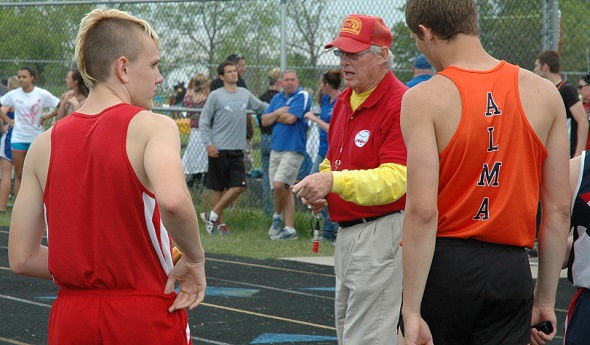
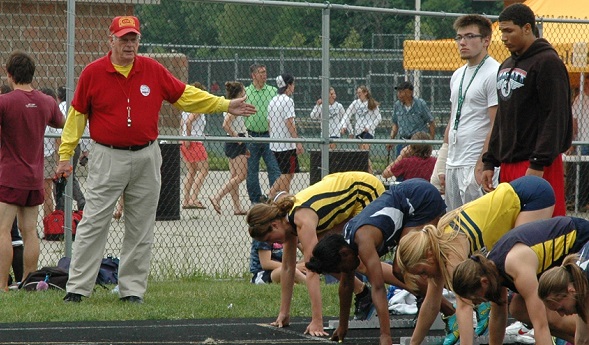
PHOTOS: (Top) Tom Truscott starts a race during last week's Lansing Area Honor Roll Track and Field Meet at Holt High School. (Middle) Truscott oganizes the 3,200 relay teams before their race. (Below) The 100-meter finalists await Truscott's start. (Photos by Geoff Kimmerly.)

Longtime Taylor AD, Game Official Ristovski Chose Athletics as Way to Give Back
By
Doug Donnelly
Special for MHSAA.com
February 20, 2024
There is a basketball court 5,000 miles from Sterling Heights with “MHL” painted on the center court.
 It’s not the name of a local basketball league in the village where it is located – Siricino, Macedonia. Instead, it stands for Madison, Haleigh and Lola, the three daughters of longtime Michigan basketball coach, referee and athletic director Loren Ristovski.
“My dad loved going back (to Macedonia),” said Madison Ristovski. “He’s probably gone every summer since about 2017. His whole family still lives there. He loved going and visiting and seeing everyone.
“It was always a goal of his to give back to where he came from. He and Mom donated to the village to build a soccer field and basketball court with lights and everything. It was a pretty big deal. It’s something he wanted to do for them back home. We were very proud he did that.”
Loren Ristovski, athletic director for Taylor schools, died earlier this month while on leave to have surgery on his foot. It was a shock to his family, friends, and the Taylor community.
“It was a heavy blow,” said Matt Joseph, girls basketball coach at Utica Ford and a longtime friend of the Ristovski family. “It was like getting kicked in the gut. Basketball was his passion. Next to his family, basketball was definitely No. 1. He loved the game and all the intricacies of it. He loved seeing kids excel.”
 Ristovski emigrated from Macedonia to Michigan when he was 9. He went to high school at Hamtramck St. Florian, where he excelled at basketball. He went to Wayne State University to get a degree in criminal justice and had plans to become a lawyer.
Before he could take the Law School Admission Test, however, basketball came calling.
“He started coaching at Henry Ford High School and Fuhrmann Middle School,” Madison said. “Once he realized how much he enjoyed coaching, he decided to go into education. He stayed the entire time. He never went to law school.”
Loren Ristovski became the head coach at Harper Woods but gave that up when his daughters were ready to start playing in high school.
“He gave up coaching varsity at Harper Woods so he could be at every one of my games,” Madison said.
He also coached them as youngsters, often teaming with Joseph to coach an AAU team.
“I met him when Madison was 5,” Joseph said. “He and I decided to put our daughters in the same parks and recreation team, and next thing you know we were coaching AAU.”
With Ristovski’s tutoring, Madison, Haleigh, and Lola all excelled at the game, each playing Division I college basketball after standout careers at Grosse Pointe Woods University Liggett. In 2012, Liggett reached the Class C Final with all three starting. They combined for 55 of Liggett’s 57 points in the championship game, with Madison scoring 42 after earlier that week receiving the Miss Basketball Award.
Lola and Haleigh played at the University of Detroit Mercy, and Madison played at the University of Michigan. Today, Haleigh lives on the west side of the state and plays recreational basketball. Lola is a referee in the Catholic High School League as well as for the Division II Great Lakes Intercollegiate Athletic Conference, and also works area Division III college games.
Madison is a teacher and the varsity girls basketball coach at Sterling Heights Stevenson.
“He taught us the game when we were very, very young,” Madison said. “We grew up in the gym with him and watched him coach his team. He coached me my whole life. He was very instrumental – he taught us all those things you need to become an athlete, and more importantly the things you need to do to succeed in life.”
Her dad is the reason she became a coach.
 “Watching my dad coach and seeing the impact he had on his high school athletes and even the kids in our church community – it inspired me to want to coach as well and give back like he did,” she said. “I watched him with my teammates and the impact he had on them. I thought it would be so cool if I could do the same for others.”
Loren Ristovski left a legacy at Taylor, too. School officials recounted several stories of how he balanced athletic budgets with the needs of student-athletes. He would lead fundraising efforts, created the Bitty Ball program for youth basketball players and cheerleaders and helped students become certified officials – and then would hire them to officiate games.
“He didn’t say no,” said Taylor boys basketball coach Chris Simons. “We made it work. We didn’t go out and ask people for a bunch of money. We would just do it. We all pulled together and made it work. Loren did everything he could to make things as pretty and presentable as he could with the budget we had.”
Ristovski also put on summer camps at both Taylor and at the Joe Dumars Fieldhouse in Sterling Heights, where he lived. He commuted about an hour to Taylor every day.
“He loved Taylor,” Madison said. “He loved who he worked with and the students. He included us, too. My mom would run the ticket table or do the scoreboard clock. I don’t know how many times I sold tickets for volleyball tournaments with him. He loved his people and loved having us there with him.”
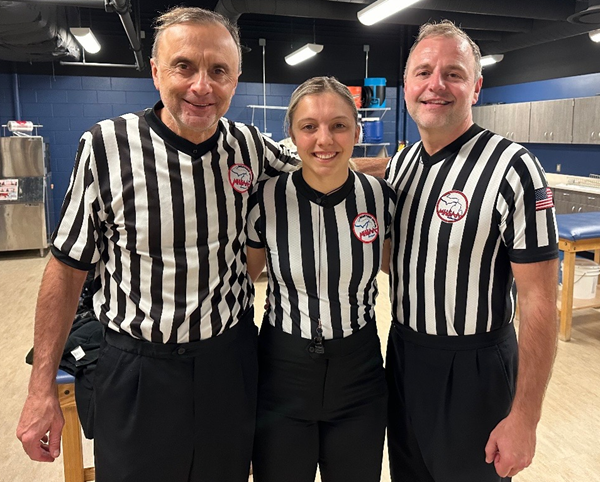
Loren Ristovski, who played professional basketball in Europe during the late 1980s, ran well over 20 marathons in his life, including the Boston Marathon. He was a registered MHSAA official for 16 years, and in the weeks before his passing he refereed a varsity game in Rochester with his daughter, Lola.
“He looked at basketball, I think, differently than other people do,” Madison said. “He saw it as a way to have relationships with other people, to help people achieve their goals and to find meaningful relationships with others. It was more than just a game to him.”
 Doug Donnelly has served as a sports and news reporter and city editor over 25 years, writing for the Daily Chief-Union in Upper Sandusky, Ohio from 1992-1995, the Monroe Evening News from 1995-2012 and the Adrian Daily Telegram since 2013. He's also written a book on high school basketball in Monroe County and compiles record books for various schools in southeast Michigan. E-mail him at [email protected] with story ideas for Jackson, Washtenaw, Hillsdale, Lenawee and Monroe counties.
PHOTOS (Top) Loren Ristovski, far left, and wife Svetlana support their lineup of Division I basketball-playing daughters – from left: Madison, Haleigh and Lola. (Middle) Loren Ristovski heads an all-family officiating crew with Lola and his brother Dean Ristovski. (Below) The daughters’ initials “MHL” glow on the court the family funded in Macedonia. (Photos courtesy of Madison Ristovski.)