

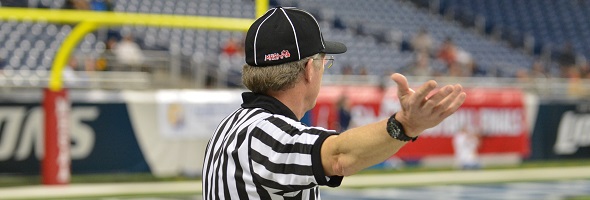
Be the Referee: 40-Second Play Clock
August 30, 2018
In this week's edition, assistant director Brent Rice explains how Michigan is continuing to experiment with a 40-second play clock in football.
Be The Referee is a series of short messages designed to help educate people on the rules of different sports, to help them better understand the art of officiating, and to recruit officials.
Below is this week's segment – 40-Second Play Clock - Listen
There’s an experiment taking place on a number of high school football fields across the state again this year. Michigan is experimenting with a 40-second play clock in football.
This is designed to provide more consistency from play to play as the ball must be snapped 40 seconds after the end of the previous play and is not dependent on the referee’s subjective signal.
When play is continuing without a stoppage, the 40-second play clock will be used. If play has been stopped for a time out or penalty, the play clock will be set at 25 seconds.
After two seasons, the feedback received from coaches and officials has been very positive, and there’s a possibility the Michigan experiment may become a new national playing rule soon.
Past editions
August 23: Football Rules Changes - Listen

Be the Referee: Wrestling Stalling
December 27, 2018
This week, MHSAA officials coordinator Sam Davis explains what wrestling officials look for while watching for stalling on the mat.
Be The Referee is a series of short messages designed to help educate people on the rules of different sports, to help them better understand the art of officiating, and to recruit officials.
Below is this week's segment – Stalling in Wrestling - Listen
Today in our series about misunderstood high school sports rules, we’re going to take up the topic of stalling in wrestling.
National high school rules require that stalling be called by the referee whenever it is recognized – regardless of the position of the wrestlers, the time in the match or the score of the match. When considering stalling, officials are watching to see if both wrestlers are making an honest attempt to stay within the 10-foot circle in the middle of the mat, and whether or not each wrestler is initiating action. Stalling would not be called when a wrestler is overpowering an opponent.
We hope that by becoming familiar with what referees are required to look for, that fans will better understand that stalling is a subjective call based on objective criteria.
Past editions
December 20: Basketball: You Make the Call - Listen
December 13: Basketball Uniform Safety - Listen
December 6: Coaching Box Expansion - Listen
November 29: Video Review, Part 2 - Listen
November 22: Video Review, Part 1 - Listen
November 15: You Make the Call - Sleeper Play - Listen
November 8: 7-Person Football Crews - Listen
November 1: Overtime Differences - Listen
October 25: Trickery & Communication - Listen
October 18: Punts & Missed Field Goals - Listen
October 11: What Officials Don't Do - Listen
October 4: Always 1st-and-Goal - Listen
September 27: Unique Kickoff Option - Listen
September 20: Uncatchable Pass - Listen
September 13: Soccer Rules Change - Listen
September 6: You Make the Call: Face Guarding - Listen
August 30: 40-Second Play Clock - Listen
August 23: Football Rules Changes - Listen