

Be the Referee: Basketball Replay
December 26, 2015
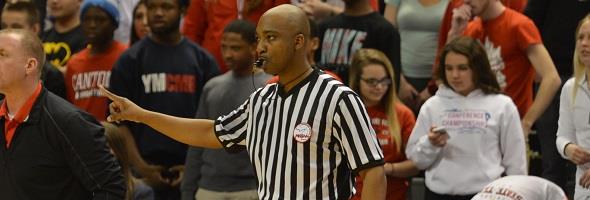
This week, MHSAA assistant director Mark Uyl explains the use of instant replay in basketball only for MHSAA Semifinals and Finals.
Be The Referee is a series of short messages designed to help educate people on the rules of different sports, to help them better understand the art of officiating, and to recruit officials.
Below is this week's segment - Basketball Instant Replay - Listen
When watching a college or NBA game, the last 2 minutes of the game can seem like they take forever, especially in recent years where more and more judgment calls made by officials are subject to instant replay.
At the high school level, video is not used to make a ruling or confirm or overturn a call made during the course of the contest. The only time video review is used at the high school level is at the MHSAA Semifinal and Final games held at the Breslin Center. In these games, video review can be used only to determine if a shot was released in time at the end of the 4th quarter or overtime or if that shot in those periods was a 2-point or 3-point field goal when the shot is released near the 3-point line.
The MHSAA believes that this very limited use of replay in these games at the very end of the tournament series in boys and girls basketball is the right call.
Past editions:
Dec. 17: Basketball Communication - Listen
Dec. 10: Basketball Excessive Contact - Listen
Nov. 26: Pregame Communication - Listen
Nov. 19: Trick Plays - Listen
Nov. 12: 7-Person Football Mechanics - Listen
Nov. 5: Make the Call: Personal Fouls - Listen
Oct. 29: Officials Demographics - Listen
Oct. 15: Make the Call: Intentional Grounding - Listen
Oct. 8: Playoff Selection - Listen
Oct. 1: Kick Returns - Listen
Sept. 24: Concussions - Listen
Sept. 17: Automatic First Downs - Listen
Sept. 10: Correcting a Down - Listen
Sept 3: Spearing - Listen
Aug. 27: Missed Field Goal - Listen
Davis Continues as MHSAA Mat Champion
By
Geoff Kimmerly
MHSAA.com senior editor
April 15, 2015
Sam Davis was a highly-touted freshman on the Michigan State University wrestling team and recently-crowned MHSAA champion from Lansing Eastern when an eye injury ended his competitive career on that mat.
But the longtime Lansing official continues to make a statewide impact on the sport he's loved for more than 50 years.
 Davis, one of the most accomplished wrestling officials in Michigan high school history and president of the Lansing Wrestling Officials Association for more than two decades, has been selected to receive the MHSAA’s Vern L. Norris Award for 2015. He will be honored at the Officials’ Awards & Alumni Banquet on May 2 at the Kellogg Center in East Lansing.
The Norris Award is presented annually to a veteran official who has been active in a local officials association, has mentored other officials, and has been involved in officials’ education. It is named for Vern L. Norris, who served as executive director of the MHSAA from 1978-86 and was well-respected by officials on the state and national levels.
Davis is in his 35th year as an MHSAA-registered official, working wrestling during the entirety of his career and baseball seven of the last eight seasons.
This winter Davis officiated in his 26st MHSAA Team Wrestling Finals – or all but two in the event’s 28-season history – and including the individual tournament he’s worked 33 Finals in the wrestling after receiving his first MHSAA championship-level assignment in 1983.
“To be recognized for being able to help a sport you love, and are still actively involved in, it can’t really get much better than that,” Davis said. “I love being out on the mat, talking with kids, talking with coaches.
“Every year I train my officials to be State Finals officials. That doesn’t mean that’s where they’ll be. But I expect them to treat every dual meet, every tournament, like the State Finals, because it means that much to every kid.”
Davis, 64, was an MHSAA Wrestling Finals individual champion at 165 pounds as a senior at Lansing Eastern High School in 1969 and also a significant contributor when the Quakers won the Class A team championship in 1968.
He then joined Michigan State University’s wrestling program but suffered an eye injury as a freshman that forced him to give up competing in the sport. However, he instead took up judo, winning state championships in 1980 and 1981 and competing at the U.S. Olympic trials.
Davis previously had officiated wrestling during the 1971-72 season and returned to the high school mat for good in 1981, beginning that winter his current 34-season run as an MHSAA registered official in the sport. He also officiated National Junior College Athletic Association Finals in 1981 and 1982.
After graduating from MSU with bachelor and master’s degrees in 1974, Davis began his teaching career at Lansing Everett High School that fall. He taught history, psychology and U.S. government and coached wrestling and football and later served as an assistant principal at the school. Davis also served as principal at Dwight Rich Middle School and then district athletic director before finishing 32 years in the Lansing School District in 2007.
Davis is a lead teaching official at MHSAA wrestling clinics and also has served as Official in Charge, managing those working matches, at a number of MHSAA Wrestling Finals. He has served as president of the Lansing Wrestling Officials Association since 1992.
“Sam Davis’ passion for education shines through both on the mat and in how he stands as a leader in Michigan’s wrestling community, making impacts both visible but frequently behind the scenes as well,” MHSAA Executive Director John E. “Jack” Roberts said. “He continues to share his talents and expertise for the betterment of his local officials and also as a mentor statewide. We are pleased to recognize Sam Davis with the Vern L. Norris Award.”
Davis followed his career in education with another in law enforcement. At age 58, he attended the Mid-Michigan Police Academy at Lansing Community College and currently serves as a major with the Ingham County Sheriff’s Office, serving as jail administrator. He’s been elected for multiple terms as chairperson of the Michigan Sheriff’s Association Jail Administrators Committee.
Getting involved in wrestling during junior high school helped lay the foundation of discipline and dedication that Davis has transferred to his other sports and careers. He is known as an instructor who teaches by the book, and his background in education plays a key role as he educates those he works with now and who will take over leadership when he's done.
"I’m so blessed to have been able to have been a teacher and learned that craft, and to have those skills,” Davis said. “When you’re trying to mentor folks, you have to understand there are different learning styles, modalities of how people operate. With that background, I’m able to impart better than if I was a coach saying this is (the only way) how we do something better.”
Longtime MHSAA official Bill Allen has had a unique viewpoint of Davis' rise as a leader. He also was Davis' high school coach for the Quakers and co-founded the LWOA.
Davis' growth as a leader was rooted in part in a wrestling loss as a junior, his first of the 1967-68 season, that eliminated Davis from individual title contention. But Davis, after a conversation with Allen on the importance of a strong finish, battled back to take third at his weight and score key points toward the team's team championship.
"Similar to the person for whom this award is named, Sam Davis is a born leader," Allen said. "When Sam was a junior in high school, his wrestling teammates chose him as captain of their team, not only because of his exceptional high standards and communication skills, but also because of his work ethic. His leadership as captain was a big factor in that year's team winning the state championship.
"With Sam as president of the Lansing Wrestling Officials Association, you can be assured that the meeting will start on time, will have useful and meaningful dialogues and instructions, and that the meeting will end on time. If further help or information is needed, Sam is always available and willing to stay and provide assistance."
Davis also has participated in efforts for the Boys & Girls Club of Lansing and served on community boards for Lansing and Jackson-based Camp Highfields and the Capital Regional Community Foundation.
Previous recipients of the Norris Award
1992 – Ted Wilson, East Detroit
1993 – Fred Briggs, Burton
1994 – Joe Brodie, Flat Rock
1995 – Jim Massar, Flint
1996 – Jim Lamoreaux, St. Ignace
1997 – Ken Myllyla, Escanaba
1998 – Blake Hagman, Kalamazoo
1999 – Richard Kalahar, Jackson
2000 – Barb Beckett, Traverse City; Karl Newingham, Bay City
2001 – Herb Lipschultz, Kalamazoo
2002 – Robert Scholie, Hancock
2003 – Ron Nagy, Hazel Park
2004 – Carl Van Heck, Grand Rapids
2005 – Bruce Moss, Alma
2006 – Jeanne Skinner, Grand Rapids
2007 – Terry Wakeley, Grayling
2008 – Will Lynch, Honor
2009 – James Danhoff, Richland
2010 – John Juday Sr., Petoskey
2011 – Robert Williams, Redford
2012 – Lyle Berry, Rockford
2013 – Tom Minter, Okemos
2014 – Hugh R. Jewell, Detroit
High school game officials with 20, 30, 40, 45 and 50 years of service also will be honored at the Officials’ Awards & Alumni Banquet on May 2.
Fourteen officials with 50 or more years of service will be honored, along with 31 officials with 45 years. A 40-year award will be presented to 72 officials. In addition, 88 officials with 30 years and 167 officials with 20 years of experience will be honored. With the induction of this year’s group of 372, the honor roll of officials who have aided young student-athletes grows to 9,788 since the inception of the banquet in 1980. Click to see the full list of this year's honorees.
Tickets for the banquet are available to the public and priced at $20. They will not be sold at the door. Tickets can be ordered by calling the MHSAA office at (517) 332-5046 or by sending the order form available at this link.
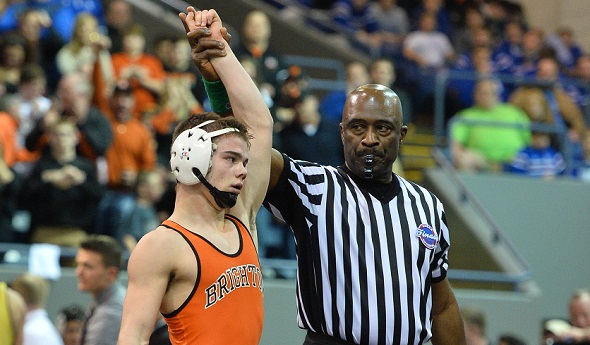
PHOTO: Official Sam Davis, right, holds up a winner's hand during this season's MHSAA Division 1 Final.