

Be the Referee: Covering Knees
September 8, 2016
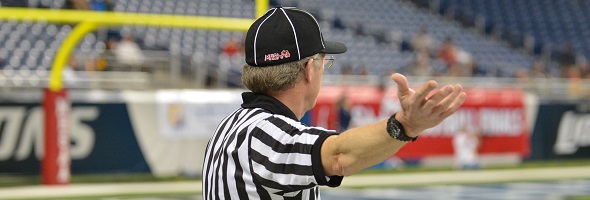
This week, MHSAA assistant director Mark Uyl explains the increased focus on making sure knee padding is worn correctly in football.
Be The Referee is a series of short messages designed to help educate people on the rules of different sports, to help them better understand the art of officiating, and to recruit officials.
Below is this week's segment – Equipment Covering the Knees - Listen
Everything in the game of football, from a rules-making perspective, starts and ends with an increased focus on player safety.
One big point of emphasis for the 2016 season centers on equipment being worn properly by all players. Too often we see college and pro players, especially those at the skill positions, wearing football pants that come nowhere close to covering the knee area.
With a continued focus on all high school players to lower the target zone when hitting an opponent to keep the head out of football, kids must wear pants with knee pads which completely cover the knee area to avoid those types of injuries.
Past editions
Sept. 1: Play Clock Experiment - Listen
Aug. 25: Clipping in the Free Blocking Zone - Listen
Be the Referee: Non-Glare Helmets
May 7, 2015
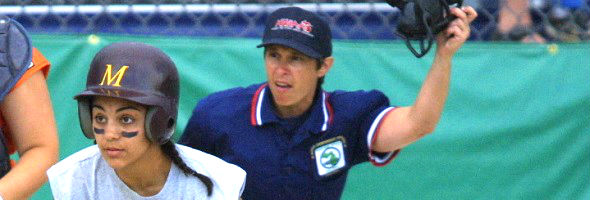
This week, MHSAA assistant director Mark Uyl explains why high-glare helmets are prohibited for softball and baseball.
Be The Referee is a series of short messages designed to help educate people on the rules of different sports, to help them better understand the art of officiating, and to recruit officials.
Below is this week's segment - Non-Glare Helmets - Listen
A new rule change this year in high school baseball and high school softball deals with helmets.
As many of us sat around over the holidays watching various college football bowl games, we saw what we often call the “Oregon Effect” – teams wearing a very shiny, high gloss helmet to try and catch a kid’s attention with the wow factor.
In both baseball and softball, these high glare-high gloss helmets can be a safety issue, where the sun can reflect off a batter’s or baserunner’s helmet, or even a catcher’s helmet, which could create a safety issue for those kids playing defense. These high gloss helmets are no longer legal starting with this season.
Past editions
April 27 - Vern L. Norris Award - Listen
March 23 - Deciding the Game - Listen
March 16 - Block/Charge Call - Listen
March 9 - Dive on the Floor - Listen
March 2 - Primary Areas - Listen
Feb. 23 - Too Much TV - Listen
Feb. 16 - Video Clip Library - Listen
Feb. 9 - Cheer Safety - Listen
Feb. 2 - Basketball PA Announcers - Listen
Jan. 26 - Wrestling Health Concerns - Listen
Jan. 19 - Basketball Physical Contact - Listen
Jan. 12 - Video Review Part 2 - Listen
Dec. 29 - Video Review Part 1 - Listen
Dec. 17 - Registration Part 2 - Listen
Dec. 10 - Registration Part 1 - Listen
Dec. 3 - Legacy Program - Listen
Nov. 26 - Sideline Management - Listen
Nov. 19 - 7-Person Mechanics - Listen
Nov. 12 - Blocking Below the Waist - Listen
Nov. 5 - Tournament Selection - Listen
Oct. 29 - Uncatchable Pass - Listen
Oct. 22 - Preparation for Officials - Listen
Oct. 15 - Automatic First Downs - Listen
Oct. 8 - Officials & Injuries - Listen
Oct. 1 - Overtime - Listen
Sept. 25 - Field Goals - Listen
Sept. 18 - Tackle Box - Listen
Sept. 11 - Pass Interference - Listen
Aug. 25 - Targeting - Listen