

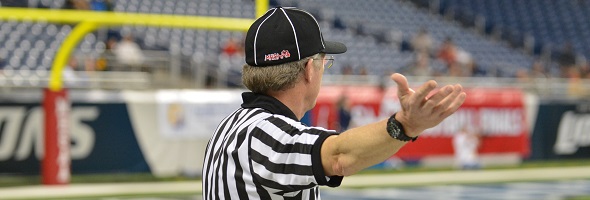
Be the Referee: Intentional Grounding
October 15, 2015
This week, MHSAA assistant director Mark Uyl explains the difference between high school and college/pro rules when it comes to intentional grounding.
Be The Referee is a series of short messages designed to help educate people on the rules of different sports, to help them better understand the art of officiating, and to recruit officials.
Below is this week's segment - Make the Call: Intentional Grounding - Listen
A QB is rolling out wide toward the sideline and is being chased by two large defenders. To avoid a certain sack, the QB throws the ball away deep down the field where no offensive receiver is even in the same zip code of where the ball hits the ground.
What’s the call?
Under high school rules, this is intentional grounding as there always has to be a receiver in the general area of the pass. At the college and pro levels, all the QB has to do is throw the ball beyond the line of scrimmage if he has scrambled outside of the tackle box. When at your next game, know this important difference when it comes to intentional grounding.
What's My Why: Official Shawn Ballor
By
Geoff Kimmerly
MHSAA.com senior editor
October 7, 2026
Shawn Ballor, Alpena
Ballor has begun his 31st school year as an MHSAA-registered official and worked on the wrestling mat all but one season of his first three decades. He’s also registered for volleyball and basketball this school year and has officiated baseball and softball in the past, baseball also for all but one year over his first 30.
I guess why I continue to officiate is because it feels really good to be a small part of helping young people develop as individuals and athletes. Over the years, I’ve found that officiating has contributed a lot to my personal growth as well.
One of the things that I like about officiating is that whether you’re an athlete or have another job, or you have a family, you’re able to choose how many games or matches you work each week so that you can balance your time with other priorities in life.
Finally, the relationships and interactions you’ll have with student-athletes, coaches and other officials over the years will stay with you forever.
“What’s My Why” is a weekly feature telling the stories of MHSAA-registered officials in their own words. If you’re an MHSAA official and would like to share your reason why, please submit a 15 to 45-second video, taken horizontally, to director of officials Sam Davis at [email protected].
What's My Why
Oct. 1: Tim Erickson, Rockford - Watch
Sept. 23: Patricia Treman, Grand Rapids - Watch
Sept. 16: Tony Bertuca, Coloma - Watch
Sept 9: Jenna Schroeder, Berkley - Watch
Sept. 2: Joey Crawford, Newton Square, Pa. - Watch
Aug. 26: Ron Torbert, Hanover, Md. - Watch
Aug. 19: Kari Seitz, Mill Valley, Calif. - Watch
Aug. 13: Mike Pereira, Sacramento, Calif. - Watch
Aug. 5: Dino Paganelli, Wyoming - Watch
Aug. 3: Stacy Smith, Caledonia - Watch
July 22: Jason Nickleby, Lake Elmo, Minn. - Watch
July 15: Sam Davis, Lansing - Watch
July 9: Candace Cox, Quincy - Watch
July 1: Robert Williams, Redford - Watch
June 24: Will Godfrey, Jackson - Watch
June 19: Jarrett Skorup, Midland - Watch
June 12: Brady Driver, Sturgis - Watch
June 8: Cindy Tyzo, West Bloomfield - Watch
June 3: Jeff Spedoske, DeWitt - Watch
June 1: Mike Carrier, Commerce Township - Watch
May 27: Stan Wright, Warren - Watch
May 26: Murray Rose, Zeeland - Watch
May 22: Mike VanLaan, Alto - Watch
May 18: Clint Abbott, Newaygo - Watch