

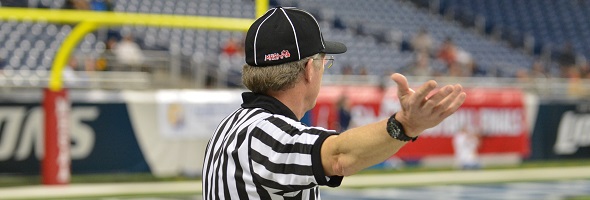
Be the Referee: Other Football Changes
September 7, 2017
This week, MHSAA assistant director Mark Uyl discusses a few final football rules in the final of a three-part series on changes in the sport for this fall.
Be The Referee is a series of short messages designed to help educate people on the rules of different sports, to help them better understand the art of officiating, and to recruit officials.
Below is this week's segment – Other Football Rules Changes - Listen
Today in our final segment of a three-part series on the football rules changes for the 2017 season, we’re going to be looking at three items:
• On passing plays, pass interference will no longer be called when the defender is simply face guarding the receiver with no contact.
• In the final two minutes of a half, the team accepting a penalty will now have the option of restarting the game clock with the snap of the ball, rather than the referee’s ready-for-play signal.
• This is the second year of an experiment in Michigan with a 40- second play clock, which starts shortly after a play is over, replacing the 25-second play clock which was always started by the referee marking the ball ready for play.
Past editions
August 31: Pop-Up Onside Kicks - Listen
August 24: Blindside Blocks - Listen

Be the Referee: Bat Safety
June 1, 2015
This week, MHSAA assistant director Mark Uyl explains how bats have been altered the last few seasons to make baseball safer for pitchers and infielders.
Be The Referee is a series of short messages designed to help educate people on the rules of different sports, to help them better understand the art of officiating, and to recruit officials.
Below is this week's segment - Bat Safety - Listen
The biggest change in the world of amateur baseball over the last five years has been the new standards for non-wood, or what most of us refer to as aluminum, bats.
Prior to these changes, it was quite common to see high school and college baseball scores in double digits on a regular basis.
The new bat standards first sought to address player safety. And now these new aluminum bats match the ball exit speed ratio – or in other words, the speed that the ball comes off the bat – for a non-wood bat with what it would be coming off a wood bat; making the amateur game safer for pitchers and infielders.
Past editions
May 25 - Balks - Listen
May 18 - Baseball Pace of Play - Listen
May 11 - Fair or Foul Ball? - Listen
May 4 - Non-Glare Helmets - Listen
April 27 - Vern L. Norris Award - Listen
March 23 - Deciding the Game - Listen
March 16 - Block/Charge Call - Listen
March 9 - Dive on the Floor - Listen
March 2 - Primary Areas - Listen
Feb. 23 - Too Much TV - Listen
Feb. 16 - Video Clip Library - Listen
Feb. 9 - Cheer Safety - Listen
Feb. 2 - Basketball PA Announcers - Listen
Jan. 26 - Wrestling Health Concerns - Listen
Jan. 19 - Basketball Physical Contact - Listen
Jan. 12 - Video Review Part 2 - Listen
Dec. 29 - Video Review Part 1 - Listen
Dec. 17 - Registration Part 2 - Listen
Dec. 10 - Registration Part 1 - Listen
Dec. 3 - Legacy Program - Listen
Nov. 26 - Sideline Management - Listen
Nov. 19 - 7-Person Mechanics - Listen
Nov. 12 - Blocking Below the Waist - Listen
Nov. 5 - Tournament Selection - Listen
Oct. 29 - Uncatchable Pass - Listen
Oct. 22 - Preparation for Officials - Listen
Oct. 15 - Automatic First Downs - Listen
Oct. 8 - Officials & Injuries - Listen
Oct. 1 - Overtime - Listen
Sept. 25 - Field Goals - Listen
Sept. 18 - Tackle Box - Listen
Sept. 11 - Pass Interference - Listen
Aug. 25 - Targeting - Listen