

Be the Referee: Play Clock Experiment
September 1, 2016
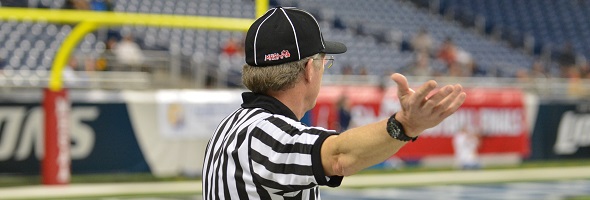
This week, MHSAA assistant director Mark Uyl explains the 40-second game clock Michigan football schools are allowed to try this fall.
Be The Referee is a series of short messages designed to help educate people on the rules of different sports, to help them better understand the art of officiating, and to recruit officials.
Below is this week's segment – Play Clock Experiment - Listen
From time to time, the MHSAA receives permission from the national rules making body, the National Federation of State High School Associations, to experiment with a new rule. This fall in high school football, Michigan schools can experiment with a 40-second play clock. In this experiment, the 40-second play clock begins at the end of the previous play, giving teams consistency from week to week when the offense can next snap the ball.
With using the traditional 25-second play clock, it really depends on the referee of the game in terms of the pace on how quickly the offenses can go.
Past editions
Aug. 25: Clipping in the Free Blocking Zone - Listen
What's My Why: Official Patricia Treman
September 23, 2026
Patricia Treman, Grand Rapids
Treman’s contributions as an MHSAA-registered volleyball official go back to the second season of girls volleyball as an MHSAA-sponsored championship sport.
She began with the 1976-77 school year and also officiated basketball during the first 10 years of her 51-year tenure.
I was mentored by Marcy Weston at CMU, and she’s the person that encouraged me to referee.
Hopefully I do that to someone, (a) young student out there, that something I say or do, that they want to move forward and either officiate or coach volleyball.
“What’s My Why” is a weekly feature telling the stories of MHSAA-registered officials in their own words. If you’re an MHSAA official and would like to share your reason why, please submit a 15 to 45-second video, taken horizontally, to director of officials Sam Davis at [email protected].
What's My Why
Sept. 16: Tony Bertuca, Coloma - Watch
Sept 9: Jenna Schroeder, Berkley - Watch
Sept. 2: Joey Crawford, Newton Square, Pa. - Watch
Aug. 26: Ron Torbert, Hanover, Md. - Watch
Aug. 19: Kari Seitz, Mill Valley, Calif. - Watch
Aug. 13: Mike Pereira, Sacramento, Calif. - Watch
Aug. 5: Dino Paganelli, Wyoming - Watch
Aug. 3: Stacy Smith, Caledonia - Watch
July 22: Jason Nickleby, Lake Elmo, Minn. - Watch
July 15: Sam Davis, Lansing - Watch
July 9: Candace Cox, Quincy - Watch
July 1: Robert Williams, Redford - Watch
June 24: Will Godfrey, Jackson - Watch
June 19: Jarrett Skorup, Midland - Watch
June 12: Brady Driver, Sturgis - Watch
June 8: Cindy Tyzo, West Bloomfield - Watch
June 3: Jeff Spedoske, DeWitt - Watch
June 1: Mike Carrier, Commerce Township - Watch
May 27: Stan Wright, Warren - Watch
May 26: Murray Rose, Zeeland - Watch
May 22: Mike VanLaan, Alto - Watch
May 18: Clint Abbott, Newaygo - Watch