

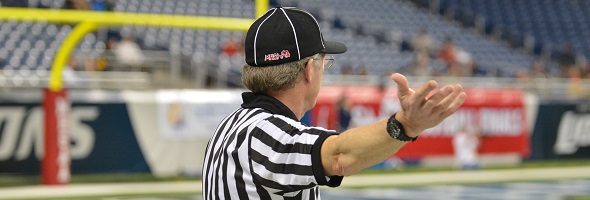
Be the Referee: Spearing
September 3, 2015
This week, MHSAA assistant director Mark Uyl explains the expanded definition of spearing added for football this season.
Be The Referee is a series of short messages designed to help educate people on the rules of different sports, to help them better understand the art of officiating, and to recruit officials.
Below is this week's segment - Spearing - Listen
One of the new changes to the high school football rules for this year is an expanded definition of spearing an opponent with the helmet. With all the attention on player safety and reducing the head-to-head collisions between players, this new definition of illegal helmet contact will better help officials, coaches, players and fans with what is illegal and must be penalized by rule.
Simply put, a spearing foul has taken place when any player hits an opponent with the crown, or top portion, of his helmet as the first point of contact. These fouls where contact has been initiated by a player first with the crown of the helmet must be called and enforced consistently throughout the season.
Past editions:
Aug. 27: Missed Field Goal - Listen
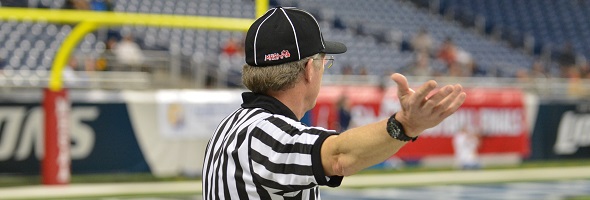
Be the Referee: Football Rules Changes
August 23, 2018
In this week's edition, assistant director Brent Rice discusses a pair of rules changes coming to high school football this fall.
Be The Referee is a series of short messages designed to help educate people on the rules of different sports, to help them better understand the art of officiating, and to recruit officials.
Below is this week's segment – Football Rules Changes - Listen
The biggest rules changes in high school football across the country this year involve player safety.
When any required player equipment is missing or worn improperly, an official's time-out shall be declared, and the player must come out of the game for one down. This includes players not wearing knee or thigh pads or rolling their pant legs up over their knees and equipment such as shoulder pads or back pads being exposed.
The other change continues to hone the definition of a defenseless player, this time affecting the quarterback once he has thrown the ball and becomes a passer. Until that time, he is defined as a runner. As a passer, he continues to be defenseless until the pass ends or he moves to participate in the play.
The penalty for hitting a defenseless player is 15 yards.