


MHSA(Q&)A: Midwest League Umpire John Libka
June 22, 2012
By Brian Spencer
Second Half
As a high school junior eight years ago, John Libka began his officiating career as part of the MHSAA Legacy Program.
Now 24, Libka -- who grew up in Mayville and attended school at Juniata Christian in Vassar -- is a baseball umpire in the Class A Midwest League.
The Legacy Program pairs high school seniors and juniors with experienced mentors and allows them to officiate junior high and sub-varsity contests. Libka's mentor was his father, Gary Libka. (Click to read more about the Legacy Program.)
We caught up with John Libka during his summer run through the communities that make up the Midwest League, which in Michigan includes Lansing, Midland and Comstock Park.
Do you think that your experience playing baseball in high school helped you at all during your early and present umpiring career?
Yeah, probably a little bit. I got to see the other side. I received insight on why certain things happen, and how plays and events develop. It also helped me develop the instincts I needed and continue to rely on to be successful.
What was the biggest factor in helping you choose the MHSAA’s Legacy Program over a senior season of baseball (Libka played for his school as a junior)?
I like spending time with my dad, and going to the Legacy Program was a great way to do that. He umpired for 30 years, so he was a good mentor and there was no better option to spend time with him. I also love baseball, so I knew I wanted to stick with baseball in some way.
What was your favorite childhood baseball memory?
I lived for going to Tiger Stadium, and Comerica Park for that matter. The memories at Tiger Stadium were the best. I went to the third-to-last game against the Yankees, I think. It was an awesome experience and a great memory.
What is the most important piece of advice you’ve been given as an umpire?
The most important advice I think I’ve received is probably just to stay even keel. You can’t get too high or too low being an umpire. You have to take every play or every pitch the same, and that is true for all levels, not just in pro ball. You just have to keep a good perspective on everything.
Being on the road a lot, is there any specific restaurant that you look for? What is your favorite food at ____?
We actually try to mix it up a lot. I like to go to Panera. If we could go anywhere, I like going there. The broccoli and cheese bread bowl is usually my favorite. We like to go get the bread bowl for a pregame meal. I also like going to McDonald’s every morning to get an iced coffee. It’s a great way to start the day.
According to an interview conducted with MLive, you worked for Bronner’s this past winter in Frankenmuth. Which do you prefer more, an artificial Christmas tree or a real Christmas tree?
I prefer an artificial Christmas tree. However, after working there you have to have a good eye. The tree has to be just right.
You must catch some flak from coaches and fans; is there any game that sticks out, in which you or your partner received the most verbal abuse?
We actually had a game earlier this year in Fort Wayne where we had three ejections in a postgame incident. We were actually commended for how we handled it. Those are the times when you learn the most.
How do you get through a game where a fan or coach is being unruly?
The best advice is to stay even keel and not to pay attention to a lot of the fans. You handle stuff when you need to, you ignore stuff when you need to. Overall, you just stay objective. If you take the high road most of the time and make the fans or coaches decide their fate, you can’t go wrong.
Do you have any advice for aspiring umpires hoping to make it to the big time?
The best advice I can give is to continue to be a student of the game. It is one of the toughest sports as far as the rules go. Tim Kurkjian once said, “You can go to the ballpark and see something different every day.” When I watch a game on TV, I watch the umpires and not the game. It’s the best way to learn.
West Michigan Mourns Longtime Mentor
By
Geoff Kimmerly
MHSAA.com senior editor
June 25, 2019
As quickly as June has come to an end, summer soon will give way to another highly-anticipated football season in the Grand Rapids area – but also one that undoubtedly will feel like someone is missing for the many officials who learned from Carl Paganelli.
The longtime high school, college and professional official died May 21 at age 82 after fighting cancer, and was laid to rest May 29 in Wyoming, near Grand Rapids, where he lived most of his life.
Paganelli’s most high-profile on-field work likely came during his time in the former USFL, World Football League and Arena Football League. More of his 58 years in the game came as supervisor of officials in the Mid-American Conference, Arena League and during the initial campaign of the XFL. His three sons Carl Jr., Perry and Dino all have gone on to officiate in NFL Super Bowls.
Those impressive notes were mentioned most when Carl Sr. died. But his influence on the high school game was similarly substantial and should continue through those he mentored during nearly 60 years as part of the West Michigan Officials Association – which referred to him as “one of the founding fathers of officiating in West Michigan” in announcing his passing.
Paganelli was an MHSAA registered official for 36 football seasons through fall 1998, and also for 24 basketball seasons through winter 1987-88. Also during the 1990s, Caledonia native Mark Uyl began a multi-sport officiating career that would carry him in part to two baseball College World Series. He got to know Paganelli well through wearing the stripes and while also serving as athletic director at his alma mater and then Middleville Thornapple Kellogg on the way to becoming an MHSAA assistant and now executive director.
“Carl was one of the greatest officiating mentors that there’s ever been, and what made Carl most unique in that area was the fact he would go out and watch a junior high game Thursday in Grand Rapids, see a new official, and give that official the same time and care and detail that he would when he was supervisor of officials for the MAC or evaluating NFL officials,” Uyl said.
“To him, an official was an official. He was there, and he wanted to help you get better.”
As noted in his obituary, Paganelli was considered the “godfather of Grand Rapids area officials” and has been credited by numerous NFL officials for his guidance over the years. He was inducted into the Arena Football Hall of Fame and also into the Grand Rapids Sports Hall of Fame twice – solo in 2008 and with his three sons as the “Paganelli Team” in 2018.
Carl Sr. with his sons was among presenters when more than 1,200 officials from across the state poured into Grand Rapids during July 2013 for the first Officiate Michigan Day. His local footprint also includes a substantial presence at Grand Rapids Community College, where the foyer of the Gerald R. Ford Fieldhouse is named after the family and a scholarship in their name is presented annually to a student-athlete. Paganelli Sr. had attended Grand Rapids Junior College in 1954 and 1955. He also served in the U.S. Navy during the Korean War, and later sat on the Wyoming City Council.
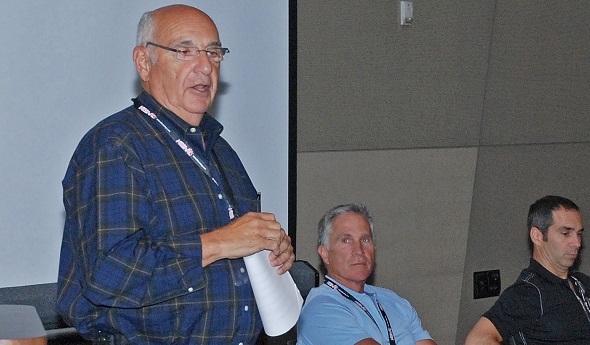
PHOTO: Carl Paganelli speaks to an audience during Officiate Michigan Day in 2013 as part of a roundtable with his three sons.