

Change Does Frankfort's 'Cage' Good
February 5, 2014
By Geoff Kimmerly
Second Half editor
FRANKFORT – Senior Christian Purchase, a Frankfort basketball player, remembers sitting in his school’s cheering section as a freshman and thinking he’d hate to be on the other team.
It wasn’t because his Panthers were winning the game. Instead, Purchase put himself in an opposing player’s shoes, at the free throw line, trying to shoot while half of Frankfort’s student body yelled “Everyone is watching you!”
 “My heart broke for them,” said junior Madison Stefanski, also a varsity player. “They would stand there to shoot their free throws, and they would look at you. And it’s just like, ‘I’m sorry.’ That’s scary, a whole student section yelling that at you.”
Frankfort students call them “You” cheers, and they made up the section’s entire repertoire before this winter. But instead of chanting, “You can’t do that” this season, the Panthers are proving you definitely can ... change an entire cheering culture.
This year’s smallest Battle of the Fans finalist – with only 152 students – admits to its negative past. But “The Cage” also has embraced its positive present and future as it works to renew its reputation and change the tone across its corner of the Lower Peninsula.
“You just need a couple people to start it, a couple positive people. And they’ll tell people, and everybody will get really excited,” Frankfort senior Allison Evans said.
“Because I feel like everyone knows that’s (negative cheering) is wrong,” Stefanski continued, “but it just takes a few people to say, ‘We could change it. Why not?’ And then it all just started.”
Frankfort on Monday was the third stop on this year’s Battle of the Fans III tour. MHSAA staff and Student Advisory Council members already have visited Buchanan and Bridgman, and will head to Traverse City West on Friday and finish at Beaverton on Feb. 14. Public voting on the MHSAA’s Facebook, Twitter and Instagram sites will take place Feb. 18-20, with the Student Advisory Council taking that vote into consideration when selecting the champion.
The winner will be announced on Second Half on Feb. 21 and honored with a championship banner during the Boys Basketball Semifinals on March 21 at Michigan State University’s Breslin Center.
To fully appreciate what’s new in The Cage, it’s best to start with Frankfort’s near past.
Instead of the current 80 percent turnout for home boys and girls basketball games – or closer to 100 percent plus middle schoolers for Monday’s boys game against McBain – the Panthers’ student section used to fill about halfway on its best nights.
Those who showed might stand for the first quarter, but by the third everyone was sitting – and many were yelling not the greatest stuff. And woe to the opposing player who had to take the ball out of bounds on the baseline in front of the Frankfort student section – there was no telling what might be hurled his or her way.
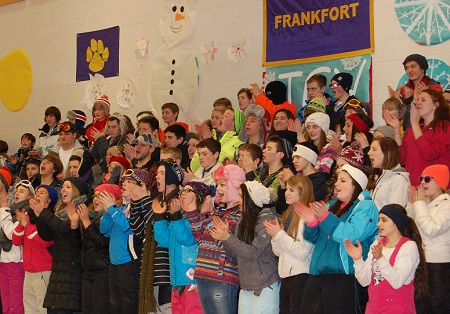 The Frankfort students were having fun, but also got bored. It’s not that they felt the “You” cheers were wrong – maybe just customary – but they definitely didn’t feel right. And the negativity frequently drew the ire or opposing parents, administrators and others who remembered bad things from the past.
“Before a game would start, people would be like, ‘Watch your cheering section,’” Evans said. “And this year, it would be like, ‘You watch, and after the game tell me if you have a problem.’”
Instead, opposing athletic directors, coaches, officials and parents have congratulated leaders and athletic director David Jackson on the section’s transformation.
Purchase started considering starting a cheering section during football season. But it took another embarrassment to set The Cage in motion.
He and five or six of his buddies formed a mini section for volleyball games this fall. They were a given to show in the area of bleachers cut out of the ball at one end of the court.
But during the Panthers’ District volleyball opener, a 3-0 loss, they were figuratively pushed aside as Fife Lake Forest Area students took over.
“We kinda felt beaten,” Purchase said. And then next day, he paid Jackson a visit. “I told him I have theme ideas. I have cheers. I have kids that want to do this. Let’s get this rolling.”
Jackson gave his blessing, and teacher/coach Jaime Smith pledged plenty of support. And in a school of 150 students, word spread quickly.
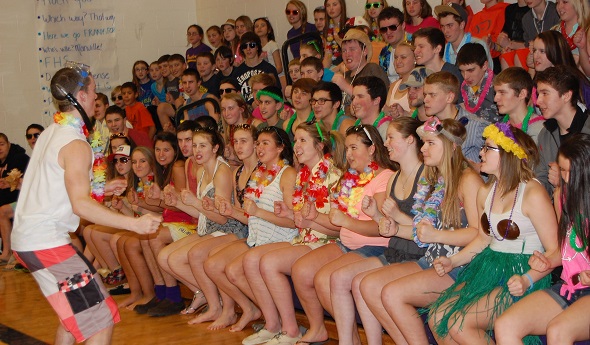
A group of leaders –all athletes – began to plan while keeping an open door to anyone in the school with an idea to add. Volleyball players Evans, Stefanski and senior Zoe Bone joined Purchase and junior Ryan Plumstead, who also was in the mini section and also plays on the hoops team. Senior wrestler Jacob Chappell is a bit of a commanding presence among his classmates and was a transformative addition to the leadership group – “If Jakes wants to change, everyone changes,” Stefanski said – and “The Cage” name was thrown out randomly by another classmate.
They taped step-by-step demonstration videos of cheers and dressed in theme night costumes – one in a toga, another in neon, a third in rain gear – for a pep assembly to explain not only how students would now cheer, but why they were making a switch.
Student attendance at basketball games has doubled, and The Cage also cheers on Chappell’s fledging wrestling team. Purchase and Smith visited the junior high to explain the new cheering philosophy and also motivate those grades to find the next leaders of the group.
Drama students come from practice dressed up and ready to yell. The artists are there too, and one is designing a giant Fathead decal to be added to The Cage’s already elaborate decorations. Students who had never attended a sporting event are now regulars.
There’s been only one complaint (and it’s not a bad thing) – that the section is too loud.
“When you’re out there and getting negative cheers from the other school, or even your own school, you kinda feel like you’re on your own island if you miss a shot or airball a shot,” Plumstead said. “When you’re getting positive cheers and miss the shot, and the crowd is like, ‘Yeah, go get ‘em next time,’ you shake it off and you’re back in the game.”
On occasion, a few students might try to dip back into the negative. But now they’re the ones made to feel on an island. “We tell them that’s not how we do things anymore,” Stefanski said. “We didn’t’ realize how bad it was, saying negative things, until we saw other schools do it.”
But the positive spin is starting to spread. The Cage found a few students from a neighboring school in its section during one game. Other schools are forming sections and starting theme nights – Purchase has traveled to a few to check them out – and it’s always a compliment when students from other schools tweet they wish they went to Frankfort so they could join in the fun.
All of the reaction seems to say what leaders of “The Cage” would most like to hear.
“That we turned this around completely. We changed the games, the feel, the entire environment at Frankfort,” Purchase said.
“Not only that we changed our school, but we’re changing the Northwest Conference,” Plumstead added. “Not only are we changing the culture at Frankfort, but changing it everywhere in northwest Michigan.”
Battle of the Fans III is sponsored in part by the United Dairy Industry of Michigan.
PHOTOS: (Top) Frankfort senior Jacob Chappell leads "The Cage" in a roller coaster during Monday's game against McBain. (Middle) The cheering section, still dressed for "icy" winter, cheer on the Panthers during the first half. (Photos courtesy of Jaime Smith.)
It's Time: Bring on Battle of the Fans V
December 15, 2015
By Geoff Kimmerly
Second Half editor
From the Indiana and Ohio borders to the Lake Superior shore, the buzz over this season's Battle of the Fans is reaching across Michigan like never before.
And we can't wait to showcase how Michigan's best are cheering on their classmates this winter.
The MHSAA and its Student Advisory Council will host its fifth “Battle of the Fans” contest this winter to again award the top high school student cheering section in Michigan and promote the opportunity for a fun, positive cheering experience for fans supporting their teams.
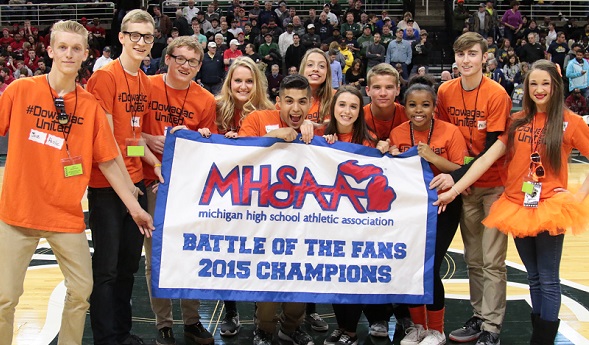
Battle of the Fans was started during the 2011-12 school year to promote the opportunity for a fun, positive cheering experience for fans supporting their teams. Dowagiac was named last year’s champion and presented with a banner during the MHSAA Boys Basketball Finals at Michigan State University’s Breslin Center. Sections from Beaverton, Buchanan, St. Johns and Yale also were finalists and recognized during the Breslin ceremony.
Schools are invited to submit a short video, via YouTube, of their cheering sections in action. Video submissions should be between 90 seconds and three minutes long and explain how that section meets the following contest criteria: positive sportsmanship, student body participation, school spirit, originality of cheers, organization of the group, student section leadership and fun.
The deadline for student-submitted video applications is noon Jan. 9. Five finalists including at least one Class C or D school then will be chosen and visited on a home game night by MHSAA staff and Advisory Council representatives. The MHSAA will produce a video of that finalist after each visit, with the champion being selected by the Student Advisory Council based in part on activity on the MHSAA’s social media sites.
This year’s winner will be announced Feb. 19 and recognized March 25 at the Breslin Center.
Make sure to mark all social media postings regarding Battle of the Fans V with the hashtag #BOTF – and keep an eye out for more information on the MHSAA's Facebook, Twitter and Instagram sites. Click the links below to see the stories and videos from visits to our first four champions:
Frankenmuth (2012) - Buchanan (2013) - Beaverton (2014) - Dowagiac (2015)
Rules, directions for submitting videos, plus links to coverage of finalists from the first four years of the contest can be found on the MHSAA Website. This year’s finalist videos, plus the announcement of the 2015-16 winner, will be published on the MHSAA Second Half.
The Student Advisory Council is made up of eight seniors and eight juniors, who each serve two-year terms. The Council acts as the voice of Michigan's student-athletes; it serves as a student sounding board for the MHSAA's Representative Council, assists in planning Sportsmanship Summits, Captains Clinics and other student leadership events; participates in a yearly focus group about the state of high school sports for Michigan State University's Institute for the Study of Youth Sports and assists with medal ceremonies at MHSAA championship events.
See below for video featuring last year's finalists introducing this season's BOTF.
PHOTO: Representatives from Dowagiac's "Attack" receive the Battle of the Fans championship banner at the Breslin Center during the 2015 Boys Basketball Semifinals.