

'Creatures' Build Beaverton Legacy
January 20, 2015
By Geoff Kimmerly
Second Half editor
BEAVERTON – Nate O’Brien has had a hand in his share of traditions at Beaverton High School.
He’ll be the latest of two generations to graduate this spring, and in the fall he quarterbacked the football team to its best record since 2000. For the last two basketball seasons, he’s been honored as caretaker of the Beaver Slide – literally, a chest slide across the floor to Beaverton’s bench to end pre-game warmups – while suiting up for coach Roy Johnston, the second-winningest in MHSAA boys hoops history. On Friday, the Beavers continued a series with rival Gladwin played for Butch, a stuffed animal trophy awarded to the yearly winner in football and boys basketball since 1937.
But O’Brien already is looking forward to watching another legacy continue when his time as a student is done this spring.
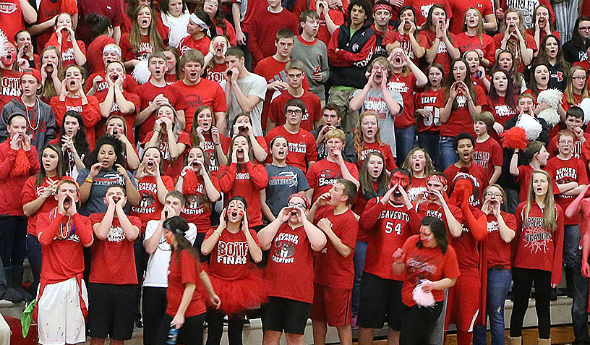
In a few years, he’ll be sitting at basketball games with parents instead – and will watch and cheer the next generation of “Bleacher Creatures” as they continue a local point of pride he and his classmates raised to statewide renown.
“I want to sit on the other side of the bleachers and watch the student section, what we built, just start going crazy,” O’Brien said. “Help them with ‘Go Red! Go White!’ and see what they do.”
In the meantime, he and the rest of the current Creatures will continue to build a legacy that includes last season’s “Battle of the Fans” championship.
BOTF III champion Beaverton is again a finalist to be named the MHSAA’s top high school student section, and Friday hosted the first visit of this season’s MHSAA finalists tour. The MHSAA next will visit Yale, this Friday, followed by Buchanan, St. Johns and Dowagiac leading up to the naming of this year’s champion Feb. 20. The public may vote for its favorite on the MHSAA’s Facebook, Twitter and Instagram sites beginning Feb. 17, with the MHSAA Student Advisory Council taking that vote into consideration when selecting the champion after that vote has concluded.
Not much has changed – in the best possible way – since last year’s Beaverton visit.
A brief review:
The original Bleacher Creatures emerged in 1979 and gained steam during the Beaverton boys basketball team’s run to the MHSAA Class C Semifinals in 1984. The section continued to thrive and now counts at least a handful of second-generation cheerers in its fourth decade.
While notable and popular, the Creatures weren’t always completely appropriate. That changed when the section became a spirit club in 2013-14; hierarchy was created complete with officers, video, photo and music coordinators and creative and fundraising leaders. They led some philosophical changes – notably refocusing the section’s fervor toward positivity and fun – and won a close race for the BOTF III title.
Then came serving as grand marshals of the town’s July 4 parade and a suggestion from one of the state’s Division II men’s basketball coaches that section leaders give his school a look for college – with the idea that they could start something similar at his university. Johnston, who has coached since 1971, told senior Jen Eaton her efforts had made school more fun again. All the while, the Creatures saw as an always-supportive community supplied even more – and they began planning for a run at the first repeat championship in BOTF’s brief history.
Make no mistake – last year’s push for change was motivated by the opportunity to win Battle of the Fans. This year’s effort is driven by the same – but has become much more for a group of section leaders who also played the major roles in 2013-14: seniors Drew Porter, Janessa Killian, Breanna Frasher, Eaton and O’Brien and junior Braeden Wolfe.
“I’ve learned through (BOTF) how important positivity is. I can remember coming (to games) when I was younger and hearing some of the things our student section would say, and you’d be like, ‘Wow, that’s not good for a sixth grader to hear,’” Frasher said. “Even as freshman I’d hear people say stuff and think that’s not OK. Now when we’re looking up chants on YouTube, trying to find new things, we’re like, ‘No, we can’t do that. That’s not in the realm of good sportsmanship.’ We’ve definitely learned how to be good sports.”
 They’ve had to adjust to a few changes this school year; most notably seventh and eighth graders moving into the high school this fall, along with a new principal and athletic director. But those changes also provided opportunities for the section.
“It felt like we had to go above and beyond what we did last year,” Porter said. “When we won last year, it set a bar. Other schools are gunning to beat us because we won last year, so we have to do whatever is in our power to one-up ourselves.”
Porter spoke with the seventh and eighth graders, a meeting that drew about 25 students a year ago. This time? Standing room only with closer to 75.
Leaders decided the best way to get better was to get more creative and asked classmates over Facebook for ideas – and got valuable response. Relying on what they’ve learned about logistics and sportsmanship, the Creatures ended up with a repertoire that included their traditional cheers and chants during game action and a variety of “skits” for the breaks and halftime – including their tradition of Moses parting the “Red Sea” and also a first-time appearance by Barbie and a powerful dunk over 6-foot-8 athletic director Ryan Roberts under a mini hoop. “We want the crowd to laugh their guts out or think, ‘That’s a really good idea,’” Wolfe said.
Successors have been identified; sophomore Austin Rhodes is the club’s current vice president and with Wolfe will continue as leaders after these seniors are gone, and Eaton will hand the technical work to a freshman who approached her about the club on the first day of school.
They’ll take over with a wealth of knowledge learned during the Battle of the Fans run – notably, how to rally the school’s 420 students to support their teams, but also how to do so in the correct and championship-caliber way.
“It became such a greater thing that I ever thought it was going to (be),” Wolfe said. “Starting off, I was like, ‘It’s the school student section; this is cool.’ But I never thought it was going to be something where you’re walking through the streets of Beaverton and people notice you for doing that. I never thought it would be something that people remembered you for. It’s awesome that it’s going to be.”
PHOTOS: (Top) Beaverton "Bleacher Creatures" cheer on their boys basketball team Friday against Gladwin. (Middle) Seniors Breanne Frasher, Janessa Killian and Jen Eaton are among leaders of the school's student cheering section. (Photos courtesy of Bob Frei.)
Online Course Trains Leaders Nationwide
By
Geoff Kimmerly
MHSAA.com senior editor
August 11, 2015
By Geoff Kimmerly
Second Half editor
The valuable lessons student leaders have received over the last decade during Captains Clinics presented statewide by Michigan High School Athletic Association staff are now available to students nationwide and beyond as part of an online Captains Course produced by the MHSAA and available from the National Federation of State High School Associations on its Learning Center website.
The Captains Course, created over two years with assistance from Michigan State University’s Institute for the Study of Youth Sports (ISYS), is broken into 10 segments providing instruction on leadership styles and skills to how to handle situations faced by leaders of teams in any sport. A total of 20 past members of the MHSAA Student Advisory Council speak during the program, providing peer-to-peer guidance that has proven effective in student leadership campaigns.
The online Captains Course has been started 2,881 times since its release in July, including 802 times during the first 10 days of this month. The first MHSAA Captains Clinic was conducted in March 2005, and clinics are presented in person on a league-by-league basis to approximately 1,000 students each school year.
The online Captains Course is free and can be downloaded after an account is created on the NFHS Learning Center website at http://www.nfhslearn.com.
“Many student-athletes have characteristics that allow them to become leaders, but rarely do they receive lessons in how to be an effective team captain; this has been the goal of our Captains Clinics and is the aim of this Captains Course,” said MHSAA assistant director Andy Frushour, who coordinates the association’s student services programs and advises the Student Advisory Council. “Our in-person Captains Clinics are still a great way to deliver leadership lessons and to get students from rival schools to interact with each other in a fun and worthwhile way. But we can only do so many in-person clinics per year.
“With the online version, we can deliver the same message, albeit through a different format. And we can do it 24 hours a day, at the user’s convenience, using a medium that kids use like the rest of us use oxygen, and potentially delivering our captains message to exponentially more students than the in-person version; even to students outside of Michigan.”
The online Captains Course is an introductory program, with plans for two more advanced leadership courses that will be facilitated online but with activities and discussions to take place offline in local communities. The goal for the “hands-on” portion of later training courses will be for leaders to conduct interviews with coaches and administrators, write short answers and interact with teammates for a more transformational learning experience.
The first course is made up of 10, 10-minute segments, and takes about two hours to complete – but is meant to be completed over multiple days. The short “bite-sized” segments make it easier for students to digest all of the information being given to them, and are based on research by the Institute for the Study of Youth Sports. Doctoral students working with the institute serve as instructors during Captains Clinics.
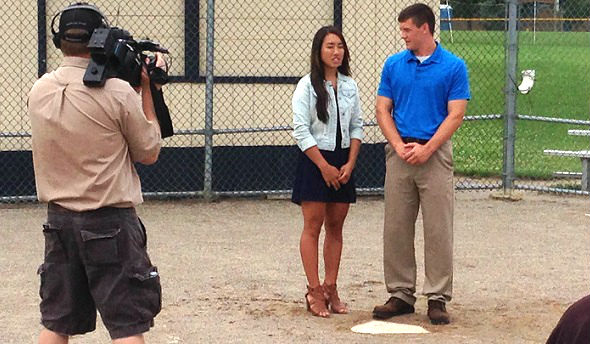
The Captains Course is hosted by recent high school graduates Caycee Turczyn of Lapeer High School and Connor Thomas of Marlette. Both were two-year members of the Student Advisory Council; Turczyn will begin studies this fall at the University of Michigan, while Thomas will start at Oakland University.
“All of the lessons are based on research conducted by MSU’s Institute for the Study of Youth Sports,” Frushour said. “Dr. Dan Gould and his doctoral students are rock stars in the field of youth and leadership development, and we are lucky to have them as partners on this project “
The Institute for the Study of Youth Sports was launched in 1978 to establish a world-class institute that would scientifically study the beneficial and detrimental effects of sports participation on children and youth and then work to maximize the beneficial effects. The mission of the Institute for the Study of Youth Sports is to provide leadership, scholarship and outreach that transforms the face of youth sports in ways that maximize the beneficial physical, psychological, and social effects of participation for children and youth while minimizing detrimental effects.
The Student Advisory Council is a 16-member group which provides feedback on issues impacting educational athletics from a student’s perspective, and also is involved in the operation of MHSAA championship events and other programming. Members of the Student Advisory Council serve for two years, beginning as juniors. Eight new members are selected annually to serve on the SAC, with nominations made by MHSAA member schools.
The MHSAA is a private, not-for-profit corporation of voluntary membership by more than 1,400 public and private senior high schools and junior high/middle schools which exists to develop common rules for athletic eligibility and competition. No government funds or tax dollars support the MHSAA, which was the first such association nationally to not accept membership dues or tournament entry fees from schools. Member schools which enforce these rules are permitted to participate in MHSAA tournaments, which attract more than 1.4 million spectators each year.
PHOTO: Lapeer's Caycee Turczyn and Marlette's Connor Thomas host the online Captains Course, with this segment shot at DeWitt High School.