


Title IX Continues to Fuel Growth of Girls and Women’s Sports, Olympic Dominance
By
Karissa Niehoff
NFHS Executive Director
September 24, 2021
To say that American female athletes dominated the recent Olympics in Tokyo would be an understatement.
Among the 66 medals earned by American female Olympians – most by any country in the history of the Games – were gold-medal performances by the U.S. basketball, volleyball, water polo and beach volleyball teams. Eighteen medals were earned by the U.S. women swimmers, female track and field athletes claimed 15 medals, and the U.S. women’s softball and soccer teams won silver and bronze medals, respectively.
In the past 30 years of the Olympic Games, the United States has dominated the women’s team sports of basketball (nine golds), soccer (four golds, one silver, one bronze) and softball (three golds, two silvers) — not to mention the untold number of medals in track and field. And this past summer, the U.S. women’s volleyball team claimed its first gold medal.
These performances by some of our nation’s most skilled female athletes never would have been possible without the passage of Title IX and the offerings of these sports through our nation’s schools. With the chance to play afforded by the landmark Title IX legislation in 1972, girls participation in several high school sports skyrocketed in the years that followed.
When the NFHS conducted its first participation survey in 1971, basketball and outdoor track and field were the primary girls sports, comprising about two-thirds of the 294,000 total. However, with the opportunity to play additional sports, girls flocked to volleyball and softball first, along with cross country and eventually soccer.
Soccer, in fact, has had the most remarkable growth. In 1971, only 700 girls were playing high school soccer. Twenty-five years later, that number had climbed to almost 210,000; and as the 50th anniversary of Title IX approaches, there are now almost 400,000 girls playing high school soccer – a staggering 56,200 percentage increase in 50 years. Soccer now ranks fourth in popularity among girls high school sports – all because of that opportunity in 1972.
There are many other success stories, however. The pre-Title IX survey in 1971 indicated that 1,719 girls were participating in cross country. With increases every year until 2015, today, there are 219,345 girls competing in high school programs and the sport ranks sixth in popularity.
Although participation numbers have leveled a bit the past 10 years, fast-pitch softball is another sport that flourished after the passage of Title IX. With fewer than 10,000 participants in 1971, the numbers quickly rose to 220,000 by 1985 and 343,000 by 2000, and softball is currently fifth among girls sports with 362,038 participants.
Since track and field and basketball were the primary sports in the early days of girls sports programs, increases in those sports have not been as dramatic; however, they remain the first and third most-popular sports, respectively, today. Volleyball, however, much like soccer, continues its upward climb.
Without a doubt, volleyball has seen the steadiest increases among girls high school sports the past 50 years. After starting with 17,952 participants in 1971, the numbers jumped to 300,810 by 1990 and 409,332 by 2010 and 452,808 by 2018. During its climb, volleyball surpassed basketball as the No. 2 girls sport.
And among the top six girls sports from 2010 to 2018 (numbers are not available the past two years due to the pandemic), volleyball has gained the most participants (43,476), followed by soccer (32,549). And all of this has occurred thanks to legislation passed in 1972 that was not fundamentally meant to address opportunities for girls to participate in high school sports.
The NFHS is leading a yearlong celebration of the 50th anniversary of Title IX, which officially occurs on June 23, 2022. “Title IX at 50 – Celebrating and Growing Opportunities” is highlighting the law’s impact by celebrating the inspirational individuals and landmark moments in the history of Title IX, and continuing to grow the educational and competitive opportunities for the future.
More information, including a Title IX Timeline, Title IX Milestones, The History and Importance of Title IX, Title IX Fact Sheet, Title IX Frequently Asked Questions and several Title IX videos, can be accessed on the NFHS Website.
Dr. Karissa L. Niehoff is beginning her fourth year as executive director of the National Federation of State High School Associations (NFHS) in Indianapolis. She is the first female to head the national leadership organization for high school athletics and performing arts activities and the sixth full-time executive director of the NFHS. She previously was executive director of the Connecticut Association of Schools-Connecticut Interscholastic Athletic Conference for seven years.
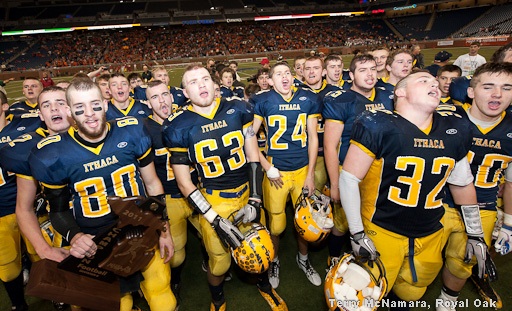
Division 6 Final: Play it Again, Yellowjackets
November 29, 2011
DETROIT – So began the legacy of Ithaca quarterback Travis Smith.
And so continues an incredible run by one of Michigan’s newest football powerhouses.
The Yellowjackets pushed their winning streak to 28 and claimed their second straight MHSAA championship by downing Constantine 42-14 in Friday's Division 6 Final.
They did so led by a number of last season’s top players, but minus their 2010 Final star. That’s where the sophomore Smith came in, joining the starting lineup in the season’s second week and bringing Ithaca back to Ford Field for another title.
“It’s more special just because this is the last time to suit up for most of us. We’re not going to be able to play another game next year, and we get to end on the biggest stage high school football has to offer in Michigan,” Ithaca senior linebacker/running back Garrett Miniard said.
“I think it was almost a little jealousy of the seniors last year of being able do that, being able to go out on top. I think that kept us going throughout the season, throughout the offseason. Being able to have that luxury of going out on top just like they did.
Ithaca (14-0) hasn’t lost since its 2009 Semifinal against Montague. With two more wins to start next fall, the Yellowjackets can become the 14th team on the MHSAA record book list with at least 30 straight victories.
And Smith should be there to lead the way. He connected on 18 of 25 passes for 299 yards and a touchdown Friday, and ran for 43 yards and a score. Miniard rushed for 43 yards and two touchdowns, and had 14 tackles. And senior David Brown caught six passes for 122 yards and also ran for a score.
Smith followed the path this fall of another former sophomore starter at his position – Alex Niznak, who graduated in the spring, plays at Central Michigan now, but didn’t leave before leading the Yellowjackets to both their first Semifinal berth and MHSAA championship over the last two seasons. Niznak’s title game performance last season included 251 yards passing, 138 rushing and an MHSAA Finals-record five touchdowns running the ball.
Brown originally took over at quarterback this fall. But he was injured on opening night – after running for three touchdowns against Williamston – and missed significant time, allowing Smith to take hold of the offense. Smith finished his first varsity season with a not-too-shabby 2,310 passing yards, 969 rushing yards, and a combined 48 touchdowns throwing or running.
“Coach (Terry) Hessbrook told me to just go in there and do what I can do, and just play football,” Smith said. “I’ve got so many good athletes around me. I just need to get my players the ball and let them do what they can do.”
Ithaca twice had catching up to do in the Final, with Constantine (11-3) scoring first and then taking a 14-7 lead midway through the first quarter – before the Yellowjackets rolled to 35 unanswered points.
“These kids had this goal since last year … of getting back here,” Hessbrook said. “We didn’t want Ithaca football to just be one and done, or a one-year wonder. And they’ve worked really hard.”
Constantine junior Ben Mallo did run 17 times for 189 yards and both scores. But the Falcons were without quarterback Tommy Reed, who was injured during last week’s Semifinal win over Ecorse. They played Ithaca to a 14-14 halftime tie before the Yellowjackets’ offense broke the game open.
“We’ve played offenses with that type of talent. Last week, for instance. And I’m sure Coach Hessbrook watched those films and saw some things he could do against us," Constantine coach Shawn Griffith said. "It’s a lot different than what we do, and you saw we caused them a little bit of problems early in the game as well. We do our thing, they do theirs. They do their thing very well. We did ours well. We just weren’t quite there on a couple drives that ended short.”