

5 Tips to Prevent Sports-Related Injuries
December 3, 2019

Henry Ford Health System
Participating in sports provides so many benefits to kids and teens. There are the obvious benefits of physical fitness and promoting regular exercise. Then, there are also the character-building lessons learned from being part of a team, working hard toward a goal, celebrating tough competition and gracefully accepting defeat. But sports don’t come without some risk.
Sports-related injuries are the leading cause of emergency room visits for kids ages 12-17, according to the Centers for Disease Control and Prevention (CDC).
These injuries impact twice as many males as females. Not surprisingly, contact sports also have higher injury rates. Football, basketball, baseball and soccer account for roughly 80 percent of all sports-related emergency room visits for children.
Sports injuries depend on the age of the athlete and the type of sport played, according to Bridget McArdle, D.O., a Henry Ford pediatrician. Generally, she says, sports injuries are divided into two groups: injuries from overuse like strains and tendonitis, and acute injuries such as concussions, fractures and tears.
The teen years pose special hazards, too. The adolescent growth spurt places teens at higher risk for injuries.
“The growth plates could still be open, which increases the risk for damage,” Dr. McArdle says. “This can lead to long-term problems.”
5 Important Injury Prevention Tips
Fortunately, many sports-related injuries can be prevented — the CDC estimates that as many as half of them could be avoided.
Here are Dr. McArdle’s tips for injury prevention for parents and coaches:
1. Ease into training. It’s important to start gradually in order to decrease the chance of sports injuries. “When you train too quickly at full peak, you are more likely to get hurt. Ease into it – and don’t overdo it,” says Dr. McArdle.
2. Cross train. Changing up the way your child trains is one way to help prevent sports injuries. “Taking a break from one sport to play another is important,” she recommends. Training a different way and using different muscles decreases the strain placed on the same body parts. Practicing gentle stretching exercises such as yoga or Pilates can also help, she adds.
3. Use the right equipment. Everything from the proper shoes and appropriate, properly fitted safety gear for the particular sport are essential for minimizing the risk of injury, as well.
4. Avoid excessive heat. The American Academy of Pediatrics (AAP) recommends young athletes avoid heat illness by wearing light clothing and drinking plenty of fluids before, during and after exercise or play. Coaches should decrease or stop practices during high heat or high humidity periods.
5. Take time to recover. If a sports injury does occur, taking time to recover is very important. Returning to play too soon increases the risk of making the injury worse, and increases the chance of long-term consequences. “Make sure the injury is completely healed before returning. Don’t allow your child to play through pain,” advises Dr. McArdle.
If you have questions or concerns about your child’s readiness to play, be sure to get a sports physical and talk with your pediatrician or primary care provider.
Dr. Bridget McArdle is a board-certified pediatrician, seeing patients at Henry Ford Medical Center – Sterling Heights.
Want to learn more? Henry Ford Health System sports medicine experts are treating the whole athlete, in a whole new way. From nutrition to neurology, and from injury prevention to treatment of sports-related conditions, they can give your athlete a unique game plan.
Visit henryford.com/sports or call (313) 972-4216 for an appointment within 24 business hours.
Mason, Okemos Score for a Cure
By
Geoff Kimmerly
MHSAA.com senior editor
November 11, 2014
Three weeks remain in the MHSAA’s 2014 fall season, and we’ve collected a few notes to pass along as we wind down the final three sports before moving inside (except for skiing) for the winter.
 Below are an update on a fundraising game we previewed earlier, plus recognition for perfection at our Girls Golf Finals and another high honor for one of the top players in MHSAA volleyball history.
Score for a cure
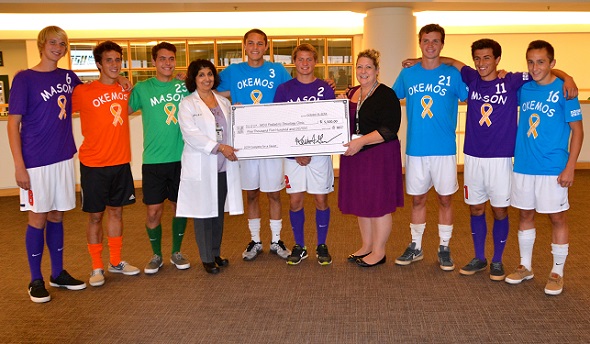
We wrote in September about an upcoming soccer game between Lansing-area powers that would raise money for pediatric cancer research. The “Compete for a Cause” game between Okemos and Mason on Sept. 13 was the third of what has become an annual event started by Mason’s team and coaching staff.
Attendance for this season’s game was nearly double the year before, and funds raised increased more than 500 percent.
The final tally: Roughly 1,400 fans attended the game, which raised $11,000 that was split between the CureSearch for Children’s Cancer national foundation and the Michigan State University Pediatric Oncology Clinic.
The first “Compete” game in 2012 raised $1,000, and the 2013 game drew 800 fans and raised about $2,000. This fall, Okemos was ranked No. 1 in Division 1 and Mason No. 7 in Division 2 when the game was played; it ended in a 1-1 tie. Both went on to postseason success – Okemos advanced to a Regional Final, and Mason fell to eventual Division 2 champion East Lansing in overtime in their Semifinal.
Only one shot needed
 It’s a rarity – most of the time. But for the second straight season, a player at the MHSAA Lower Peninsula Girls Golf Finals sunk a hole-in-one.
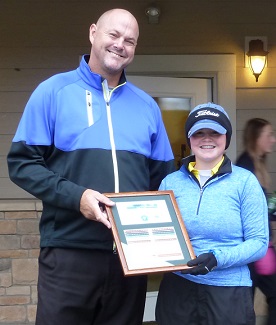
Grosse Pointe South’s Lucy Buzolitz aced the par-3 No. 12 at Bedford Valley in Battle Creek, dropping the shot from 97 yards out during the first round of Division 1 play. Buzolitz was one of two individual qualifiers from her team and shot a 92-97-189 for the two-day tournament.
At the 2013 Division 2 Final, Fenton then-sophomore Madison Shegos aced the par-3 18th hole at Michigan State University’s Forest Akers East.
Sportswoman of the Year
Former Leland and Penn State University volleyball standout and current U.S. national team setter Alisha Glass was a finalist for 2014 Team Sportswoman of the Year at the 35th Salute to Women in Sports gala in October in New York City.
The event, put on by the Women’s Sports Foundation, annually recognizes a Sportswoman of the Year for both individual and team sports based on nominations by sport governing bodies and the public. Glass was one of 10 candidates this year for the team award after being named USA Volleyball Indoor Female Athlete of the Year in 2013. She also was named International Federation of Volleyball’s best setter at the 2014 World Championship in Italy after helping the United States to the title.
Olympic gold medal-winning ice dancer Meryl Davis received the Sportswoman of the Year team award, while the individual award when to gymnastics all-around world champion Simone Biles.
PHOTOS: (Top) Members of the Mason and Okemos boys soccer teams present a check for $5,500 to the MSU Pediatric Oncology Clinic and Dr. Renuka Gera last month. (Middle) Lucy Buzolitz receives a plaque recognizing her hole-in-one at the Division 2 Golf Final from Bedford Valley head pro Dean Kolstad.