

Century of School Sports: Michigan's National Impact Begins at NFHS' Start
By
Geoff Kimmerly
MHSAA.com senior editor
January 28, 2025
The beginning of the National Federation of State High School Associations (NFHS) predated the start of the MHSAA by about 4½ years. But Michigan played a leading role in creating the national organization for school-based sports and arts activities – and through its work with the NFHS continues to impact how school sports are played across the country.
On May 14, 1920, representatives from the Illinois, Indiana, Iowa, Michigan and Wisconsin high school associations met to discuss common issues – especially national championships and eligibility rules in football, as returning World War I veterans were seeking to play on high school teams; and, according to meeting minutes, because “high school athletics were being handled in an unsatisfactory manner in contests under the auspices of colleges and universities.” At this time, Michigan school sports were governed by the MHSAA’s predecessor organization – the Michigan Interscholastic Athletic Association (MIAA) – and president A.W. Krauss, the principal at Grand Rapids South High School, represented our state.
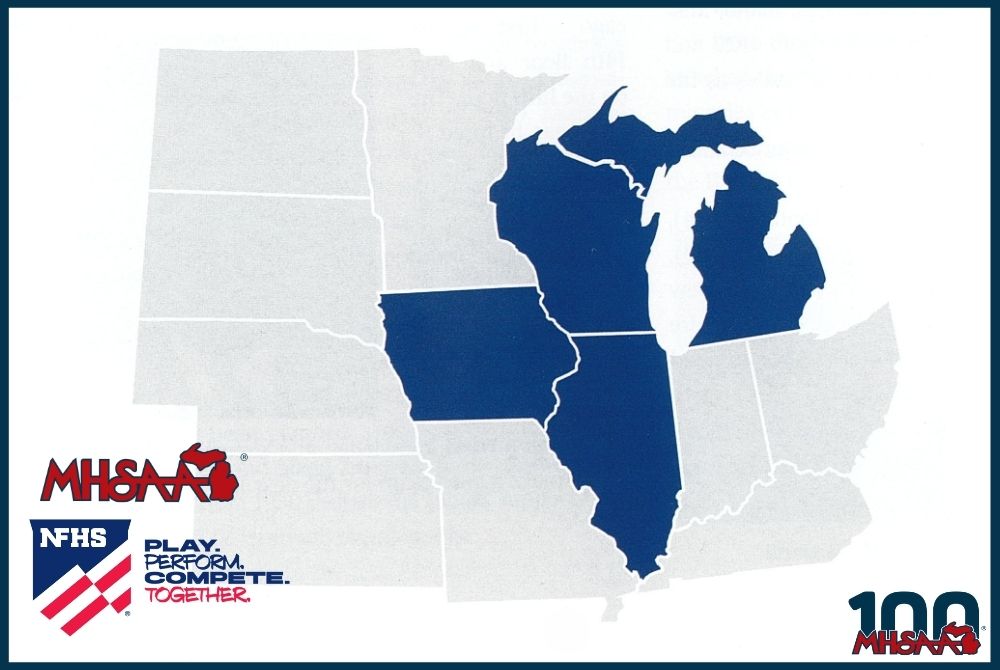
Building on their desire to form common rules to govern athletics, those five states together formed the framework for the Mid-West Federation of State High School Associations, and the MIAA officially voted to join the organization March 31, 1921, becoming one of the four founding states (Indiana was absent when the Mid-West Federation constitution was adopted). Just about a year later, on March 1, 1922, with 11 states now present, the Mid-West Federation changed its name to the National Federation of State High School Athletic Associations – which became the current NFHS in 1970.
Representing the MIAA at the 1922 Federation meeting was Ann Arbor High School principal L.L. Forsythe – cited frequently for his outsized contributions during this “Century of School Sports” series – and he was elected as Federation vice president, a role in which he served for 15 years. Obviously his impact in that role was significant for the growing organization, which now includes associations from all 50 states and Washington, D.C.
Another Michigan school sports luminary, retired executive director John E. Jack Roberts, also had significant ties to the NFHS. He served on staff from 1973-80 and was heavily involved with the implementation of Title IX at the local and state levels. He also made immense contributions as the NFHS representative to the landmark Amateur Sports Act of 1978, and played a significant role in the NFHS rules-writing process as the organization started writing and publishing rules for a number of new sports during the 1970s. Roberts began his 32-year tenure leading the MHSAA in 1986.
The NFHS’s primary contribution to state associations remains today as writer of game rules for nearly all school sports, and those rules govern the majority of MHSAA-sponsored programs. (Competitive cheer is exclusive to Michigan, and golf, tennis and bowling are regulated by national governing organizations).
By agreeing to follow NFHS game rules, the MHSAA receives the opportunity to help make them, serving turns on rules-making committees with other representatives from the NFHS’s Section 4 – which also includes Wisconsin, Iowa, Illinois and Indiana. Michigan also sends a rotating representative to serve on the national record book committee.
Previous "Century of School Sports" Spotlights
Jan. 21: Awards Celebrate Well-Rounded Educational Experience - Read
Jan. 14: Predecessors Laid Foundation for MHSAA's Formation - Read
Jan. 9: MHSAA Blazes Trail Into Cyberspace - Read
Dec. 31: State's Storytellers Share Winter Memories - Read
Dec. 17: MHSAA Over Time - Read
Dec. 10: On This Day, December 13, We Will Celebrate - Read
Dec. 3: MHSAA Work Guided by Representative Council - Read
Nov. 26: Finals Provide Future Pros Early Ford Field Glory - Read
Nov. 19: Connection at Heart of Coaches Advancement Program - Read
Nov. 12: Good Sports are Winners Then, Now & Always - Read
Nov. 5: MHSAA's Home Sweet Home - Read
Oct. 29: MHSAA Summits Draw Thousands to Promote Sportsmanship - Read
Oct. 23: Cross Country Finals Among MHSAA's Longest Running - Read
Oct. 15: State's Storytellers Share Fall Memories - Read
Oct. 8: Guided by 4 S's of Educational Athletics - Read
Oct. 1: Michigan Sends 10 to National Hall of Fame - Read
Sept. 25: MHSAA Record Books Filled with 1000s of Achievements - Read
Sept. 18: Why Does the MHSAA Have These Rules? - Read
Sept. 10: Special Medals, Patches to Commemorate Special Year - Read
Sept. 4: Fall to Finish with 50th Football Championships - Read
Aug. 28: Let the Celebration Begin - Read
(Map graphic courtesy of NFHS.)
Leadership: A Skill that can be Taught
January 30, 2013
 By Jed Blanton
MSU Institute for the Study of Youth Sports
At the MHSAA and the ISYS, in the milieu of work we conduct centered on understanding and developing leadership in young athletes, there is one definition that seems to govern our approach and serve as a foundation for the research questions and training clinics that follow it.
Penned by Peter Northouse, that definition states “leadership is a process, whereby an individual influences a group of individuals to achieve a common goal.”
Choosing to frame ‘leadership’ as a process, rather than as some personality characteristic destined only for those naturally-born leaders, allows the concept of leadership to be utilized and taught as a skill, or set of skills. If a coach can agree with the philosophy that leadership can be learned, we can begin to design a series of strategies to enhance leadership in our young athletes.
First, I’m going to discuss what most coaches already know about teaching skills. Teaching skills is essentially an effort of behavior modification. A coach sometimes is able to choose athletes who already possess a certain level of competency within the skills necessary for their sport; sometimes coaches must work with whoever shows up on the first day of practice.
In either case, coaches tend to conduct a subconscious assessment of skills that must be learned (that they must teach), whether complex strategies or mere fundamentals. When teaching athletic skills to young people, coaches must break down the multitude of steps involved.
Think about a lay-up in basketball or the high jump in track & field. Either skill itself is actually a combination of several skills, and the ability to pay attention to very specific cues in the environment. Coaches teach the approach, the proper hand/arm placement, the essential cues to focus on, and the follow-through. Coaches can devote segments or entire practices to particular skills – breaking down all the steps, creating drills to practice the steps, and offering the full practice of the skill in a competition-like environment.
During this episode of developing a skill in our athletes, to get them to perform in a very specific way, our interactions often mirror what behavioral psychology has known for decades: People respond to reinforcements and punishments. Coaches positively reinforce their athletes with compliments, clapping hands, and congratulations. Our words and actions shape how the individual learning the skill makes adjustments to receive more praise.
These shifts of their body and miniscule changes in their actions to get to the desired behavior of their instructor are “learning.” Similarly, coaches often threaten punishment of extra sprints or difficult drills to give athletes a clue as to what behaviors they should avoid. Often, something as simple as a disapproving glance can be reinforcing enough to change whatever behavior the athlete shouldn’t be practicing. The simple “good job” or the threat of sprints essentially shapes how our athletes behave athletically.
This same approach can work toward leadership development.
What would it look like for a coach to reinforce and punish athletes toward leadership development in the same vein they develop athletic skills? If coaches could determine what three or four behaviors they’d like their athlete leaders to showcase, and then positively reinforce those skills with compliments and thanks, and potentially punish athletes with disapproving glances or even lectures after practice, leadership can be learned like any other athletic skill.
Phil Jackson, the multiple championship-winning NBA coach, has been quoted saying he would try to give two compliments for every criticism with his professional teams. The Positive Coaching Alliance – a national nonprofit organization that strives to educate coaches on ways to enhance the youth sport experience – suggests a ratio of five positive comments to every negative criticism. Research has consistently shown that people respond better and more rapidly to positive reinforcement than to punishment.
All too often, coaches wait for leaders to emerge, rather than teach the leadership they desire. Imagine if coaches waited for players to figure out the offensive plays and strategies instead of teaching players where to move, how to move, and why they are moving there. Adopting a similar approach with your athlete has the potential to expedite the behaviors you’d most ideally want them to possess. Using tactics of positive reinforcement can help these young players to become excellent leaders in a shorter period of time than merely hoping someone steps up.
I’ll leave you with a simple list of suggestions of how coaches can teach leadership, just like they teach any other necessary athletic skill.
- Develop goals with your athletes regarding leadership. What kinds of things do your athletes value or feel would help the team? How can they practice leading their teammates in that way?
- Develop your own goals toward teaching leadership. What would it look like if a coach made it a goal to compliment three players on specific leadership behaviors each practice? Think about the ultimate team captain for your team, and develop strategies to teach your players how to be that captain.
- Break down leadership skills into smaller and easier to practice chunks, just like an athletic skill. Then create an environment where the athletes can practice these skills. By organizing your team into smaller groups, or even partners, you can assign leadership roles within each group. Asking certain players to lead various parts of practice (stretches, lay-ups, circuit training), you are giving them a sense of ownership over their athletic experiences and responsibility over their teammates.
- Positively reinforce the desired behaviors. How would it make a player feel if their coach pulled them aside and thanked them for their specific leadership behavior after a practice or game? A “job well done” or an approving thank you can go a long way in making a young athlete feel they are developing into the leader you desire them to be.
Blanton is a doctoral candidate at Michigan State University in the department of Kinesiology, specializing in the PsychoSocial Aspects of Sport and Physical Activity, and a research assistant for MSU's Institute for the Study of Youth Sports. He has served as a facilitator at MHSAA Captains Clinics the last three years and currently is assisting the association with its student leadership programs.