

Century of School Sports: We Recognize Those Who Make Our Games Go
By
Geoff Kimmerly
MHSAA.com senior editor
February 11, 2025
A long-held and common philosophy among those serving in educational athletics is that celebrations of achievement should be focused primarily on the student-athletes who participate in MHSAA sports.
But those making those activities possible also realize more than most how much is accomplished behind the scenes – and the MHSAA annually recognizes those contributors as well.
Every school year, the MHSAA presents a series of service awards, voted upon by its Representative Council. Nominations are due by Nov. 1, and awards are then presented over the following months.
Below are brief descriptions of the MHSAA’s awards, and more information including all past honorees is available on the Awards page.
Winners of the 2024-25 Women in Sports Leadership, Nate Hampton Champion of Progress in Athletics and Charles E. Forsythe Lifetime Achievement awards will be announced later this month. This school’s year’s Vern L. Norris Leadership in Officiating Award honoree will be announced in April, and Allen W. Bush Meritorious Service Award winners will be announced later this spring.
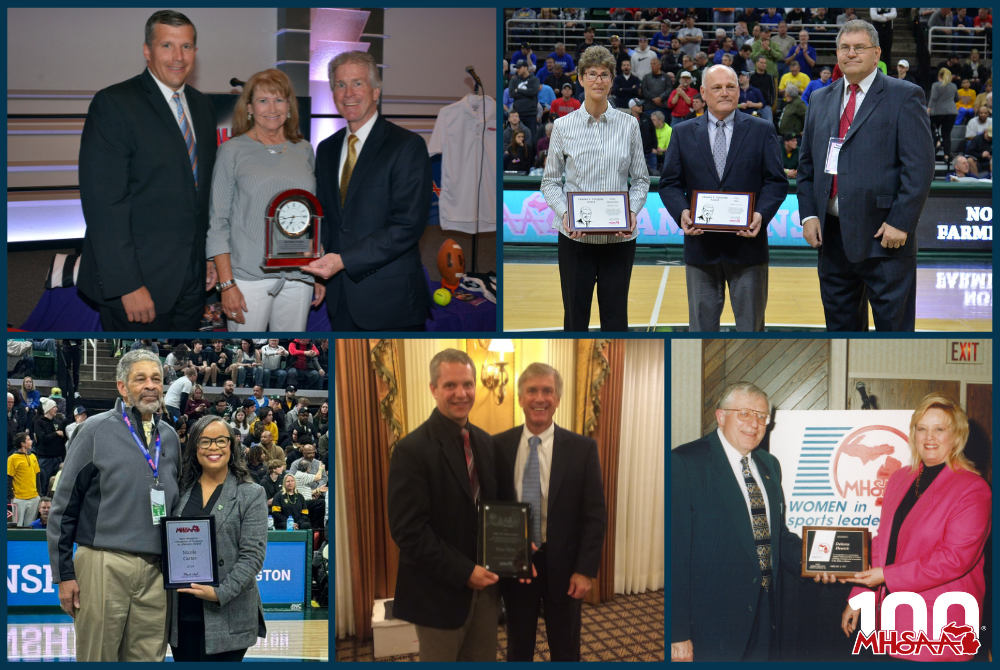
Women In Sports Leadership Award: The MHSAA has honored 38 leaders since 1990 with this award, which is presented either during the every-other-year Women in Sports Leadership Conference or during MHSAA Finals in years between conferences. The WISL Award recognizes the impacts of women coaches, officials and athletic administrators.
Nate Hampton Champion of Progress in Athletics Award: The newest addition to the MHSAA’s annual honors was presented in 2024 for the first time and recognizes leaders who promote the advancement of opportunities for women, minorities and other underrepresented groups within interscholastic athletics, while serving as an administrator, coach, official, educator or school sports leader. Hampton served as an MHSAA assistant director for 32 years, retiring in 2021.
Charles E. Forsythe Lifetime Achievement Award: Since 1978, the Forsythe Award has honored 74 individuals who epitomize excellence and service throughout the interscholastic community based on outstanding contributions at the local, regional and statewide levels. Forsythe was the first fulltime executive director of the MHSAA, serving from 1931-68.
Vern L. Norris Leadership in Officiating Award: A total of 34 officials have been recognized with this award since 1992 for their participation in local officials associations, mentoring of other officials and involvement in officials education. Candidates all have been registered with the MHSAA for 20 or more years at the high school level. Norris served as the MHSAA’s executive director from 1978-86 and on staff for 23 years total, and also was a highly-respected game official.
Allen W. Bush Meritorious Service Award: Beginning in 1992, the Council has honored 108 individuals for their contributions in a number of roles including coach, administrator, game official, trainer, doctor or member of the media – focusing on candidates who have served without receiving much attention for their difference-making work. Bush was the MHSAA’s second fulltime executive director and served from 1968-78.
Previous "Century of School Sports" Spotlights
Feb. 4: WISL Conference Continues to Inspire Aspiring Leaders - Read
Jan. 28: Michigan's National Impact Begins at NFHS' Start - Read
Jan. 21: Awards Celebrate Well-Rounded Educational Experience - Read
Jan. 14: Predecessors Laid Foundation for MHSAA's Formation - Read
Jan. 9: MHSAA Blazes Trail Into Cyberspace - Read
Dec. 31: State's Storytellers Share Winter Memories - Read
Dec. 17: MHSAA Over Time - Read
Dec. 10: On This Day, December 13, We Will Celebrate - Read
Dec. 3: MHSAA Work Guided by Representative Council - Read
Nov. 26: Finals Provide Future Pros Early Ford Field Glory - Read
Nov. 19: Connection at Heart of Coaches Advancement Program - Read
Nov. 12: Good Sports are Winners Then, Now & Always - Read
Nov. 5: MHSAA's Home Sweet Home - Read
Oct. 29: MHSAA Summits Draw Thousands to Promote Sportsmanship - Read
Oct. 23: Cross Country Finals Among MHSAA's Longest Running - Read
Oct. 15: State's Storytellers Share Fall Memories - Read
Oct. 8: Guided by 4 S's of Educational Athletics - Read
Oct. 1: Michigan Sends 10 to National Hall of Fame - Read
Sept. 25: MHSAA Record Books Filled with 1000s of Achievements - Read
Sept. 18: Why Does the MHSAA Have These Rules? - Read
Sept. 10: Special Medals, Patches to Commemorate Special Year - Read
Sept. 4: Fall to Finish with 50th Football Championships - Read
Aug. 28: Let the Celebration Begin - Read
(MHSAA file photos.)

NFHS Voice: Good Time to Appreciate Officials
April 9, 2020
By Karissa Niehoff
NFHS Executive Director
During this shutdown of normal life in our nation, we are learning to deal with a new challenge – how to handle the unexpected time on our hands at home. Simply keeping up with the days of the week is a major accomplishment!
While we anxiously await the re-opening of schools and a return of high school sports and performing arts, this down time can be used in positive ways to take advantage of educational opportunities. And kudos to some individuals who already are seizing those opportunities – men and women who officiate high school sports.
Two weeks ago, we began to offer the 11 officiating courses on the NFHS Learning Center free of charge, and the response has been nothing short of amazing. By the end of March – merely a week into this new opportunity – more than 5,200 courses had been taken.
In addition to veteran officials fine-tuning techniques in one or more of the seven sports featured in these courses, this has been a great opportunity for individuals interested in officiating to take a free course to determine their interest level.
Those of us in leadership positions are so appreciative of these individuals who give freely of their free time to officiate high school sports or adjudicate music contests. We would suggest that everyone – student-athletes, coaches, parents and other fans – use this down time to do the same.
At various times this year before the shutdown of schools, officials have been the victim of verbal and physical abuse. Inappropriate behavior by parents and other fans was causing officials to quit before they even reached two years on the job.
And yet, in the past three years, more than 35,000 individuals have signed up to become officials through the NFHS’ #BecomeAnOfficial campaign and 5,200 courses that have been taken in the past couple of weeks by men and women who want to give back to high school sports. These are good signs more people will continue to be involved in officiating when the games return.
But what about the parents and other fans in the stands? Will their behavior be changed upon return? The conclusion of the New Mexico Activities Association’s state basketball tournament last month provided an interesting perspective on the impact of fans to the atmosphere at high school sporting events.
After completing the first two days of its state tournament with fans in the stands, the NMAA conducted the final three days without fans because of concerns about the spread of the COVID-19 virus. Dana Pappas, commissioner of officials for the NMAA, noted the following about the final three days of competition:
“Officials would make a call and if coaches had a question about it, they asked – calmly and respectfully. In huddles during time-outs, coaches just talked to their players, without raised voices. The behavior of coaches on the sidelines from Thursday through Saturday was in stark contrast to what we witnessed on Tuesday and Wednesday. Perhaps they did not feel the need to be overly emotional for the benefit of their fans.
“My hope is that the absence of sport throughout the world gives us all a moment to gain perspective and do a ‘gut check’ as to the kind of fans we are at contests. If the quality of the game is unchanged (or even better) without fans there to scream at the coaches, officials and players, then is that behavior really necessary when the games resume?”
The message here is that while the games can continue without fans, the ideal situation is for stands full of fans positively cheering for their teams.
Dr. Karissa L. Niehoff is in her second year as executive director of the National Federation of State High School Associations (NFHS) in Indianapolis, Indiana. She is the first female to head the national leadership organization for high school athletics and performing arts activities and the sixth full-time executive director of the NFHS, which celebrated its 100th year of service during the 2018-19 school year. She previously was executive director of the Connecticut Association of Schools-Connecticut Interscholastic Athletic Conference for seven years.