

Century of School Sports: We Recognize Those Who Make Our Games Go
By
Geoff Kimmerly
MHSAA.com senior editor
February 11, 2025
A long-held and common philosophy among those serving in educational athletics is that celebrations of achievement should be focused primarily on the student-athletes who participate in MHSAA sports.
But those making those activities possible also realize more than most how much is accomplished behind the scenes – and the MHSAA annually recognizes those contributors as well.
Every school year, the MHSAA presents a series of service awards, voted upon by its Representative Council. Nominations are due by Nov. 1, and awards are then presented over the following months.
Below are brief descriptions of the MHSAA’s awards, and more information including all past honorees is available on the Awards page.
Winners of the 2024-25 Women in Sports Leadership, Nate Hampton Champion of Progress in Athletics and Charles E. Forsythe Lifetime Achievement awards will be announced later this month. This school’s year’s Vern L. Norris Leadership in Officiating Award honoree will be announced in April, and Allen W. Bush Meritorious Service Award winners will be announced later this spring.
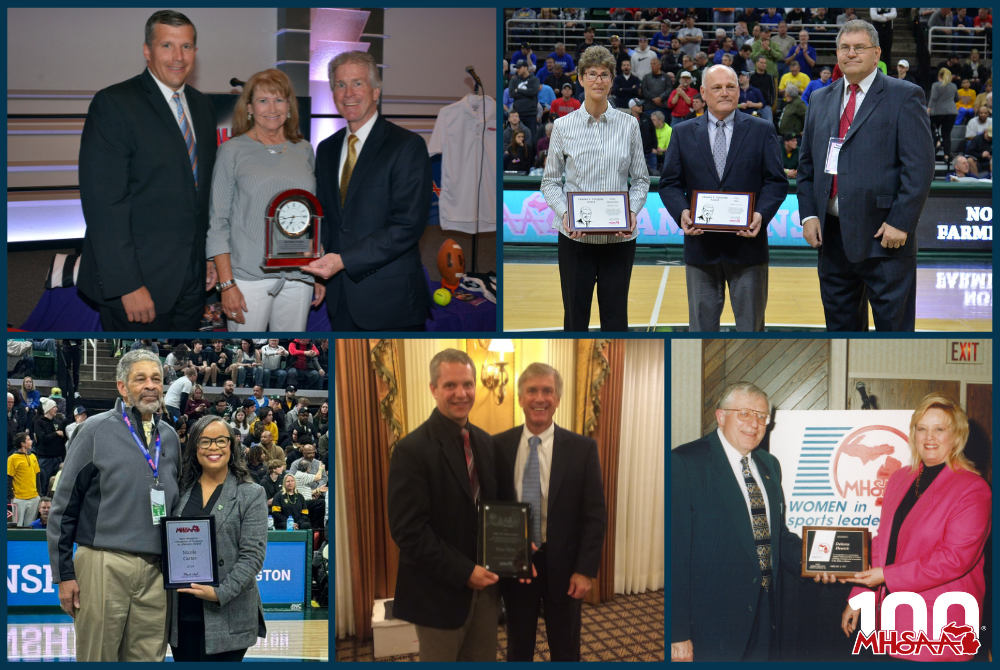
Women In Sports Leadership Award: The MHSAA has honored 38 leaders since 1990 with this award, which is presented either during the every-other-year Women in Sports Leadership Conference or during MHSAA Finals in years between conferences. The WISL Award recognizes the impacts of women coaches, officials and athletic administrators.
Nate Hampton Champion of Progress in Athletics Award: The newest addition to the MHSAA’s annual honors was presented in 2024 for the first time and recognizes leaders who promote the advancement of opportunities for women, minorities and other underrepresented groups within interscholastic athletics, while serving as an administrator, coach, official, educator or school sports leader. Hampton served as an MHSAA assistant director for 32 years, retiring in 2021.
Charles E. Forsythe Lifetime Achievement Award: Since 1978, the Forsythe Award has honored 74 individuals who epitomize excellence and service throughout the interscholastic community based on outstanding contributions at the local, regional and statewide levels. Forsythe was the first fulltime executive director of the MHSAA, serving from 1931-68.
Vern L. Norris Leadership in Officiating Award: A total of 34 officials have been recognized with this award since 1992 for their participation in local officials associations, mentoring of other officials and involvement in officials education. Candidates all have been registered with the MHSAA for 20 or more years at the high school level. Norris served as the MHSAA’s executive director from 1978-86 and on staff for 23 years total, and also was a highly-respected game official.
Allen W. Bush Meritorious Service Award: Beginning in 1992, the Council has honored 108 individuals for their contributions in a number of roles including coach, administrator, game official, trainer, doctor or member of the media – focusing on candidates who have served without receiving much attention for their difference-making work. Bush was the MHSAA’s second fulltime executive director and served from 1968-78.
Previous "Century of School Sports" Spotlights
Feb. 4: WISL Conference Continues to Inspire Aspiring Leaders - Read
Jan. 28: Michigan's National Impact Begins at NFHS' Start - Read
Jan. 21: Awards Celebrate Well-Rounded Educational Experience - Read
Jan. 14: Predecessors Laid Foundation for MHSAA's Formation - Read
Jan. 9: MHSAA Blazes Trail Into Cyberspace - Read
Dec. 31: State's Storytellers Share Winter Memories - Read
Dec. 17: MHSAA Over Time - Read
Dec. 10: On This Day, December 13, We Will Celebrate - Read
Dec. 3: MHSAA Work Guided by Representative Council - Read
Nov. 26: Finals Provide Future Pros Early Ford Field Glory - Read
Nov. 19: Connection at Heart of Coaches Advancement Program - Read
Nov. 12: Good Sports are Winners Then, Now & Always - Read
Nov. 5: MHSAA's Home Sweet Home - Read
Oct. 29: MHSAA Summits Draw Thousands to Promote Sportsmanship - Read
Oct. 23: Cross Country Finals Among MHSAA's Longest Running - Read
Oct. 15: State's Storytellers Share Fall Memories - Read
Oct. 8: Guided by 4 S's of Educational Athletics - Read
Oct. 1: Michigan Sends 10 to National Hall of Fame - Read
Sept. 25: MHSAA Record Books Filled with 1000s of Achievements - Read
Sept. 18: Why Does the MHSAA Have These Rules? - Read
Sept. 10: Special Medals, Patches to Commemorate Special Year - Read
Sept. 4: Fall to Finish with 50th Football Championships - Read
Aug. 28: Let the Celebration Begin - Read
(MHSAA file photos.)
This Week In High School Sports: 1/10/20
January 8, 2020
This week’s show highlights Livonia Stevenson hockey's Seth Lause after he scored three short-handed goals, awards Game Balls to Fruitport Calvary Christian's Kelsey Richards and Flint Beecher's Jalen Terry, explains the importance of the new basketball pregame meeting between officials, coaches and players; and discusses the impact of multimedia and social media on high school athletics.
The 5-minute program, powered by MI Student Aid, leads off each week with feature stories from around the state from the MHSAA’s Second Half or network affiliates. "Be The Referee," a 60-second look at the fine art of officiating, comes in the middle of the show and is followed by a closing MHSAA "Perspective."
Listen to this week's show by Clicking Here.
Past editions
Dec. 27: Mona Shores "Sailor Nation" life-saving success - Listen
Dec. 20: Battle of the Fans IX, details on purchasing Finals broadcasts - Listen
Dec. 13: Port Huron United hockey, what matters most in high school sports - Listen
Dec. 6: Highlights from 2019 11-Player Football Finals, instant replay in review - Listen
Nov. 29: Highlights from 2019 8-Player Football, Girls Volleyball and Girls Swimming & Diving Finals - Listen
Nov. 22: Ida volleyball record-setter Taylor Wegener, new Football Finals video review - Listen
Nov. 15: Reading lineman Nick Affholter, coaches as leaders in sportsmanship - Listen
Nov. 8: Lower Peninsula Cross Country and Boys Soccer Finals highlights - Listen
Nov. 1: Muskegon Orchard View football, bolstered MHSAA broadcast schedule - Listen
Oct. 25: Grand Rapids NorthPointe Christian girls golf, MHSAA Football Playoff selection - Listen
Oct. 18: Mendon volleyball's title drive, recognition for longtime announcer Erik O. Furseth - Listen
Oct. 11: Negaunee cross country's Emily Paupore, MHSAA mental health awareness efforts - Listen
Oct. 4: South Lyon soccer's Josh Mason, improving youth football - Listen
Sept: 27: Utica Eisenhower golfer Ariel Chang, adult fan behavior - Listen
Sept: 20: Pinckney football inspiration, decisions made at the local level - Listen
Sept. 13: Muskegon's offensive line, soccer substitution rule change - Listen
Sept. 6: Jenison girls golf's inspiration, new football practice contact restrictions - Listen
Aug. 30: St. Johns quarterback-now-coach Andy Schmitt, benefits of a multi-sport experience - Listen