

Granlund's Voice Continues to Tell Story in 56th Year Serving Clarkston Schools
By
Keith Dunlap
Special for MHSAA.com
February 13, 2025
CLARKSTON — When many people think of Clarkston as a community, high school and athletic program, they understandably think of Dan Fife.
 After all, Fife was a hometown hero as a standout basketball and baseball player at Clarkston High School, a college basketball player at Michigan, a professional baseball player and ultimately, the longtime boys basketball coach and athletic director who built that hoops program into a state power.
But what some might not know is that there is another prominent figure connected to the school and athletic program, one who has served the community since the year after Fife graduated from high school in 1967.
It’s hard to imagine anyone having Clarkston more in his heart and soul than Neil Granlund.
The 79-year-old Granlund has been a part of the Clarkston community since starting his teaching career in the district in 1968. He is best-known at the moment not just as an announcer within the athletic program, but as pretty much THE announcer for Clarkston athletics.
Granlund is the main announcer for contests in football, boys and girls basketball, hockey, boys and girls soccer, and track & field. He also helps out announcing for volleyball, wrestling, lacrosse and field hockey.
And those are just the high school sports within the community. Granlund also announces middle school track events.
Granlund took over the football and basketball duties in 2018 after the longtime “Voice of the Wolves,” Dale Ryan, retired. For all those years, Granlund was Ryan’s right-hand man spotting in the press box and working the clock.
When Ryan stepped away, it was a no-brainer to have Granlund take over, even if he was seemingly announcing every other sport for the school.
 When Granlund stepped into Ryan’s role for football and basketball, he said Fife offered some advice.
“He gave me instructions on what to and how he wanted it done,” Granlund said. “He told me that you’re not the cheerleader. He didn’t want nicknames for the kids. Just keep it strait-laced and treat both schools fairly. I’ve always stuck to that.”
Granlund said announcing Clarkston football games when the Wolves played at Michigan Stadium in Ann Arbor and doing Clarkston team introductions when they advanced to championship games at Ford Field have been thrills, adding others in the community have helped make his life easier when switching from sport to sport.
“I had mediocre understanding of the sports, but I’ve had good people to work with,” he said. “In football, you are only as good as your spotter.”
Clarkston as an athletic program has had many memorable moments since 2013, whether it’s been the football team breaking through and winning Division 1 titles in 2013, 2014 and 2017, or Fife finally realizing a lifelong dream by leading the basketball team to Class A titles in 2017 and 2018.
But Granlund said the most memorable moment came during a basketball game at the old high school between Clarkston and historic archival Pontiac Northern.
Clarkston was coached by Fife, while Northern was coached by the legendary Sy Green, and the game was played before the 3-point line.
Granlund said before that game, referees told him that they couldn’t hear the buzzer on the scoreboard.
So they gave Granlund a task.
The referees gave Granlund a towel and said If the game came down to a buzzer-beating shot, Granlund would monitor the clock and the action on the court to see if the player beat the clock with his shot. Granlund would then throw the towel to the middle of the court to indicate that the shot counted.
 “Sure thing, that’s what did happen,” said Granlund, adding Clarkston was down by two and attempting a game-tying shot. “Clarkston went on to tie the game. I remember when that did go off — I had that panel in front of me so I could see exactly what the time was on the clock when it had left the player’s hand — both Sy Green and Dan Fife looked at me and I gave the signal that the basket was good. That tied the game, and it went into overtime. That was exciting. Everything in that old gym was exciting.”
While that was the most memorable moment to date for Granlund at Clarkston, the one he wants to see most hasn’t happened yet.
Granlund’s biggest dream is to see the boys soccer team win a Finals championship, something it came closest to accomplishing in 2007 when the Wolves lost to East Kentwood in the Division 1 title match.
Granlund was the school’s first boys soccer coach, starting the program in 1983, and helped build it up until he stepped away as coach in 1990. But he has stayed involved as the announcer and a general supporter.
“I wish we could (win a state title) one of these days,” he said. “Having started the soccer program here, I always stuck with it.”
Even though he is nearing 80, Granlund might still be around to one day see the Wolves win that soccer championship. He still teaches a construction tech class for the high school, doing so for the same reason he still announces: He loves being around kids he says are so good to him.
Teaching also gives him an opportunity to spend more time with his grandson, who is in the class.
“He said ‘Grandpa, will you stick around for a couple more years?’” Granlund said. “I said, ‘Oh yeah.’”
As for announcing, listen for his voice to still be a fixture at Clarkston sporting events for the foreseeable future.
“For a while longer,” he said. “I really do enjoy it.”
 Keith Dunlap has served in Detroit-area sports media for more than two decades, including as a sportswriter at the Oakland Press from 2001-16 primarily covering high school sports but also college and professional teams. His bylines also have appeared in USA Today, the Washington Post, the Detroit Free Press, the Houston Chronicle and the Boston Globe. He served as the administrator for the Oakland Activities Association’s website from 2017-2020. Contact him at [email protected] with story ideas for Oakland, Macomb and Wayne counties.
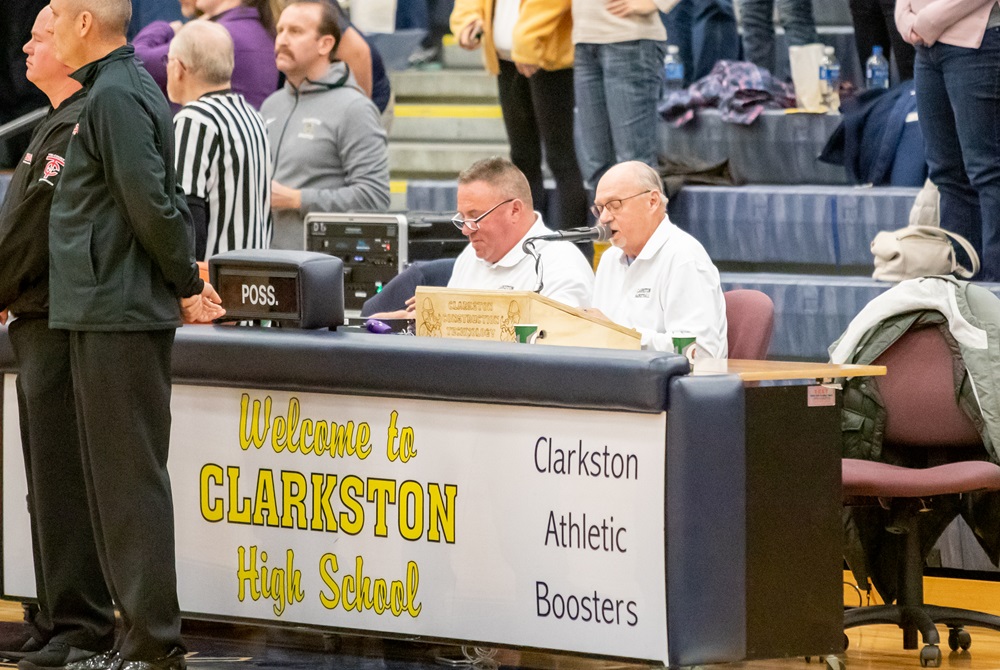
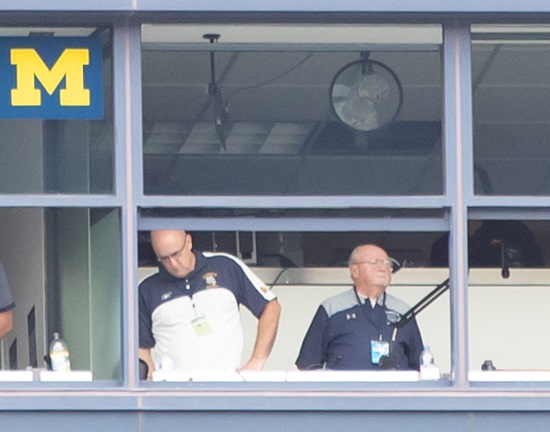
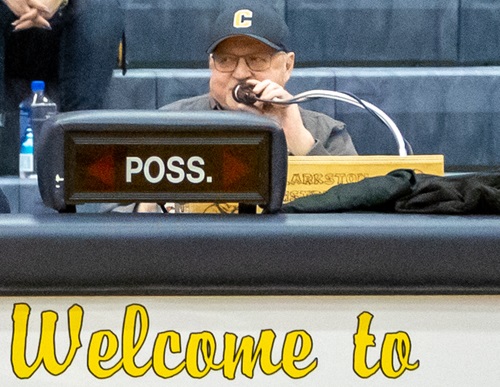
PHOTOS (Top) Neil Granlund, speaking into the microphone, announces during a Clarkston home basketball game. (Middle) Granlund, right, takes his place in the Michigan Stadium press box in advance of announcing Clarkston’s “Battle at the Big House” football game. (Below) Granlund narrates the action during another event at the school. (Photos by Larry Wright.)
NFHS Voice: Football's Promising Results
September 9, 2020
By Karissa Niehoff
NFHS Executive Director
Normally at this time of year, the NFHS releases the latest figures from its annual High School Athletics Participation Survey. One of the most important and successful endeavors in the organization’s history, the NFHS has collected participation data through its 51 member state associations annually since 1971.
Before the 2018-19 school year, the number of participants in high school sports had increased for 29 consecutive years. Despite the first decline last year since 1988, we anticipated a quick turnaround in 2019-20 because of the continued strength of education-based high school athletics programs across the country.
There were encouraging reports last fall that football participation numbers were headed in a more positive direction. Interest in other fall sports continued to be at a high level, and winter sports were experiencing tremendous success. Then came the pandemic in mid-March, which shut down all high school sports competition.
Two-thirds of the states were unable to complete state basketball tournaments, and participants in the traditional spring sports of baseball, softball, track and field, and lacrosse – in most cases – were never able to take the field.
With spring sports unable to even get off the ground, state associations could not compile comprehensive surveys of sports participation for the 2019-20 school year. As a result, for the first time in the 50-year history of the survey, the NFHS is unable to release its annual summary of high school sports participation.
However, there is a silver lining to report. Though complete statistics are unavailable, numbers from a couple of sports last fall were obtained; and the optimism surrounding a positive trend in football participation came to fruition.
After annual declines of 23,311, 20,540 and 30,829 the past three years, participation by boys in high school 11-player football in 2019 dropped by only 2,489 – from 1,006,013 to 1,003,524. These numbers suggest to us that parents are appreciative of the risk minimization efforts that have been put in place. Every state has enacted rules that limit the amount of contact before the season and during practice, and every state has established concussion protocols and laws.
Participation in 11-player football reached an all-time high of 1,112,303 in 2008-09, and except for 2013-14, has declined every year since; however, this year’s decline is the smallest in 10 years.
The continued enthusiasm for football has been evident this fall – even amid the COVID-19 pandemic. State associations have worked with government, education and health leaders to do everything possible to offer the sport at some time during the 2020-21 season.
Some of the 34 states that are conducting football this fall have started play, and there is a special sense of gratitude on the part of students, coaches, officials and fans for the opportunity. While there may be pauses with some players and teams quarantined, and while 17 other states will not play until later in the school year, the excitement and anticipation of Friday Night Lights continues.
In addition to football, girls volleyball continued its tremendous growth last fall, increasing by 9,751 participants for a total of 462,559. In the past 10 years, the sport has added 60,000 participants and has passed basketball as the No. 2 sport for girls behind track and field.
Though a complete participation report for 2019-20 will not be available due to the loss of spring sports, totals on more fall and winter sports from 2019-20 will be formulated in the coming weeks. Judging from the early returns, it appears the past year’s participation numbers would have started the NFHS on a new streak of record participation if spring sports had not been cancelled.
Most likely, next year’s participation survey will be anything but ordinary as well. Regardless of the challenges in compiling participation statistics in 2020-21, the opportunity and desire to participate in all education-based activities remain.
Dr. Karissa L. Niehoff is starting her third year as executive director of the National Federation of State High School Associations (NFHS) in Indianapolis, Indiana. She is the first female to head the national leadership organization for high school athletics and performing arts activities and the sixth full-time executive director of the NFHS, which celebrated its 100th year of service during the 2018-19 school year. She previously was executive director of the Connecticut Association of Schools-Connecticut Interscholastic Athletic Conference for seven years.