

Invest in Athletic Diversification
January 7, 2013
 By Scott Westfall
MSU Institute for the Study of Youth Sports
As part of my duties at Michigan State University, I have recently conducted extended research in the area of sport specialization. For those who are unfamiliar with the term, sport specialization is focusing on one sport year-round while eliminating all other sports or activities.
According to Dr. K. Anders Ericsson, in order for a person to achieve expertise in a sport or activity, he or she must invest approximately 10 years or 10,000 hours of practice. Thus, children, parents, and coaches might see specializing in one sport as a fast track to gaining the expertise needed to win starting positions, state championships, and even college scholarships.
However, these remarkable accomplishments (if they are actually reached) can come with some nasty baggage including social isolation, mental burnout, psychological stress, and overuse injuries such as stress fractures, Osgood-Schlatter & Sever’s Diseases. Often what remains is a kid with some very polished skills, but no love for the sport and a body that has had enough!
To combat these problems, young athletes should participate in numerous sports until at least the age of 14 or 15. When young athletes diversify their sports experiences, they reduce the physical impact by spreading it across different parts of the body, thereby allowing for a faster and more thorough recovery.
Furthermore, sport diversification allows kids to learn transferrable physical skills to other sports, not to mention introducing them to a larger group of active peers, along with more coaches and role models to assist with the tribulations of adolescence.
As a former coach, I can attest to the excitement I felt when I had a group of players that were gung-ho and fully committed to my sport. I would become outwardly excited when they would ask, “What can I do this offseason to get better?”
While I was tempted to respond selfishly with answers specific to my sport (which most likely would make our team better), I would try to think of the “whole child,” causing me to reply with the question, “What other sports are you going to try this year?
The cultures in high school athletic departments can be somewhat ambivalent. While coaches would like to believe that their colleagues always support them and their program, there is adequate reason for them to be skeptical. After all, with the trend of sport specialization, coaches at the same school can end up competing with each other for athletes – even when their seasons do not overlap.
Often I have heard coaches say, “I don’t discourage kids from going out for another sport.” Even if they do not outwardly deter athletes from joining other sports, a coach’s personal interests, reactions, and body language can be felt and heard sometimes even louder than his or her words.
Coaches need to begin supporting, collaborating with, and trusting the expertise of their colleagues – believing they will improve student-athletes on many levels (maybe even in ways that original coach cannot). Coaches must work together and encourage young athletes to diversify by participating in additional sports.
The culture of the athletic department starts with the athletic director. Athletic directors must build a department and coaching staff that is conceived in collaboration, trust, and support for the high school’s entire athletic program. True collaboration cannot exist among coaches if competition for athletes is ongoing – coaches must share the pool of athletes by supporting and even encouraging participation in other sports.
Athletic Directors may be thinking “easier said than done.” So here are a few tips:
- Hold pre-season meetings with all head coaches at the beginnings of each of the three major sports seasons (fall, winter & spring).
- At these meetings, create buy-in with open communication. With the help of your coaches, make a list of the ways sport diversification can help the overall athletic program. Record the many transferrable skills that are seen between two sports (cross country gets wrestlers in shape during the fall season; basketball produces more athleticism for volleyball; track creates faster football players, etc.)
- List fears or myths that each other’s sports or training regimens might present (heavy lifting on game days slows players down; football players lose bulk during wrestling season, coaches not wanting their best player to get hurt playing “other” sports, etc.). Once these fears are brought into the open and effectively addressed, coaches will be much more open to supporting each other’s programs.
- Make a policy for offseason training (weight room, speed training, fall baseball, etc.). Establish that these are supplemental and should be held at different times of the day than practices or games. Example: Mandatory weight training sessions should take place before or during school – not during another team’s practice. This will eliminate athletes from having to prioritize between participating in Sport A and training for Sport B.
- Create a huge master schedule to map-out and plan all summer sports camps so they do not overlap. This will allow athletes to participate in multiple camps and reduce the competition coaches have for athletes’ time during the summer.
- Encourage (politely demand) all coaches to work in the weight room during the offseason and summer. This will boost cooperation among coaching staffs. No longer will the weight room be seen as belonging only to the football team. Conversely, football coaches will not feel they are babysitting athletes from other sports when they come to train.
- Encourage (politely demand) all head coaches keep the scorebook and/or run the clock at the home games for other sports events. When athletes and parents see head coaches supporting other programs, the tone will be set that the athletic department is diversified and supportive of all teams.
Athletic Directors: If you are met with some hesitation, know you are creating change. If you receive backlash or resentment from your coaches, sit down with them and hear them out. However, stay true to your vision that collaboration, trust, and support are the new culture you want for your athletic department. To paraphrase Jim Collins from his book Good to Great, “You are trying to get the right people on the bus, the wrong people off the bus, and the right people sitting in the right seats!”
Coaches: This change might take some getting used to, but in the end sport specialization will be better understood and allowed as the exception rather than the norm. Kids will participate in multiple sports and you will be a member of a high school coaching staff built on collaboration and trust. These will combine to create a richer athletic culture at your school.
However, the greatest improvement will be for your student-athletes’ individual experiences; they will be healthier physically, socially and psychologically.
Scott Westfall has spent the last 10 years as a teacher, coach, and athletic director in Fort Collins, Colo. He currently is working on his Doctorate at Michigan State University, with an emphasis in Sport Psychology and Athletic Administration, and assisting the MHSAA with its student leadership programs. Westfall is a former athlete who participated in football, wrestling, tennis and cross country at the high school level, and rugby at the collegiate level. He can be reached at [email protected].
Century of School Sports: All-Time 'Parade of Champions'
By
Geoff Kimmerly
MHSAA.com senior editor
June 25, 2025
As we do every June, we will complete 2024-25 this week by publishing our “Parade of Champions” – a listing of every team to win an MHSAA Finals championship trophy this school year.
Recognizing about 130 champions annually – give or take a few if there were shared titles along the way during that past fall, winter and spring – it’s always an impressive list. So we’re plenty stoked – maybe even 100 times more – to present as our second-to-last “Century of School Sports” feature a few findings from our work-in-progress all-time “Parade of Champions.”
Eventually, the data we’ve collected will be provided on the MHSAA website as a searchable data base – there’s more work to come, and I’ll explain some of that below. But for today, here are some of the first facts that jump off the pages from this massive collection.
Starting with the biggest: Since its first titles were awarded to finish the Winter 1924-25 season, the MHSAA has recognized 6,876 teams for winning Finals championships.
Five schools have won at least 100 Finals titles, and 17 schools have won 50 or more. Marquette leads the list with 295, followed by East Grand Rapids (145), Escanaba (134), Ann Arbor Pioneer (122) and Detroit Country Day (107).
For several reasons, it’s difficult to compare championship totals among Upper Peninsula and Lower Peninsula schools as apples to apples – chiefly, schools in both peninsulas compete against each other in postseason competition in only 16 of 28 MHSAA-sponsored sports, and a handful of those 16 have little or no representation from the U.P. despite being statewide tournaments.
That said, here’s a look at some expanded school Finals title rankings, but by peninsula, going deeper on Lower Peninsula schools ranked because the majority of Michigan’s high schools are below Mackinac Bridge:
Lower Peninsula: 1. East Grand Rapids (145), 2. Ann Arbor Pioneer (122), 3. Detroit Country Day (107), 4. Bloomfield Hills Cranbrook Kingswood 88, 5. Detroit Catholic Central (74), 6. Bloomfield Hills Brother Rice (69), 7. Grosse Pointe Woods University Liggett (64), 8. Jackson Lumen Christi (55), 9. Petoskey (46), 10. Traverse City Central (45).
11. Okemos (44), 12. Detroit St. Martin dePorres (41), 13. East Lansing (39), 14. Rockford (37), T-15. Ann Arbor Greenhills (35), T-15. Birmingham Seaholm (35), 17. Flint Powers Catholic (33), T-18. Bloomfield Hills Marian (32), T-18. Kalamazoo Central (32), 20. Grand Rapids Forest Hills Northern (31).
Upper Peninsula: 1. Marquette (295), 2. Escanaba (134), 3. Iron Mountain (78), 4. Menominee (66), 5. Ishpeming Westwood (65), T-6. Ishpeming (64), T-6. Pickford (64), T-8. Negaunee (50), T-8. Ontonagon (50), 10. Houghton (49).
A few more interesting notes:
• Note Detroit dePorres at No. 12 among Lower Peninsula schools; dePorres closed in 2005. Flint Northern ranks 21st among Lower Peninsula schools with 30 championships despite closing in 2013. The former Ypsilanti High School, which consolidated with Willow Run in 2013 to form Ypsilanti Community, also is high on the list with 24 titles.
• Larger schools generally play more sports, and hence have more opportunities to win Finals titles. But Lower Peninsula small schools fell just outside those listed above, including Battle Creek St. Philip and Fowler – both with 29 championships – and Flint Beecher, Kalamazoo Hackett Catholic Prep and Pewamo-Westphalia with 26 apiece.
• We don’t have an easy way – yet – to figure out which schools have won at least once in the most sports. But among the top five, East Grand Rapids and Marquette both have won titles in 18 sports, Country Day has won in 17, Ann Arbor Pioneer in 15 and Escanaba in 13. Pioneer’s 15 include boys gymnastics, which was sponsored by the MHSAA from 1925-31 and 1961-81.
• Detroit Catholic Central has the most championships among all-boys schools, among 11 sports. Bloomfield Hills Marian ranks highest among all-girls schools, with its titles covering seven sports.
As noted, this remains a work in progress, as we’re continuing to research several school closings, consolidations or other name changes over the last 100 years and how those might affect our championship totals. We also need to continue figuring in how to list championships won by cooperative programs and if those are credited to primary schools or as standalone programs.
In the meantime, we’ll continue to update the data with championships won each season, including in our new sports of girls field hockey and boys volleyball debuting in 2025-26. Once the data is fully edited and complete, we’ll add this substantial source to our growing collection of historical information available for all to enjoy.
Previous "Century of School Sports" Spotlights
June 17: Top Performers Tell Us What High School Sports Mean to Them - Read
June 10: 'The Mitten' Becomes Sought-After Symbol of MHSAA Greatness - Read
June 3: MHSAA's Move to TV, Now Internet, 60 Years Old & Growing - Read
May 27: Upper Peninsula Helps Make Michigan's School Sports Story Unique - Read
May 20: From Nearly A to Z, Schools Repped by 221 Nicknames - Read
May 13: These Record-Setters were Nearly Impossible to Defeat - Read
May 6: 200+ Representatives Fill All-Time Council Roster - Read
April 29: MHSAA Programs Prioritize Health & Safety - Read
April 23: Patches Signify Registered Officials' Role in MHSAA Story - Read
April 16: Student Advisory Council Gives Voice to Athletes - Read
April 9: State's Storytellers Share Spring Memories - Read
April 2: Sharp Leadership Synonymous with MHSAA Success - Read
March 25: Athletic Directors Indispensable to Mission of School Sports - Read
March 18: 2025 Finals Begin Next Half-Century of Girls Hoops Championships - Read
March 11: Boys Basketball's Best 1st to Earn MHSAA Finals Titles - Read
March 5: Everything We Do Begins with Participation - Read
Feb. 25: Slogans & Logos Remain Unforgettable Parts of MHSAA History - Read
Feb. 19: MHSAA Tickets Continue to Provide Fan-Friendly Value - Read
Feb. 11: We Recognize Those Who Make Our Games Go - Read
Feb. 4: WISL Conference Continues to Inspire Aspiring Leaders - Read
Jan. 28: Michigan's National Impact Begins at NFHS' Start - Read
Jan. 21: Awards Celebrate Well-Rounded Educational Experience - Read
Jan. 14: Predecessors Laid Foundation for MHSAA's Formation - Read
Jan. 9: MHSAA Blazes Trail Into Cyberspace - Read
Dec. 31: State's Storytellers Share Winter Memories - Read
Dec. 17: MHSAA Over Time - Read
Dec. 10: On This Day, December 13, We Will Celebrate - Read
Dec. 3: MHSAA Work Guided by Representative Council - Read
Nov. 26: Finals Provide Future Pros Early Ford Field Glory - Read
Nov. 19: Connection at Heart of Coaches Advancement Program - Read
Nov. 12: Good Sports are Winners Then, Now & Always - Read
Nov. 5: MHSAA's Home Sweet Home - Read
Oct. 29: MHSAA Summits Draw Thousands to Promote Sportsmanship - Read
Oct. 23: Cross Country Finals Among MHSAA's Longest Running - Read
Oct. 15: State's Storytellers Share Fall Memories - Read
Oct. 8: Guided by 4 S's of Educational Athletics - Read
Oct. 1: Michigan Sends 10 to National Hall of Fame - Read
Sept. 25: MHSAA Record Books Filled with 1000s of Achievements - Read
Sept. 18: Why Does the MHSAA Have These Rules? - Read
Sept. 10: Special Medals, Patches to Commemorate Special Year - Read
Sept. 4: Fall to Finish with 50th Football Championships - Read
Aug. 28: Let the Celebration Begin - Read
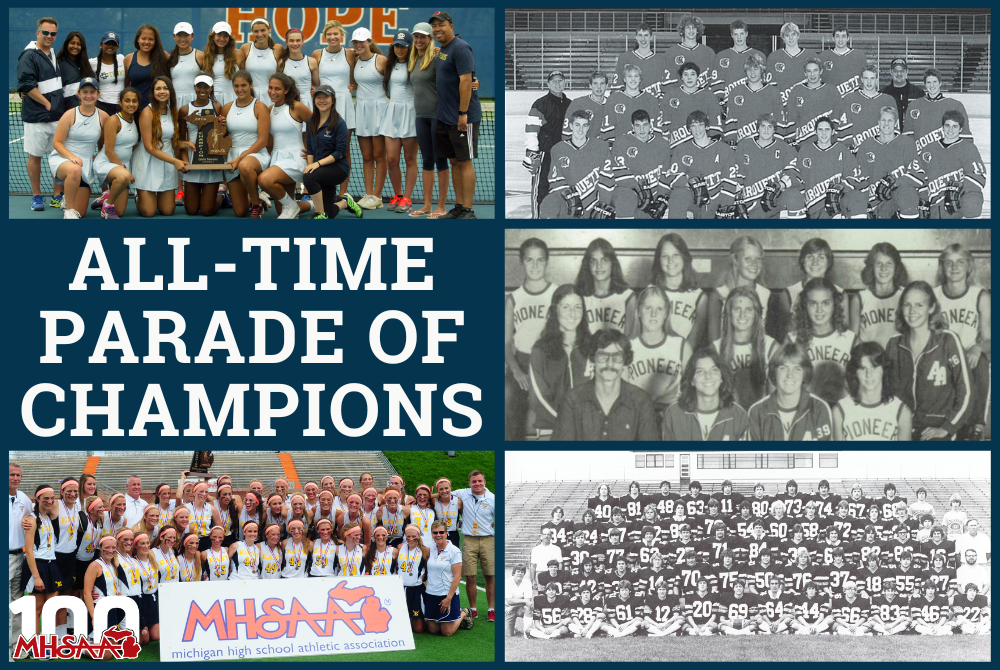
PHOTOS These are all past MHSAA Finals champions, clockwise from top left: The 2016 Detroit Country Day girls tennis team, 2004 Marquette ice hockey team, 1978 Ann Arbor Pioneer girls cross country team, 1981 Escanaba football team and 2013 East Grand Rapids girls lacrosse team.