

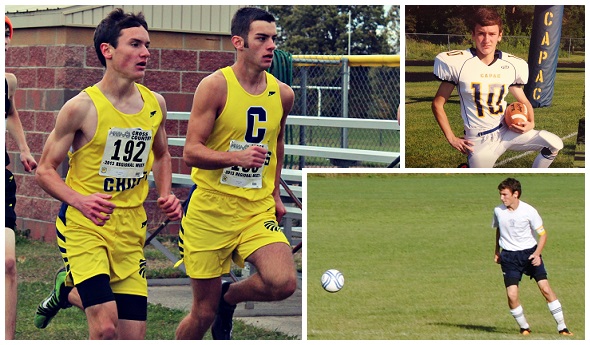
Capac Standout Delivers 3-Letter Fall
November 14, 2013
By Geoff Kimmerly
Second Half editor
The Blue Water Area Conference, on the eastern side of the Thumb, created this fall a patch it will award to athletes who letter in three sports during a school year.
Winning a high school letter always has been a notable accomplishment. Earning two is a sign of a well-rounded athlete. And in these days of single-sport specialization, we celebrate those who continue to play three at the varsity level.
Then there’s the rare – if not unique – case of Capac junior Nick Geliske.
Earlier this week, he became the first to win the newly-minted BWAC award – after just one season. He finished his fall as an all-league midfielder for the soccer team, an all-league honorable mention cross country runner and the fulltime kicker for the football squad.
“I wasn’t sure how it would work out when I decided to go into it. I wanted to do all of them, but a year ago I wouldn’t have seen myself doing this,” Geliske said. “I was just hoping to help my teams this year.
"I’ve got bigger expectations for myself next year.”
Three-sport letterwinners are not a rarity in Geliske’s hometown. Despite an enrollment of 100 fewer students than all but one of the other schools in its eight-team conference, Capac has the most who play a sport every season. The Chiefs had 41 three-sport athletes during 2012-13, athletic director Arnie VandeMark said, and 33 athletes who earned letters in three sports played as part of the BWAC – 24 more three-sport athletes than the league school with the next-highest total.
Playing two sports during the same season, while uncommon, also occurs from time to time when an athlete can handle the added load and coaches can work out a flexible schedule. But VandeMark never had seen an athlete do what Geliske accomplished this fall – not to mention the success he had in the process. Geliske just kept finding ways to compete – and contribute to Chiefs teams alongside his friends.
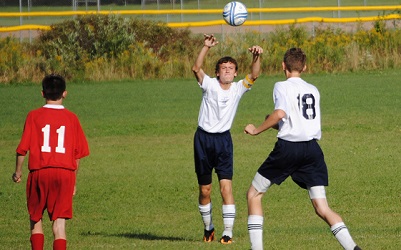
He has been a starter on the soccer team for three seasons and captain these last two, and that’s his primary sport. A midfielder, he led the team with five assists this fall to go with three goals as Capac – in its eighth season as a program – set a wins record in finishing 11-8.
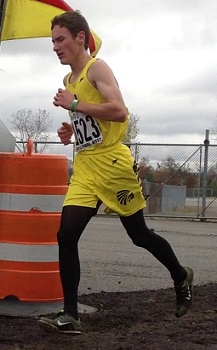
 Geliske decided to double in cross country this season at the urging of a few friends on that team. Great move on their part, as Geliske ended up the team’s regular second- fastest finisher. He took sixth at his Regional (in 17:52) and was part of the lineup that made the Lower Peninsula Division 3 Final at Michigan International Speedway.
But before practice for either of those sports began, Geliske had another request from his best friend on the football team. Capac needed a kicker. Geliske loves football but never had played at the high school level and never had kicked. No matter – two hours before the first practice he decided to give it a try, showed up and won the job.
“Nick was a huge part of our team qualifying for team states. He set an example for others to follow being a very busy athlete in soccer and football,” Capac boys cross country coach Tim Gross said. “He would show up for practice and set the standard for everyone else to follow. He was not only a great athlete, but a very organized person.”
On schedule
Geliske also holds a 3.85 grade-point average – after earning a 4.0 during the first quarter of this school year – and is involved with Capac’s student council and chapters of the National Honors Society and Business Professionals of America.
Pulling off the above plus participating on three athletic teams takes heavy doses organization and discipline both. Thankfully, the sports schedules just happened to fall into place.
 First-year soccer coach Jerry Parisot needed to hold his practices at 6 p.m., leaving the afternoon for Geliske’s other pursuits. Geliske ran with the cross country team from 3-4 p.m. and kicked with the football team until 5 before catching a quick meal and heading to the soccer field.
On cross country meet days, Geliske would run and usually make it back in time for soccer practice. On soccer game days, he’d kick with the football team right after school before switching uniforms.
The biggest challenge came on Friday, Oct 25, when Geliske ran in the cross country team’s Regional at Algonac – an hour trip south of Capac – then had to drive nearly two hours back north for a football game at Sandusky. He made it two minutes before kickoff.
But amid jumping through those hoops, Geliske continued to make academics a priority with study time from 8-10 p.m. most weeknights.
“Usually, for football I’d just talk to my coach and could schedule around because I’m the kicker, and I have awesome coaches. For soccer, my dad is the assistant coach so that worked out pretty well, and the varsity coach coached me at younger levels. And for cross country, he was an awesome guy too. They knew I’d be busy all the time,” Geliske said.
“My mom wasn’t so sure about (three sports), but she said as long as I keep my grades up I can play all of those sports. I gave myself studying time; I didn't want to let my teams or myself down.”
Before the season began, Geliske brought Gross a schedule detailing where he’d be every day over the next three months. Gross credits Geliske's parents for his runner's discipline, and Nick also credits Mom and Dad with instilling that trait – and a lot more.
Cracking the code
Geliske was so competitive as a kid, sometimes he’d get a little out of control and his parents would have to calm him down. That intensity hasn't faded much – “Even during pick-up games and stuff, people get mad that I’m so competitive,” he said. “I don’t like losing ... (but) I have to tone it down a little bit.”
“He's 200 percent competitive,” Parisot said. “It’s not really about winning or losing. It's more about trying as hard as you can.”
 That streak was ingrained by his father Barry Geliske, who along with coaching soccer and serving on the school board works on the chain gang for home football games and is “the most competitive and passionate guy about sports,” Nick said.
His athletic side? Geliske believes that comes from his mom Sandra. And then, matter-of-factly, he reveals a family line that backs his theory pretty well.
Among second cousins is former Marquette University basketball standout Travis Diener, who beginning in 2005 played for three NBA teams and now plays professionally in Italy. Sandra Geliske’s maiden name is Thome – as in Jim Thome, another cousin, and a likely future Hall of Famer who hit 612 home runs during a Major League Baseball career stretching two decades.
There’s another cousin, former NFL tight end Dave Casper, who made five Pro Bowls for the Oakland Raiders during the late 1970s. A great uncle named Ronald Jackson played seven seasons of pro baseball with the Chicago White Sox and Boston Red Sox from 1954-60.
Geliske will begin basketball practice Monday and plans to play baseball and run track this spring before coming back for all six sports as a senior. VandeMark has had an athlete finish high school with 13 letters – but Geliske hopes to graduate with 15.
That leads to another significant question – how will Geliske display them?
Like at most schools, some Capac athletes wear traditional letter jackets. They receive an actual letter for their first, then a series of pins and medals for each additional year on a varsity team.
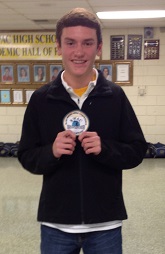
Geliske’s mom wants instead to frame the awards. If that’s the decision, Geliske is looking for something sizable – and he’s got to fit that BWAC patch now as well.
It's been a fall full of other accolades too. He made the all-league soccer team and earned an all-league cross country award, and was part of an academic all-state team in the latter as well. But he’s got much higher expectations for fall 2014 since he’ll be settled into his balancing act. And no way does that include picking a favorite.
“I can’t imagine it for myself. I’ve been playing these sports my whole life,” Geliske said. “Sometimes someone might be really good in that (one) sport and stay with it, but I say doing more sports is better. It keeps you active. I just love competing, and that’s the big thing about it.”
PHOTOS: (Top) Capac’s Nick Geliske lettered as part of the school’s cross country, boys soccer and football teams this fall. (Middle) Geliske throws a ball in during a soccer game and turns a corner during a race this season. (Below) Geliske poses with his Blue Water Area Conference three-letter patch after becoming the first to earn the award. (Photos courtesy of Capac athletic department and Geliske family.)
Gladwin Soars to 55 Straight League Wins
By
Paul Costanzo
Special for MHSAA.com
August 28, 2019
Erik Seebeck was a manager for the Gladwin boys soccer team in 2015 when it advanced to the MHSAA Division 3 Semifinals.
 That team and its postseason run made quite an impression on the then-eighth grader.
“It was a good experience. I really enjoyed it,” said Seebeck, now a senior sweeper and captain for the Flying Gs. “I learned a lot from being around them and watching how they all responded even when they were down – just never giving up and always giving their all.”
That 2015 team gave Seebeck – and the Gladwin soccer program – something else: the start of what is now a 55-match conference win streak. Gladwin has not lost a Northern Michigan Soccer League game since the conference tournament in 2014.
“We like to set goals at the beginning of the season, and we like to talk about where we want to reach,” Seebeck said. “We want to keep this streak going. We have lots of talent this year, and we’re not having a drop off. We’ve had guys step up and fill the seniors’ positions. We talked over our goals, and we kind of wanted to keep that continuing, to see how far we could make it on that streak.”
Gladwin, a member of the Jack Pine Conference in its other sports, competes in the South division of the NMSL. The league includes schools as far north as Cheboygan and as far west as Big Rapids Crossroads.
Gladwin’s streak includes four straight victories in the league’s conference tournament, which consists of the top two teams from each division at the end of the season.
“We try not to dwell on it too much, but it’s kind of a fun thing for some of the kids,” Gladwin coach Jerome Smalley said. “The graduating class of last year, we had players that played on varsity all four years, and they never lost in the conference. There are some good teams in our conference, and some teams that would really like to end this. But we try not to dwell on it too much.”
This season, Gladwin is off to a 7-0-1 start, which has included 7-0 and 8-0 conference wins against Clare and Big Rapids Crossroads, respectively.
Jonathan Grijalva, a senior forward and captain who is in his third year on the Gladwin varsity team, admitted there’s some pressure that comes along with the streak, but added that it doesn’t define the team.
“Obviously we’d like to keep that going, and there is pride there,” Grijalva said. “But if it ended, I don’t think we’d be horribly upset, because we’re a successful team. And even if we didn’t keep that record going, we just like to have fun, too.”
This year’s team has built another streak all its own, not having allowed a goal through its first eight matches. While the Flying Gs are having no problem putting the ball in the net, having scored 37 goals, Smalley said the strength of the team is its defense and the collective effort the entire team puts into keeping the ball out of the net.
 “Our entire team is playing defense,” Seebeck said. “Everybody is getting back, and everybody is helping out on defense. Our four guys in the back (Seebeck, Wilson Bragg, Cal Woodbury and Kurt Landenberger), we’re all communicating great and letting each other know what we have to do. Our midfield is coming back and covering those give and gos. That helps tremendously when all of your team comes back to help on defense.”
The hope now for Gladwin is that this early success on both sides of the field can translate to success not just through the regular season, but into the postseason as well. Because while the Flying Gs have not lost a conference game since 2014, they also haven’t advanced beyond the District tournament since 2015.
In 2016, Gladwin lost 1-0 in the District Semifinal against Tawas. In 2017, it lost 2-1 in the District Semifinal against NMSL North member Ogemaw Heights. And in 2018, Gladwin again lost to Ogemaw Heights, this time in a shootout in the District Final one week after the Flying Gs had claimed the conference crown with a shootout win against Ogemaw.
“The postseason hasn’t been as kind to us as the regular season,” Smalley said.
In order to try and change that, Smalley said he has attempted to beef up the nonconference schedule throughout the years. This past weekend, Gladwin won the Alma Tournament, defeating the hosts, as well as Birch Run, while playing to a scoreless draw against Big Rapids.
“Close games definitely put things into perspective for everybody,” Seebeck said. “We were in the Alma Tournament, and we played Big Rapids and played them to a 0-0 tie, and they had some good players and good passing that kind of opened up to some of our guys what very skilled teams are going to look like when we go into the postseason. It definitely shows you what your limits are.”
There’s a belief among the players that this year’s team can end the recent postseason woes and hopefully catch up to the 2015 team that set them on their current path.
“I’m hoping we can go to state,” said Landenberger, a senior stopper. “I think we can do it; we just have to work together and try our hardest. It’s not going to be easy by any stretch, but I think we can do it.”
 Paul Costanzo served as a sportswriter at The Port Huron Times Herald from 2006-15, including three years as lead sportswriter, and prior to that as sports editor at the Hillsdale Daily News from 2005-06. He can be reached at [email protected] with story ideas for Genesee, Lapeer, St. Clair, Sanilac, Huron, Tuscola, Saginaw, Bay, Arenac, Midland and Gladwin counties.
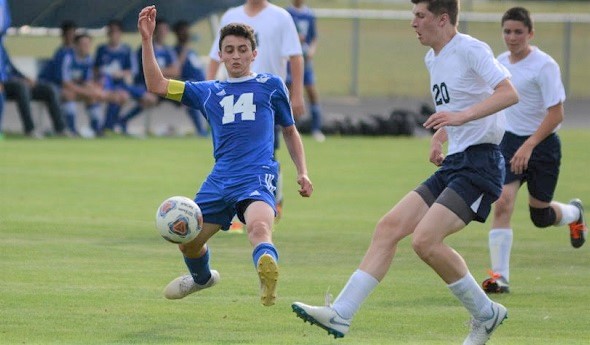
PHOTOS: (Top) Gladwin's Jonathan Grijalva (14) works to deflect the ball away from an opponent. (Middle) The Flying Gs celebrate their Alma Tournament championship this month. (Top photo by Max McDonald/Gladwin County Record. Middle courtesy of the Gladwin boys soccer program.)