

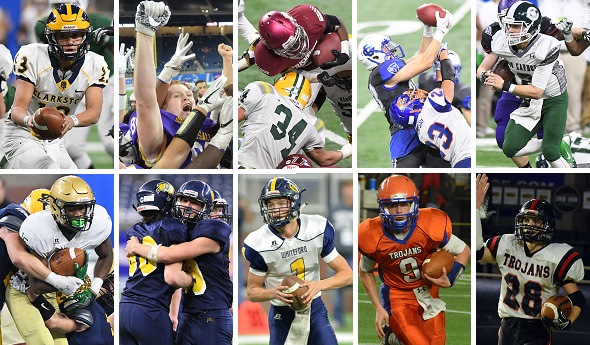
Drive Complete: 2017 Finals in Review
November 27, 2017
By Geoff Kimmerly
Second Half editor
Every November, the MHSAA Football Finals give players, coaches and fans an opportunity to see what everyone else has been talking about.
 These last two weekends were no different. We saw powers restored and others emerging. We witnessed two first-time winners finish perfect seasons and another champion win for the fifth straight year. We enjoyed performances from some of the talented stars we’d only read about, and encores by others returning to the championship round – including the now-winningest coach in Michigan high school history.
Second Half covered all 10 championship games last weekend at Ford Field and two weekends ago at the Superior Dome, with quick recaps and links (click on the game scores) to those stories below followed by notations of performances entered into the MHSAA record book and a report on some of the biggest and best stories to emerge from the 2017 Finals.
Finals in Review
11-Player Division 1: Clarkston 3, West Bloomfield 2
This one had an intriguing circumstance from the start: West Bloomfield, playing its first Final, had tied for first and Clarkston finished third in the Oakland Activities Association Red during the regular season with the Lakers beating the Wolves 37-16 in Week 4. The rematch ended with the second fewest points scored in MHSAA Finals history.
11-Player Division 2: Warren DeLaSalle 41, Livonia Franklin 6
DeLaSalle took its lead 16 seconds into the game on a fumble return touchdown and never slowed down in winning its second championship in four seasons. Franklin, playing in its first title game since 1975, had turnovers on three of its first four possessions (and a turnover on downs to end the other one) and never got rolling again.
11-Player Division 3: Muskegon 28, Farmington Hills Harrison 10
Muskegon won its first championship since 2008 after finishing runner-up four of the last five seasons. The Big Reds finished one of the most impressive runs in recent playoff history, winning on average by 37 points over its five postseason victories. Harrison – led by all-time winningest coach John Herrington – did give Muskegon one of its toughest tests.
11-Player Division 4: Grand Rapids Catholic Central 42, Edwardsburg 31
After winning a 2016 Division 4 title game that saw only 17 points scored between the two teams, GRCC repeated in a game featuring 73. The Cougars came back from an early deficit as standout running back Nolan Fugate put together one of the top rushing performances in Finals history. The Eddies were playing in their first championship game and made this arguably the most entertaining of the weekend.
11-Player Division 5: Grand Rapids West Catholic 34, Saginaw Swan Valley 7
Grand Rapids West Catholic tied two more programs by winning its fifth straight MHSAA championship, jumping out to a 34-0 lead led by three-year quarterback Gaetano Vallone and a number of others who have contributed to multiple titles. Swan Valley was making its first Finals appearance, but will be a strong candidate to return next fall.
11-Player Division 6: Jackson Lumen Christi 40, Ithaca 34
What was expected to be one of the most competitive Finals didn’t disappoint, as the Titans came back from a 13-8 halftime deficit to repeat. They put up some of the biggest rushing numbers in championship game history to offset the dual danger posed by Ithaca quarterback Joey Bentley, who threw three touchdown passes in the fourth quarter as the Yellowjackets worked for a chance to win.
11-Player Division 7: Pewamo-Westphalia 21, Saugatuck 0
These teams met in the playoffs for the third straight season but first in a championship game. P-W, despite losing quarterback/defensive end Jimmy Lehman to a hand injury near the end of the second quarter, hung on through a scoreless second half to repeat as champion.
11-Player Division 8: Ottawa Lake Whiteford 42, Saginaw Nouvel 21
Whiteford returned after finishing runner-up in 2016 to claim its first MHSAA football championship. The Bobcats got on the board before the first minute was over and totaled 484 yards as quarterback Thomas Eitniear and running back Logan Murphy both ran for three touchdowns.
8-Player Division 1: Central Lake 32, Deckerville 30
Central Lake came back from 2-7 last season, its last in 11-player, and 10 points down during the second half of this game to win its first MHSAA football championship and first in any sport since 1980. The Trojans went ahead to stay with 2:49 to play.
8-Player Division 2: Crystal Falls Forest Park 54, Portland St. Patrick 12
The Trojans claimed their first championship since 2007 and first as an 8-player program, but in similar style as their 11-player winners. Forest Park ran for 481 yards and built a 30-point lead by halftime.
Record Report
Clarkston’s three points against West Bloomfield tied the record for fewest by a winning team (with Ann Arbor Pioneer’s 1987 team) and the five points scored between the teams ranked as the second fewest for a Final. The two also combined to tie the record for most punts, with 14, with Clarkston’s Jermaine Roemer tying the individual Finals record with eight.
 Brandan Madigan made the “quickest touchdown” list by returning a fumble return 13 yards for a touchdown 16 seconds into Warren DeLaSalle’s Division 2 win. Warren DeLaSalle also tied for the third-most points in a quarter, putting up 31 during the second in its win over Livonia Franklin.
Warren DeLaSalle’s Riley Garrison and Grand Rapids West Catholic’s Liam Putz both drilled two field goals, joining seven others who have done the same (two hold the record at three field goals). Garrison also made the extra points list with five on five tries.
Farmington Hills Harrison broke the record it previously held with Detroit Catholic Central by playing in an 18th MHSAA championship game, this its first since 2010. The MHSAA Football Playoffs began in 1975.
Muskegon sits 11th with 10 MHSAA Finals appearances and moved up to tied for 10th with six championships. La’Darius Jefferson earned multiple entries with his 245 yards and four touchdowns rushing, tying for fourth-most points (24) in one Final, third most total touchdowns and also rushing touchdowns in a game and eighth most rushing yards.
Harrison’s Ben Williams earned entries for his 91-yard opening kickoff touchdown, both among the longest kickoff returns and fastest touchdowns (16 seconds into the game) scored in a Final.
Nolan Fugate capped his career with one more jaw-dropping rushing performance. The Grand Rapids Catholic Central running back ran for 306 yards, one shy of tying the Finals record, and his 392 total yards ranked seventh all-time. He did tie Finals records with five touchdowns and 30 points and tied for third with four rushing scores. Kicker Alec Winden tied for the fourth-most extra points making all six of his tries.
Edwardsburg also took home two Finals records, as Nick Bradley tied the longest running play with a 90-yard touchdown dash; his run equaled Nick Williams’ for Farmington Hills Harrison in 1994. Caden Goggins tied the 2014 record set by Tommy Scott of Muskegon Catholic Central by bringing a kickoff back 99 yards for a touchdown.
Grand Rapids West Catholic moved up lists with its eighth MHSAA Finals appearance and sixth championship, and into a first-place tie with a fifth-straight title. Farmington Hills Harrison 1997-2001 and East Grand Rapids 2006-2010 also won five consecutive Finals. Grand Rapids Catholic Central also moved up the Finals appearances list with its seventh, while Jackson Lumen Christi is tied for eighth most with 12 and Ithaca added its seventh as well. Lumen Christi’s championship was its 10th, good to tie for the sixth-most titles.
Jackson Lumen Christi became the third team to rush for more than 500 yards in a Final, its 514 yards the third most and its 67 carries second. Sebastion Toland ran for 244 yards – ninth-most by one player – and teammate Kyle Minder made that list with 206 yards. The team’s 523 yards of total offense tied for fifth most, and its 24 first downs tied for eighth.
Ithaca’s Joey Bentley made his last game another great one, even in defeat. His four touchdown passes tied for fifth-most in a championship game, and his 329 total yards of offense – 89 rushing, 240 passing – also earned a record book entry.
Ottawa Lake Whiteford’s offense impressed to open Finals weekend, tying for third with six rushing touchdowns and becoming the latest of 24 teams that did not punt in a championship game.
Crystal Falls Forest Park set an 8-Player Finals record with 481 yards on the ground, rushing 52 times without throwing a pass. Peter Ropiak had the second-most yards in one game, 275 on 16 carries, while backfield mate Connor Bortolini was added for scoring 26 points on four rushing touchdowns and a two-point conversion. Ropiak’s total yards also qualified in the total offense category, and the team’s eight rushing touchdowns also set a record.
Central Lake made the rushing list with 316 yards in its 8-Player Division 1 win over Deckerville, and also the first downs list with 21.
Portland St. Patrick’s Colin Cook was added for seven punts in the 8-Player Division 2 game against Forest Park. Cook averaged 34.1 yards per punt with a long of 63.
Stories behind the scores
Repeat again: For the second straight season, there were four repeat champions at the 11-Player Finals – this time, as noted above, Grand Rapids Catholic Central in Division 4, Grand Rapids West Catholic in Division 5, Jackson Lumen Christi in Division 6 and Pewamo-Westphalia in Division 7. Also noted above, West Catholic next fall will attempt to become the first team in MHSAA football history to win six straight titles.
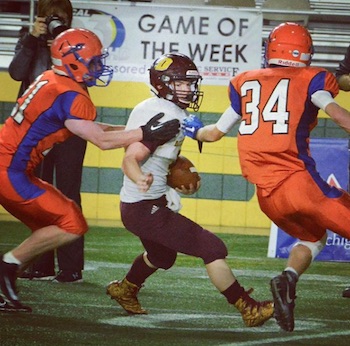 First-time celebrations: Ottawa Lake Whiteford in 11-Player Division 8 and Central Lake in 8-Player Division 1 claimed their first championships, showing off powerful running games against opponents who had won championships previously – Whiteford over Saginaw Nouvel and Central Lake over Deckerville.
Running ran the day(s): In an era of wide-open spread offenses, power running ruled the 2017 Finals. Start with Whiteford and Central Lake mentioned above; Crystal Falls Forest Park set an 8-Player Finals record for rushing while Jackson Lumen Christi put rushers on the all-time record book list for the second straight season. Muskegon threw two passes and didn’t complete any in running away in Division 3, and the Division 4 Final between GRCC and Edwardsburg featured a combined 675 rushing yards.
We may never see this again: Clarkston’s 3-2 win over West Bloomfield was the lowest-scoring Final in 30 years, but how the teams got to five total points might end up rarer. Clarkston’s points, of course, came on a field goal by Roemer from 30 yards out on the final play of the second quarter. But to that point, West Bloomfield led for 15 minutes thanks to a safety when a punt snap sailed through the end zone. For unrelated comparison’s sake, two of our four Baseball Finals in the spring were higher scoring, and only one was decided by the same close margin.
Hawks’ last stand: Farmington Hills Harrison finished something of an unexpected run by playing in its 18th MHSAA football championship game, capping the season that saw Herrington become the winningest coach in state history with a 435-108-1 record. The school will close in spring 2019, and Herrington will coach the final season next fall; he has served as coach since the school opened in 1970. Harrison’s enrollment likely will fall without the usual underclassmen next year – which could make the Hawks an interesting contender staying in Division 3 or moving into Division 4 or 5.
The MHSAA Playoffs are sponsored by the Michigan Army National Guard.
Hudson Paying 50-Year Tribute to Winning Streak Record-Setters, Supporters
By
Doug Donnelly
Special for MHSAA.com
October 14, 2025
It’s a little over two hours’ drive from Mount Pleasant to Hudson. But the November 1975 bus ride seemed to take forever.
The Hudson football team had just lost in the Class C state championship game to Ishpeming, ending a national record 72-game winning streak, and was on the way home.
“It was a really long ride,” said Ray Curran, an assistant coach for the Tigers. “A quiet ride.”
After the game, Hudson head coach Tom Saylor let his players know they had played hard and he was proud of them, but there were plenty of tears.
“We tried to tell them it wasn’t the end of the world,” Curran said.
For nearly everyone except maybe a few coaches, it was the first, and probably last, time they rode the bus home after a loss.
Hudson’s streak still stands today as the record for consecutive wins by a varsity football team in Michigan. From Week 2 of the 1968 season until the Class C Final in 1975, the Tigers never tasted defeat.
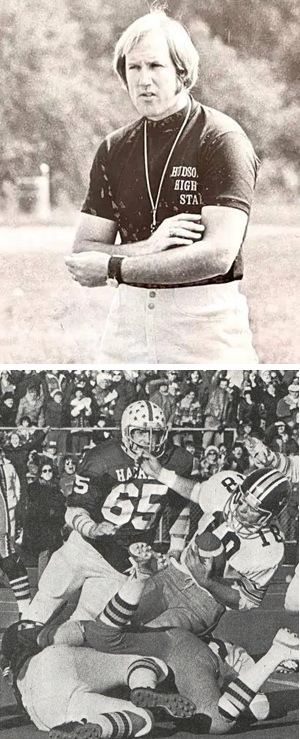 As disappointing as it was to lose, what happened on that bus ride home had a huge impact on the program for years to come.
“When we got close to town, we started to see fire trucks and cars lining the streets,” Curran said. “We lost, but the fans still showed up for us. We had tremendous community support from parents and families and community members. I think that made a lot of the players feel like everything was going to be okay.”
Everything was okay. In fact, Hudson went 9-0 the next season, although the Tigers failed to qualify for the MHSAA Playoffs (which had a field of only four teams in each classification, 16 teams total, at the time).
To mark the end of that incredible 72-game win streak, Hudson is inviting back everyone who had a part in those undefeated teams during the 1960s and 1970s – players, coaches, cheerleaders, band and members of the flag corps are all expected to take part in the ceremony before Friday’s final home game of the regular season at Thompson Field in Hudson.
Bill Mullaly, who played for Hudson during that streak and has become a historian for the Tigers, said this celebration will be the last one.
“This is it,” Mullaly said. “It’s been 50 years, and this is the last one we are planning.”
Curran went to see Saylor a few weeks before he died, at the family’s request. Saylor had been in declining health and had dementia. Curran said when they got together, they talked football.
“We were talking about some of the games, some of the players,” he said. “He definitely remembered. It was a good visit.”
Hudson’s football team this season is undefeated, ranked No. 1 in Division 8 and gearing up for what the Tigers hope is another historic playoff run. Head coach Dan Rogers said the record streak remains an important piece of the community’s history, and the celebration Friday and recent passing of Saylor have brought it all back to the forefront.
“It’s definitely a big part of the community,” Rogers said. “I grew up here, and I’ve heard stories about it. You don’t live it, but you are part of it. I think it has helped mold our community, and it has been a way to identify the community. The streak is definitely alive and well.”
To commemorate this season, current Hudson players will be wearing a throwback uniform Friday – black and white jerseys with orange pants and the same design of socks the players in the 1970s wore. The helmet sticker will be the same one used during the streak.
“It’s all been very positive, all season,” Rogers said. “Some of the kids have grandpas that played in the streak, which is great. They weren’t around, but I think it’s my job to pass all of that along to a new generation. We have embraced it.”
Rogers said he’s gone back and talked to former players and coaches, and Hudson plans to pattern much of its pregame routine on the Tigers’ during Saylor’s regime.
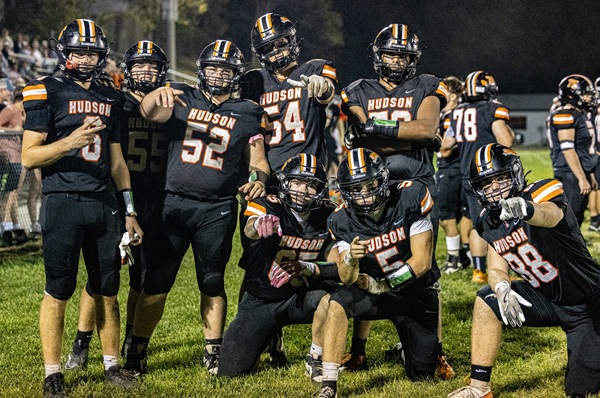 “We have people coming back who haven’t been to a Hudson football game since they played here,” Rogers said. “They had a lot of cool traditions back then. We want them to be proud.”
One of the current assistant coaches is Chris Luma, who played on that 1975 team. Luma was Hudson’s head coach before Rogers took over six years ago. He and Saylor were close. Luma will speak at Saylor’s memorial service later this month.
“It just seemed like with Tom you were learning life lessons along with how to win football games,” he said. “He installed discipline in all of us. What he had us go through was the things you needed to know to go through life.”
Mullaly also played for Saylor.
“He didn’t put Hudson on the map, but he took it to another level,” he said. “He was a great coach and a great man. His legacy is with Hudson football.”
Rogers said after Saylor died, more RSVPs started coming in for Friday’s event.
“It’s brought it to another level,” he said. “There are people flying in from all over the country to be a part of it. This is the final one. After this, it’s only the stories.”
 Doug Donnelly has served as a news and sports reporter at the Adrian Daily Telegram and the Monroe News for 30 years, including 10 years as city editor in Monroe. He's written a book on high school basketball in Monroe County and compiles record books for various schools in southeast Michigan. He is now publisher and editor of The Blissfield Advance, a weekly newspaper. E-mail him at [email protected] with story ideas for Jackson, Washtenaw, Hillsdale, Lenawee and Monroe counties.
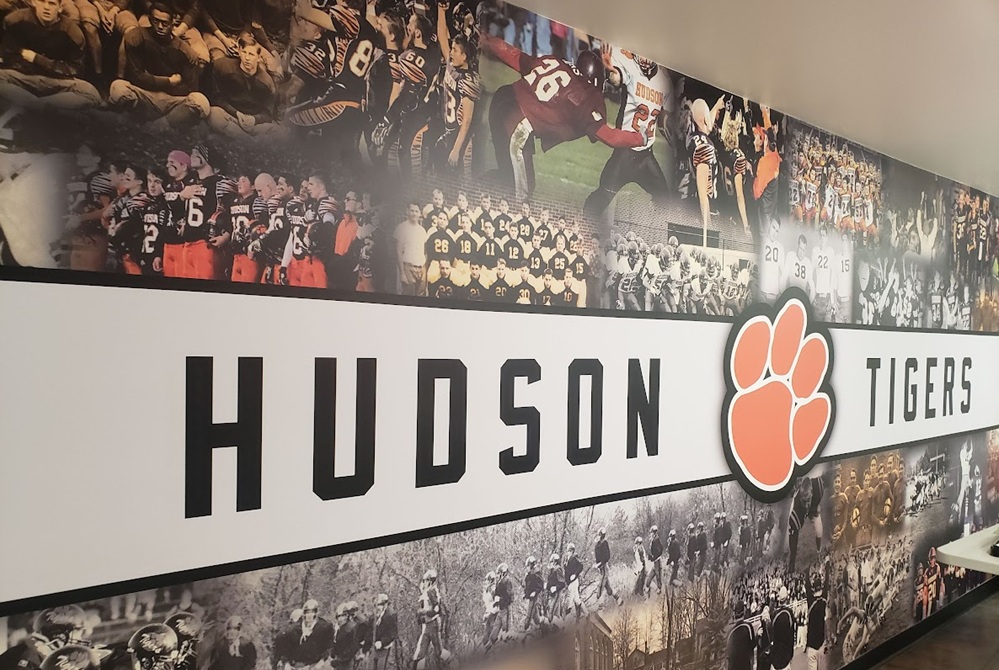
PHOTOS (Top) A wall in the Hudson press box tells of the football program’s rich history. (Middle) Tom Saylor, top, was the longtime coach of the Tigers dynasty, while Tim Decker (18) was among standouts during the streak. (Below) Hudson players come together for a quick photo on a game night this fall. (Wall photo by Doug Donnelly. Saylor photo courtesy of Todd Saylor; Decker photo courtesy of Jackson Citizen Patriot/Hudson Historical Museum. Current team photo by Rachel Stiverson.).